
Pineapple
Ananas comosus (L.) Merr.
Bromeliaceae
Location in our garden
Principal
Synonym
Bromelia comosa L.
Habitus

Herbaceous. Perennial or biennial herb, 50-150 cm tall
Part Used
 Leaves
 Fruit
Fruit Stem
Stem
Growing Requirements
 Full Sunshine
 Drought Resistant
Habitat
 Terrestrial
Overview
Pineapple comes from South America. In the 16th century the Spaniards brought pineapples to the Philippines and Peninsular Malaysia and possibly Indonesia as well. This plant is now widely grown throughout the tropics and subtropics.
Vernacular Names
Maneas, Moneah (Cambodia), Ananas, Pineapple (English), Pain de sucre (France), Nanas (Indonesia), Ananas, Nat (Laos), Nanas, Nanas pager (Malaysia), Piña (Spanish), Dúa, Thom (Vietnam).
Agroecology
Pineapple grows and develops in areas with a temperature range of 23-32 °C. The plant is tolerant of dry seasons and extensive rainfall; 1,000-1,500 mm per year is considered ideal. Pineapple grows well in well-drained sandy soil, with high natural ingredients and a pH of 4.5-6.5. However, pineapple can be grown in a variety of soil types, such as the corrosive peat (pH 3-5) in Malaysia.
Morphology
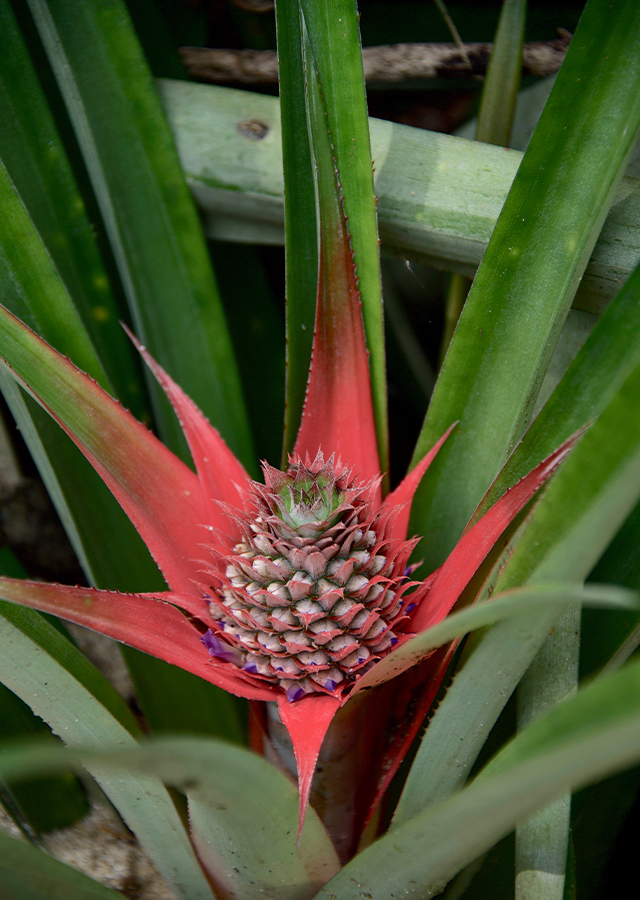
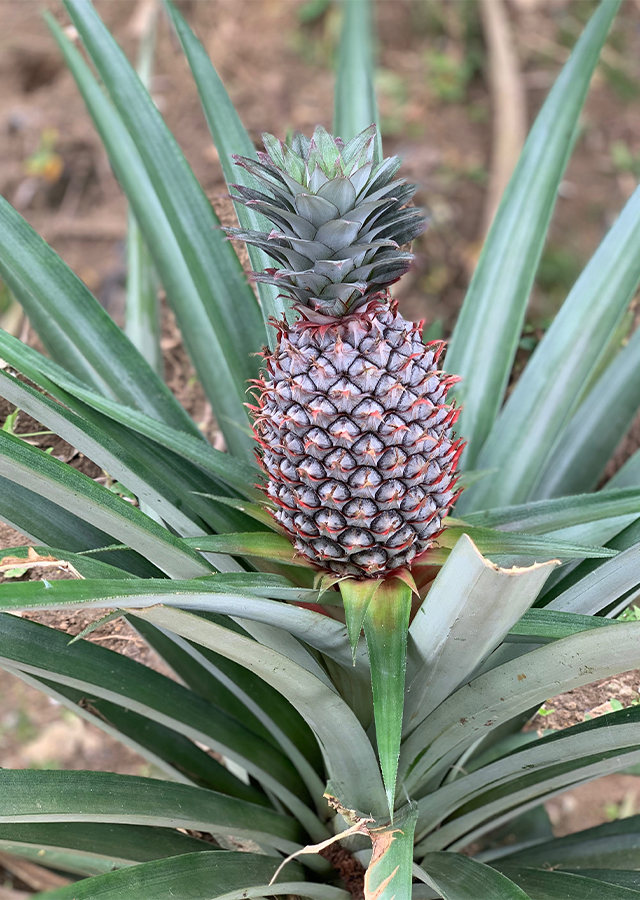
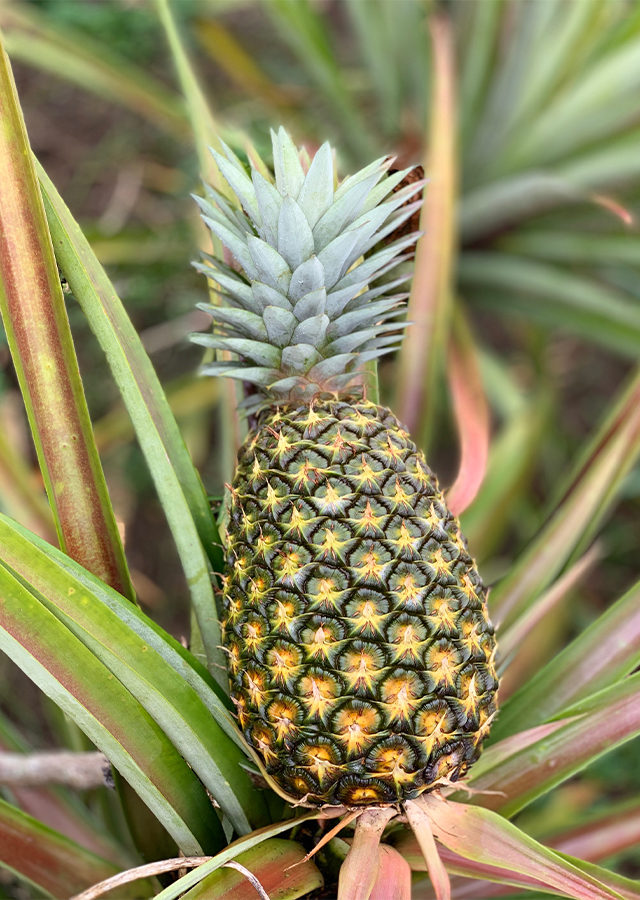
- Fruit - a coenocarpium shaped by an broad thickening of the pivot of the inflorescence and by the combination of the little berry-like person natural products; the difficult skin of the natural product is shaped by the tireless sepals and flower bracts, which more or less combine; on normal the natural product is round and hollow, almost 20 cm long and 14 cm in distance across, weighing 1-2.5 kg; the natural product is surmounted by a rosette of brief, firm spirally organized clears out, called the "crown"; tissue pale to brilliant yellow, more often than not seedless.
- Inflorescence - compact with numerous (up to 200) reddish-purple sessile flowers, each subtended by a pointed bract; sepals 3, short, fleshy; petals 3, forming a tube enclosing 6 stamens and a narrow style with 3-branched stigma.
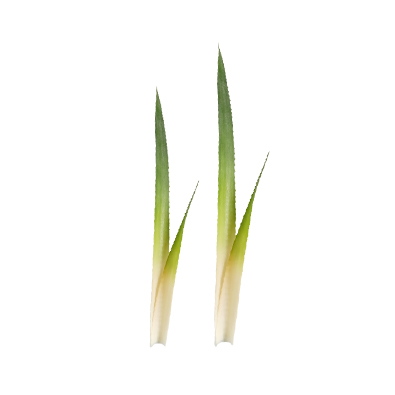
- Leaves - sword-shaped, up to 1 m or more long, 5-8 cm wide, margin spiny or almost entire, top ending in a fine point, fleshy, fibrous, grooved on upper surface, arranged in a close spiral, clasping the main axis at their base.
Cultivation
Pineapples are bred by crowns, slips or suckers.
Chemical Constituents
Alkaloids, flavonoids, tannins, phytosterols, phenol glycosides, bromeilin enzyme, citric acid, malic acid.
Traditional Medicinal Uses
Pineapple leaf extract has anti-diabetic, anti-dyslipidemic and anti-oxidative activity.
Part Used
Reference Sources
- Verheij, E.W.M. and Coronel, R.E. (Editors), 1992. Plant Resources of South-East Asia No 2. Edible fruits and nuts. Prosea Foundation, Bogor, Indonesia. 431 pp.
- Xie W, Xing D, Sun H, Wang W, Ding Y, Du L. The effects of Ananas comosus L. leaves on diabetic-dyslipidemic rats induced by alloxan and a high-fat/high-cholesterol diet. Am J Chin Med. 2005;33(1):95-105. doi: 10.1142/S0192415X05002692. PMID: 15844837.