
Maple Oyster Mushroom
Pleurotus cystidiosus O.K. Mill.
Pleurotaceae
Location in our garden
Mushroom House

Synonym
Pleurotus abalonus Y.H. Han, K.M. Chen & S. Cheng
Pleurotus cystidiosus subsp. abalonus (Y.H. Han, K.M. Chen & S. Cheng) O. Hilber
Pleurotus cystidiosus subsp. cystidiosus O.K. Mill.
Habitus

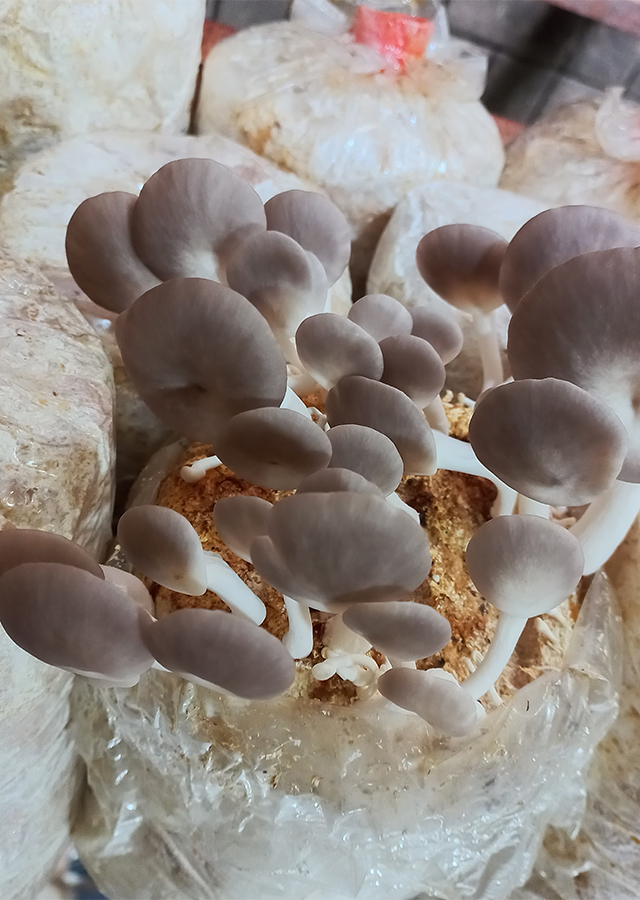
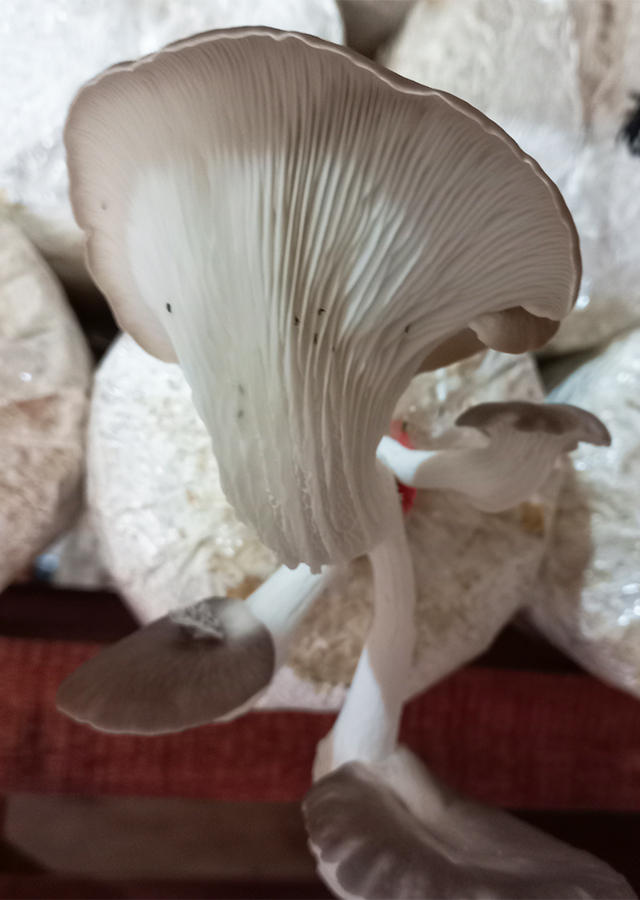
Succulent. Fungi, annual, with small cream-white caps, strongly decurrent gills and a short central or eccentrical stem about 6 cm tall.
Part Used
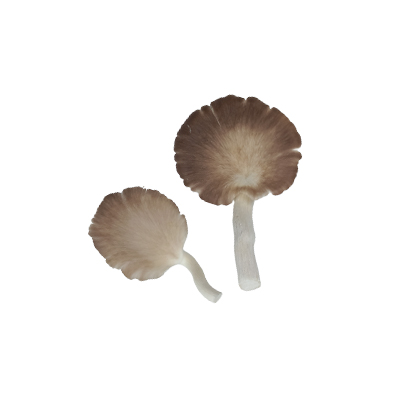
 The Whole Plant
Growing Requirements
 Need Shade
Habitat
 Forest
 Terrestrial
Overview
Pleurotus cystidiosus is found in tropical, subtropical and temperate climates throughout the world. A well-known edible mushroom that is rich in nutrients (protein, dietary fibers, B vitamins) and is low in fat, and they possess many promising therapeutic properties. Mushroom fruitbodies, mycelium, and their extracts are considered potential sources of food and have the capability to supply nutrients that are important for human health.
Vernacular Names
No found data on this. Need further research.
Agroecology
Substrate: straw, hardwood sawdust (cottonwood, oak, maple, sweetgum elm, beech, poplar). Biological efficiency rated at 50-75%, higher on sawdust based substrates than on straw.
Morphology
- Pileus - 10−13 × 6.3−8 cm, convex in young stage then depressed, parabolic modification of pileus disc, surface scaly, dry velvety in touch, smooth and slightly lobed margin, with greyish yellow pink context, scales moderate reddish brown.
- Lamellae - decurrent, 4−8 cm in length, closed, with marginate edge, moderate reddish brown, face brilliant yellow, thin and remaining unchanged on drying.
- Stipe - eccentric, 3.7−5 × 2.4−3.5 cm, equal and flattened, smooth, slightly curved at the base, greyish brown, dry velvety, solid, veil absent, base bulbous.
- Basidiospores - 7.4−14 × 3−6 µm, cylindrical to ellipsoidal, thin walled, hyaline, smooth and inamyloid.
- Basidia - 23.7−35 × 3.8−6 µm, cylindrical to clavate, thin walled, hyaline, 2− or 4− spored, with sharp and thin sterigmata of 1.9−2.18 µm.
- Cheilocystidia - 24−40 × 3.03−5.66 µm, frequent, pyriform to cylindrical, thin walled.
- Pleurocystidia - 26−42 × 6−9 µm, thin walled, hyaline, sub-fusiform to sub-globose.
- Stipehyphae - 6−10 µm in diameter, septate, thin-walled, hyaline with frequent clamp connections.
Cultivation
It reproduces by spores.
Chemical Constituents
Volatile oils (palmitic acid, indole and myristic acid), amino acids (such as isoleusin, lysin, methionin, cystein, penylalanin, tyrosin, treonin, tryptopan, etc).
Traditional Medicinal Uses
- Studies have shown some anti-tumor, anti-cancer, anti-bacterial, anti-fungal, anti-viral, anti-inflammatory, genoprotective, anti-oxidant, immuno-modulatory, anti-diabetic, anti-allergic, anti-mitogenic, anti-hypertensive and anti-hypercholesterolemic properties.
- It is used in the treatment of liver disease and lose weight.
- Help to prevent breast cancer, can lower high blood pressure, and it is good for heart health.
Part Used
Reference Sources
- Galappaththi M.C.A., Dauner L., Madawala S., Karunarathna S.C. 2021. Nutritional and medicinal benefits of Oyster (Pleurotus) mushrooms: a review. Fungal Biotec 1(2), 65–87, Doi 10.5943/FunBiotec/1/2/5. https://www.researchgate.net/publication/356633910_Nutritional_and_medicinal_benefits_of_Oyster_Pleurotus_mushrooms_a_review.
- India Biodiversity Portal. (No date). Pleurotus cystidiosus O..K. Mill. 1969. https://indiabiodiversity.org/species/show/240333. 05-07-2022.
- Shroomery. (2017). Pleurotus cystidiosus-Maple Oyster. https://www.shroomery.org/9405/Pleurotus-cystidiosus. 05-07-2022.
- The Mycelium Emporium. (2017). Abalone (Pleurotus cystidiosus). https://www.themyceliumemporium.com/product-page/abalone-pleurotus-cystidiosus. 05-07-2022.
- Usami, A., Motooka, R., Nakahashi, H., Okuno, Y., and Miyajawa, M. (2014). Characteristic Odorants from Bailingu Oyster Mushroom (Pleurotus eryngii var. tuoliensis) and Summer Oyster Mushroom (Pleurotus cystidiosus). Journal of Oleo Science, Vol 63(7):731-739. Also available: https://www.jstage.jst.go.jp/article/jos/advpub/0/advpub_ess14043/_article/-char/ja/.