
Stalked Bulbine
Bulbine frutescens (L.) Willd.
Asphodelaceae
Location in our garden
Principal

Synonym
Anthericum frutescens L.
Bulbine caulescens L.
Phalangium rostratum (Jacq.) Kuntze
Habitus

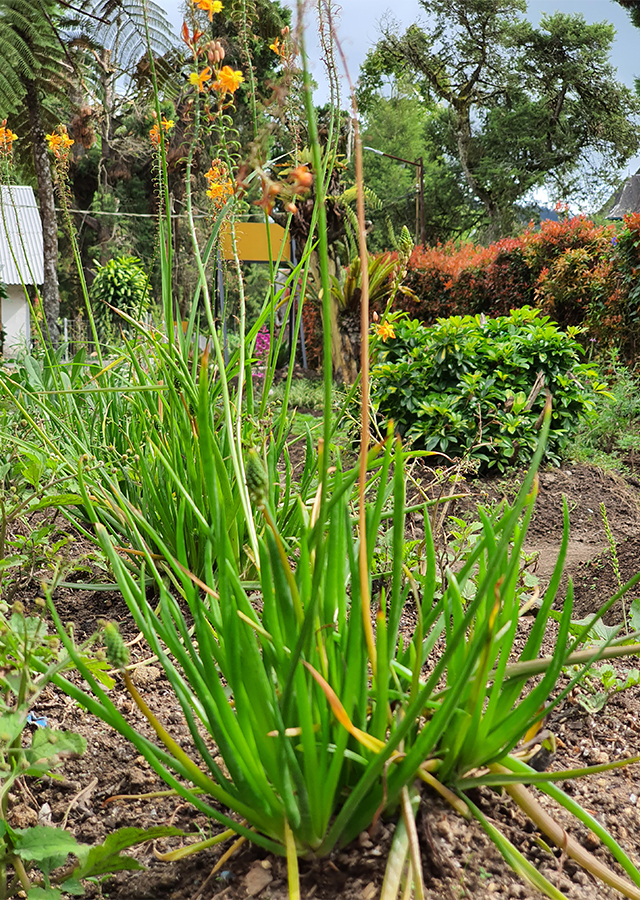
Succulent. A fast growing, succulent perennial shrub, spreading clumps, reaching up to 0.6 - 0.8 m tall and 1 m wide.
Part Used
 Leaves
 The Whole Plant
Growing Requirements
 Full Sunshine
 Need Shade
 Drought Resistant
Habitat
 Terrestrial
Overview
Bulbine frutescens is native to South Africa, and is widespread throughout parts of Northern Cape, Western and Eastern Cape. It is often used in landscaping where a drought-resistant, tough groundcover is required. It is also cultivated for its medicinal properties. This plant is ideal to grow and is a useful first-aid remedy for childrens' daily knocks and scrapes.
Vernacular Names
Geelkatstert (Afrikaans).
Agroecology
Stalked bulbine can be found in waterwise garden plant, especially when planted en masse as a ground cover, or in rock gardens. For best results it should be planted in well-drained soil preferably enriched with compost. The dead flower heads should be removed to encourage further flowering. These plants prefer full sun, but they will also grow in semi-shade for part of the day. Although it will grow indoors, it requires maximum light.
Morphology
- Stem - branched, greyish stems often bearing adventitious roots.
- Leaves - fleshy, linear green leaves in opposite rows and clasping the stems at the base.
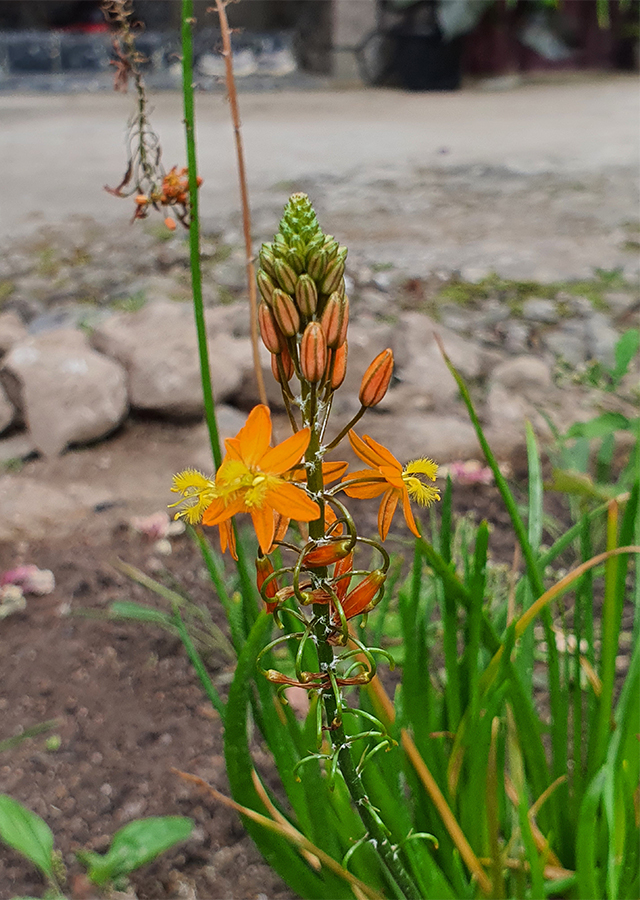
- Flower - small 6-petaled star shaped flowers are carried on an upright, spreading raceme during spring (or occasionally at other times). The petals are either yellow or sometimes orange, which combines attractively with the fluffy yellow stamens to give a bi-coloured look.
- Fruit - a small, rounded capsule.
- Seed - containing 3-4 black seeds in a cell.
Cultivation
- Generative propagaation is by seed.
- Vegetative propagations is by cuttings and division of clumps. Once the seedlings have four leaves and the cuttings have a well-formed root system, they can be transplanted.
Chemical Constituents
Biaryl anthraquinones, knipholone, isofuranonaphthoquinones, flavonoids, terpenoids.
Traditional Medicinal Uses
- The plant is commonly used in the Eastern Cape Province of South Africa for the treatment of burns, dysentry, sexually transmitted diseases (STDs), urinary tract infections, cracked lips, herpes, ringworm, rashes and itches.
- The fresh leaf produces a jelly-like juice that is used for burns, rashes, blisters, insect bites, cracked lips, acne, cold sores, mouth ulcers and areas of cracked skin.
- In Jamaica, the Rastafarians make an infusion of a few fresh leaves in a cup of boiling water. The strained drink is taken for coughs, colds and arthritis.
Part Used

Reference Sources
- Harris, Shireen. (2003). Bulbine frutescens. http://pza.sanbi.org/bulbine-frutescens. 15-04-2022.
- Kenfack, M. S., Mbeng, W. O., Materechera, S. A. (2017). An ethnopharmacological review of Bulbine frutescens (L.) Willd. (Asphodelaceae) - a medicinal plant used for the treatment of skin diseases in the Eastern Cape, South Africa. North-West University. Also available: https://repository.nwu.ac.za/handle/10394/30361.
- Kew Royal Botanic Gardens. (No date). Plants of the World Online: Bulbine frutescens (L.) Willd. https://powo.science.kew.org/taxon/urn:lsid:ipni.org:names:532169-1. 15-04-2022.
- National Park of Singapore. (2022). Flora & Fauna Web: Bulbine frutescens. https://www.nparks.gov.sg/florafaunaweb/flora/3/6/3646. 15-04-2022.
- Plantinfo. (2022). Bulbine frutescens. https://plantinfo.co.za/plant/bulbine-frutescens/. 15-04-2022.