
White Champaca
Magnolia × alba (DC.) Figlar
Magnoliaceae
Location in our garden
Principal

Synonym
Michelia × alba DC.
Michelia × longifolia Blume
Sampacca × longifolia (Blume) Kuntze
Habitus

Trees. An evergreen perennial tree, growing about 16-30 m tall
Part Used
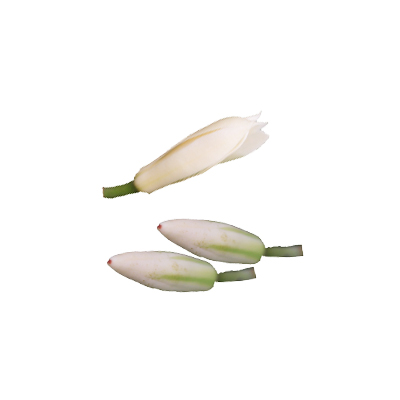
 Flowers
Growing Requirements
 Full Sunshine
Habitat
 Roadside
 Terrestrial
Overview
Magnolia x alba is a hybrid of M. champaca L. dan M. montana Blume and is native to Indonesia (Java). It is grown as an ornamental and used medicinally. Essential oil from flowers used in perfumery; also for tea-perfuming. In Indonesia, the flower is often used in traditional ceremonies. In China, known as bai lan, and the flowers are made for tea called yulan tea.
Vernacular Names
Tsampakang-puti (Tagalog-Philippines), Bai yu lan (Chinese).
Agroecology
Prefers sandy and well-drained soil. Like most tropical members of the Magnoliaceae family, it grows best in acidic soil, from pH 6.5 down to as acidic as pH 5.6. It requires full sun and moderate watering, and does not tolerate over-watering.
Morphology
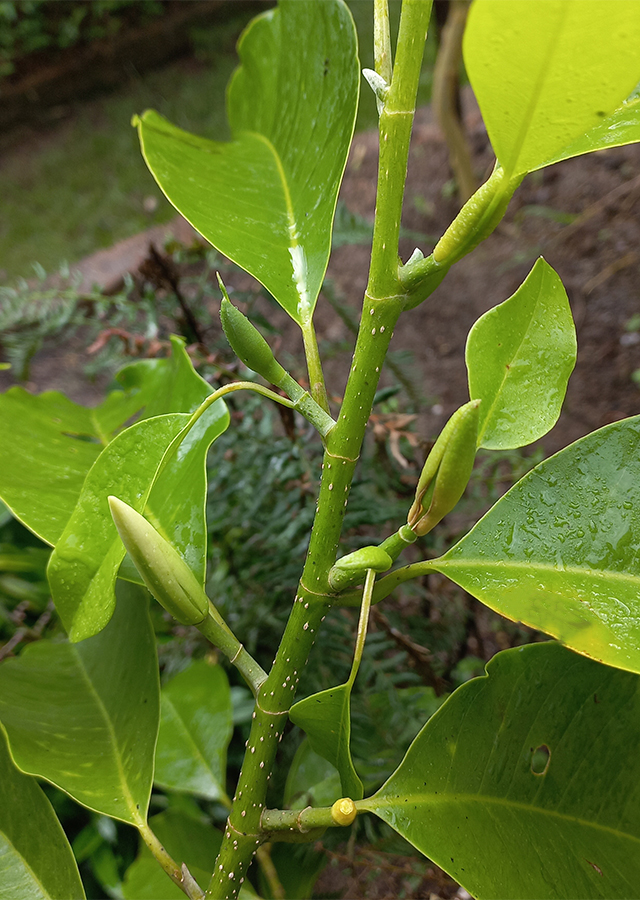
- Stem - bark grey, branches fragrant after being crushed. Twigs patent, forming a broadly umbelliform crown; young twigs and buds densely pale yellowish white puberulous, trichomes gradually deciduous with age. Stipular scar nearly reaching middle of petiole.
- Leaves - fragrant, simple, petiole 1.5-2 cm, sparsely puberulous; leaf blade long elliptic to narrowly ovate, 10-27 × 4-9.5 cm, thinly leathery, abaxially sparsely puberulous, adaxially glabrous, reticulate veins very conspicuous on both surfaces when dry, base cuneate, apex long acuminate to caudate-acuminate.
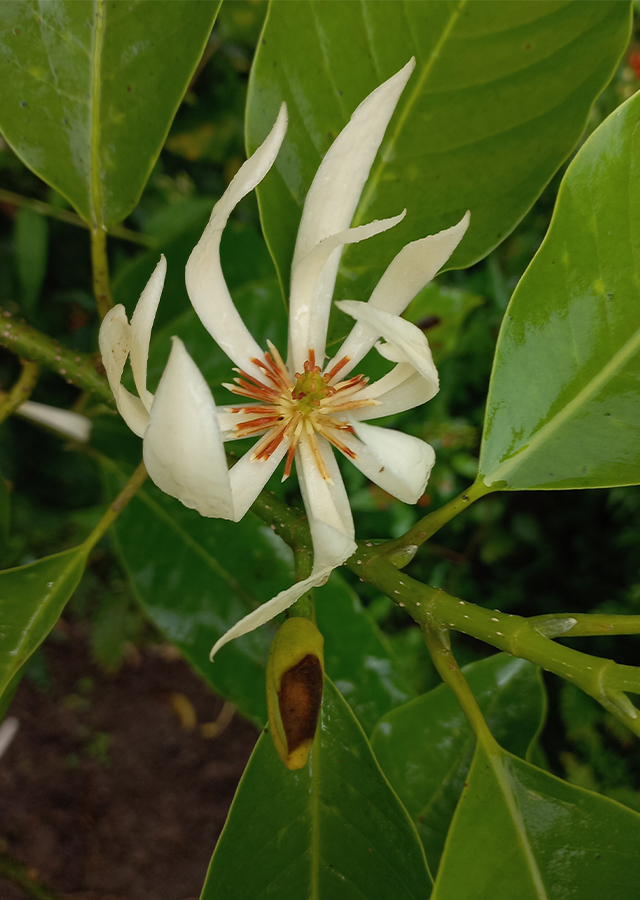
- Flower - has waxy, long and narrow tepals surrounding the green pistil. Tepals 10, white, lanceolate, 3-4 cm × 3-5 mm. Staminal connective exserted and forming a long tip. Flowers are white or cream in colour, about 5 cm in diameter. They are strongly scented, especially after dark. The flowers retain their fragrance even after being picked.
Cultivation
Generatively propagated by seed, and vegetatively by grafting.
Chemical Constituents
Essential oils (campbene, β-pinene, α-phellandrene, β-myrcene, limonene, 1,8-cineole), linalool, methyl eugenol, methy ethyl- acetic ester, acetic acid, -N-formylanonaine, (-)-oliveroline, (+)-nornuciferine, lysicamine, (+)-cyperone, (+)-epi-yangambin, ficaprenol-10, pheophytin a, aristophyll C, and michephyll A.
Traditional Medicinal Uses
- Studies have shown antibacterial, antioxidant, and antiasthmatic properties.
- Infusion of flowers is used as vaginal wash and for cough.
- It is used as tea.
Part Used

Reference Sources
- Flora of China. (No date). Michelia ×alba. http://www.efloras.org/florataxon.aspx?flora_id=2&taxon_id=250090229. 06-03.2022.
- Kew Royal Botanic Gardens. (2017). Plant of the World Online: Magnolia × alba (DC.) Figlar. https://powo.science.kew.org/taxon/20011680-1. 06-03-2022.
- National Park of Sigapore. (2022). Flora & Fauna Web: Magnolia (DC.) Figlar × alba. https://www.nparks.gov.sg/florafaunaweb/flora/3/0/302. 06-03.2022.
- Stuartxchange. (2011). Philippine Medicinal Plants: Tsampakang-puti. http://www.stuartxchange.ph/Tsampakang-puti.html. 06-03.2022.