
Persian Shield
Strobilanthes auriculata var. dyeriana (Mast.) J.R.I.Wood
Acanthaceae
Location in our garden
Green House
Synonym
Perilepta dyeriana (Mast.) Bremek.
Strobilanthes dyeriana Mast.
Habitus

Shrubs. Erect herbaceous perennial shrub that grows 0.9 m to 1.2 m.
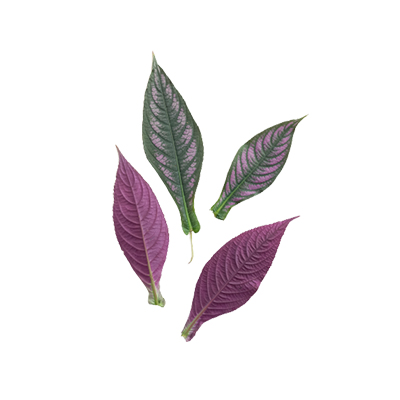
Part Used
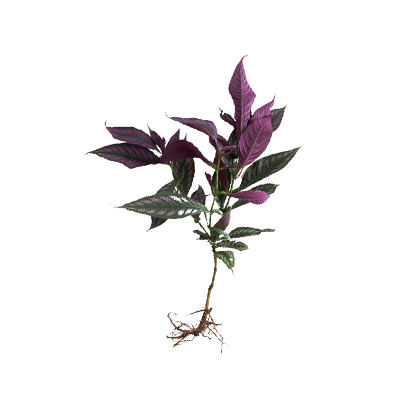
 Leaves
Growing Requirements
 Full Sunshine
 Need Shade
Habitat
 Forest
 Shrublands
 Terrestrial
Overview
Strobilanthes auriculata var. dyeriana is native of Myanmar and Thailand; the species as a whole more widespread in Pakistan, India, Nepal, China, Myanmar, Thailand, Malaysia. Then introduced into Cameroon, Cuba, Dominican Republic, Haiti, Venezuelan Antilles. Commonly cultivated in the tropics. Genus Strobilanthes is derived from two Greek words - "strobilos" which means cone and "anthos" which means flower, and refers to the plant's inflorescence. Species dyerianus is named after Sir William Thistleton-Dyer (1843 - 1928) of the Science Schools Buildingor landscaping uses in , London, and Director of the Royal Botanic Gardens, Kew, from 1885-1905. It is desirable for its ornamental leaves for landscaping uses in container planting, general, parks and gardens.
Vernacular Names
Escudo persa (Spanish).
Agroecology
Strobilanthes dyeriana can be found in terrestrial, and underwood of the humid forest. It needs full sun to partial shade. Keep soil evenly moist, water when top couple inches of soil are dry. High humidity preferred, and temperature is 15.5 °C and above. Cool temperatures and low lighting conditions can reduce the color of the foliage, giving the plat a sort of washed out appearance. As the plant ages, it can also lose its brilliant coloring. It grows best when planted in a rich soil and located in an area that receives bright light with no direct sunlight. Requires rich, well-drained soil with lots of plant matter, pH range 5.5-7.5. Tolerates to wet soil.
Morphology
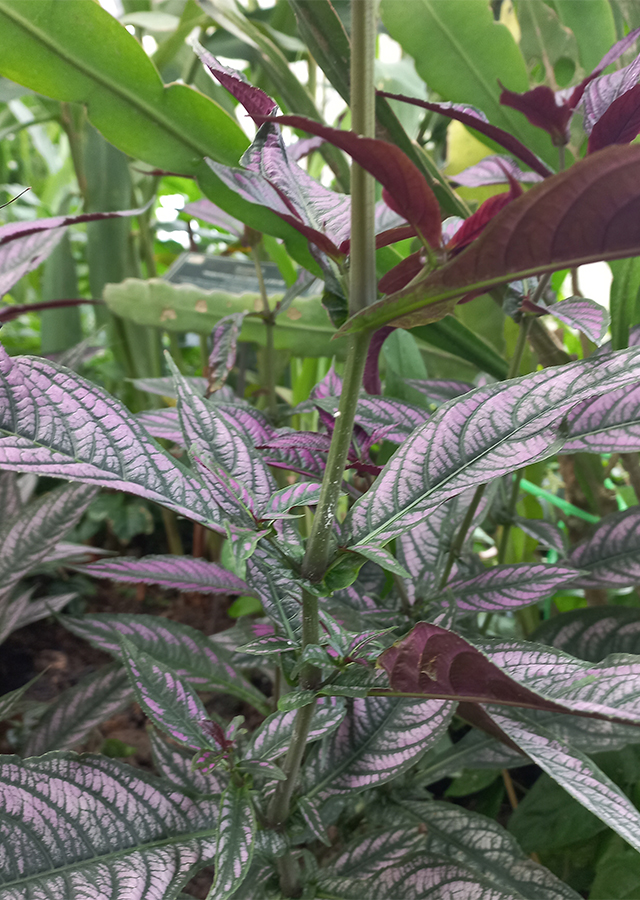
- Stems - soft stemmed, squarish in cross-section.
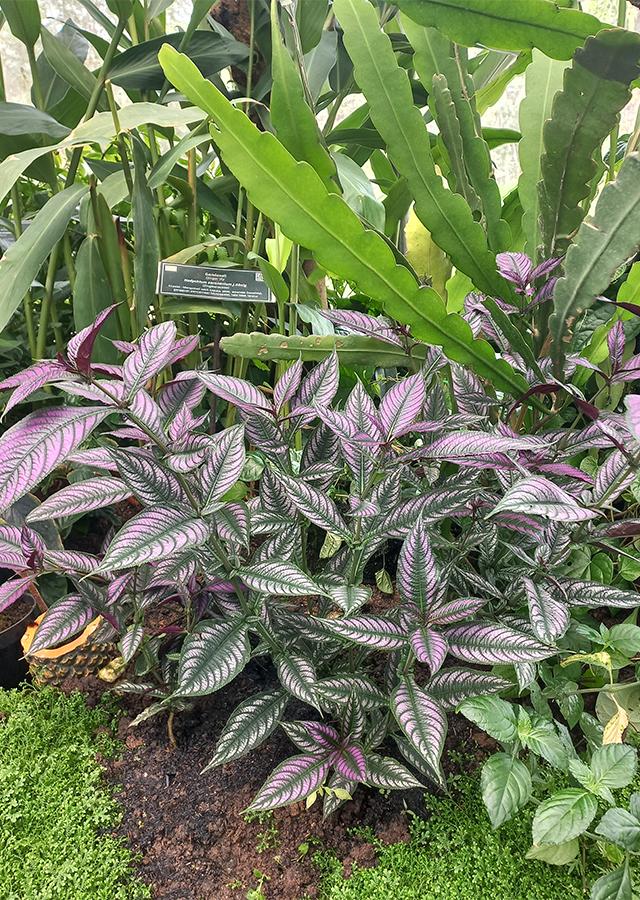
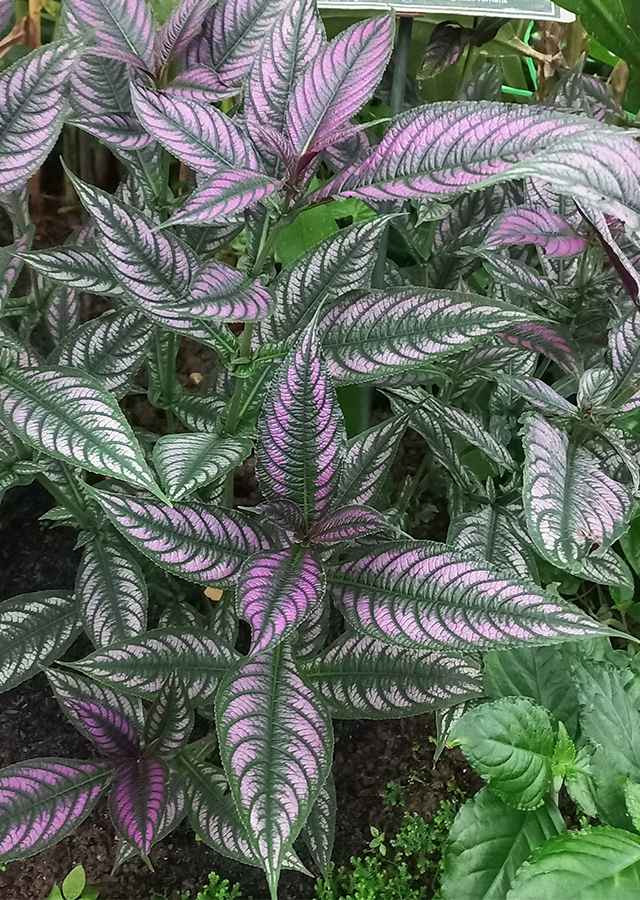
- Leaves - opposite simple, slightly toothed margins, and pointed apex, variegated with shimmering shades of purple, green and silver, with completely purple underneath, ovate-lanceolate in shape and measuring up to 20 cm long, 5-7 cm broad.
- Flower - erect panicle inflorescences, about 15 cm long, with imbutiform flower, about 3 cm long, of pale violet colour, subtended by green bracts, 5-lobed funnel-shaped flowers are arranged in short cone-like inflorescences.
- Fruit - oblong capsules containing 4 seeds.
Cultivation
Generative propagation is by seed, and vegetative propagation is by division and by stem/apical cutting.
Chemical Constituents
Saponins, polyphenols, and flavonoids.
Traditional Medicinal Uses
- The decoction of the leaves is used as diuretic.
- Its used as a remedy for rheumatism.
Part Used
Reference Sources
- Kew Royal Botanic Gardens. (2017). Plants of the World Online: Strobilanthes auriculata var. dyeriana (Mast.) J.R.I.Wood. https://powo.science.kew.org/taxon/urn:lsid:ipni.org:names:20011952-1. 14-01-2022.
- National Park of Singapore. (2019). Flora & Fauna Web: Strobilanthes dyerianus Mast. https://www.nparks.gov.sg/florafaunaweb/flora/2/4/2481. 14-01-2022.
- Epic Gardening. (2021). Persian Shield: Caring For Strobilanthes Dyeriana. https://www.epicgardening.com/persian-shield/. 14-01-2022.
- Missouri Botanical Garden. (No date). Strobilanthes dyerianus. https://www.missouribotanicalgarden.org/PlantFinder/PlantFinderDetails.aspx?kempercode=a122. 14-01-2022.
- North Carolina Cooperative Extension. (No date). North Carolina Extension Gardener Plant Toolbox: Strobilanthes auriculata var. dyeriana. https://plants.ces.ncsu.edu/plants/strobilanthes-auriculata-var-dyeriana/. 14-01-2022.
- Monaco Nature Encyclopedia. (No date). Strobilanthes dyeriana. https://www.monaconatureencyclopedia.com/strobilanthes-dyeriana-2/?lang=en. 14-01-2022.
- Widyaningrum, H., Tim Solusi Allternatif. 2019. Kitab Tanaman Obat Nusantara. Media Pressindo (Anggota IKAPI). Yogyakarta.