
Mother of Thousands
Kalanchoe daigremontiana Raym.-Hamet & H.Perrier
Crassulaceae
Location in our garden
Principal
Synonym
Bryophyllum daigremontianum (Raym.-Hamet & H.Perrier) A.Berger
Habitus

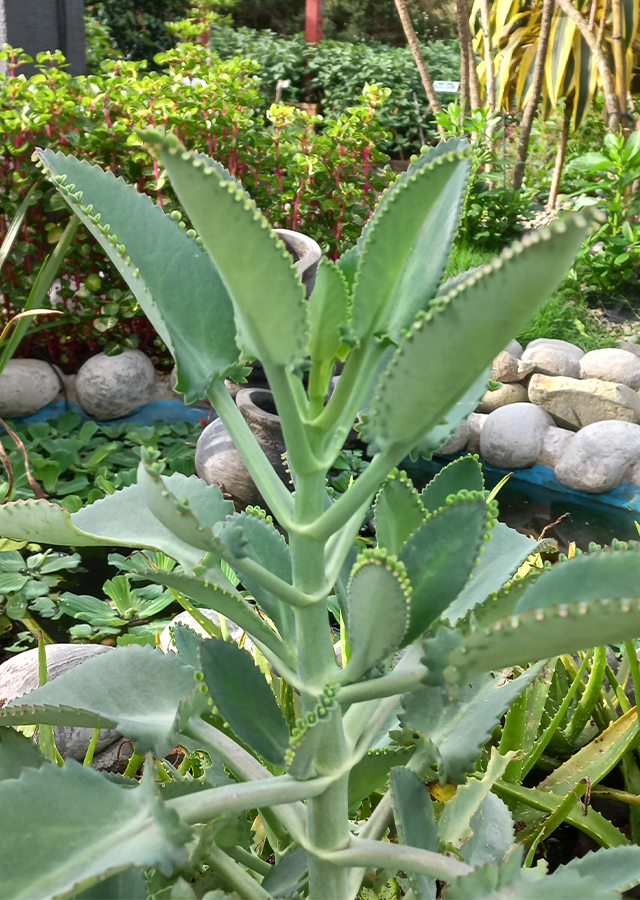
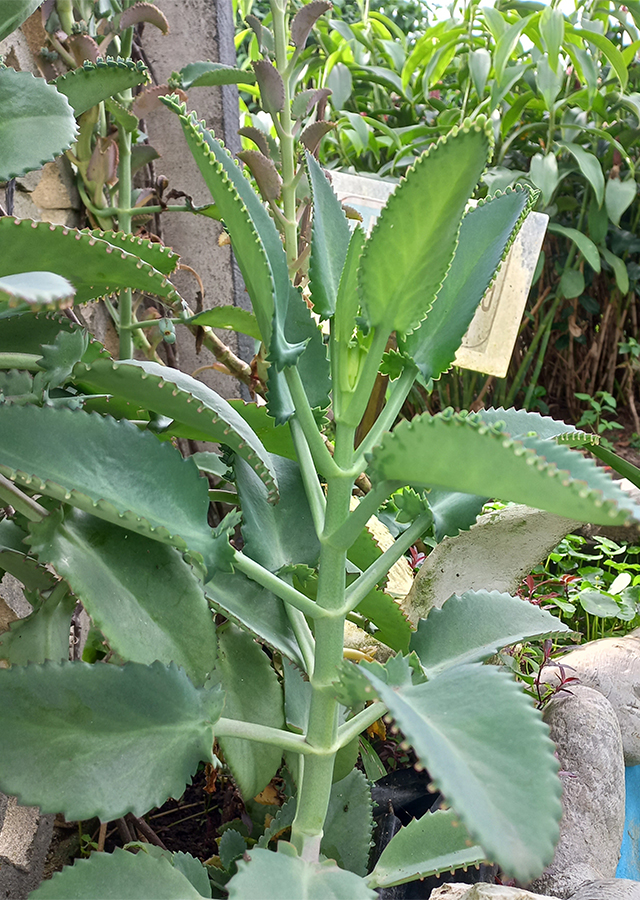
Succulent. A short-lived succulent, perennial glaucous herb, growing up to 1 m tall
Part Used
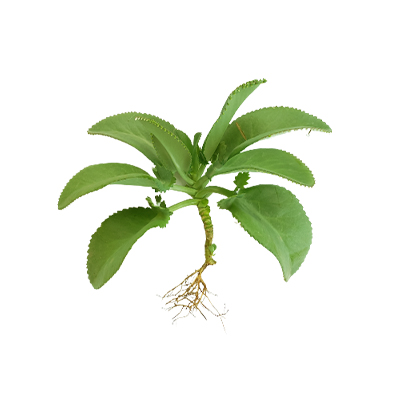
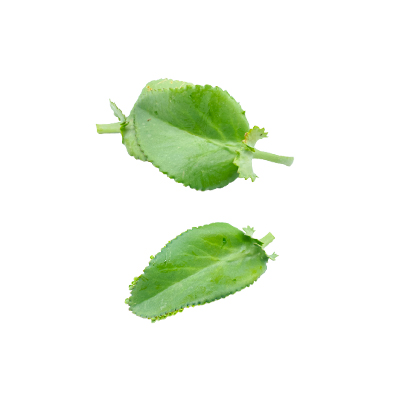
 Leaves
 The Whole Plant
Growing Requirements
 Full Sunshine
 Need Shade
 Drought Resistant
Habitat
 Forest
 Roadside
 Shrublands
 Grassland
 Terrestrial
Overview
Kalanchoe daigremontiana is native to dry zones in Madagascar. It has been introduced in tropical and subtropical regions as an ornamental and a house-plant and it can now be found growing in arid and semiarid habitats in Mexico, Florida, the West Indies, Venezuela, Spain, Portugal, Italy, Australia, South Africa, and on several islands in the Pacific. Juice of this plant has long been used in everyday life for the treatment of many diseases since it has hemostatic, wound healing, and anti-inflammatory properties.
Vernacular Names
Amaranto (Spanish), Mãe de milhares (Potugalese), Tope-tope (Haiti).
Agroecology
K. daigremontiana is well adapted to dry areas because of its succulent features. Thus, this species can be found growing in xeric environments including deserts, dry forests, grasslands, cactus thickets, spiny scrubs, thorny forests, disturbed forests, and roadsides.
Morphology
- Roots - brown taproot.
- Stems - mostly simple, 5–25 dm × 0.5–2 cm.
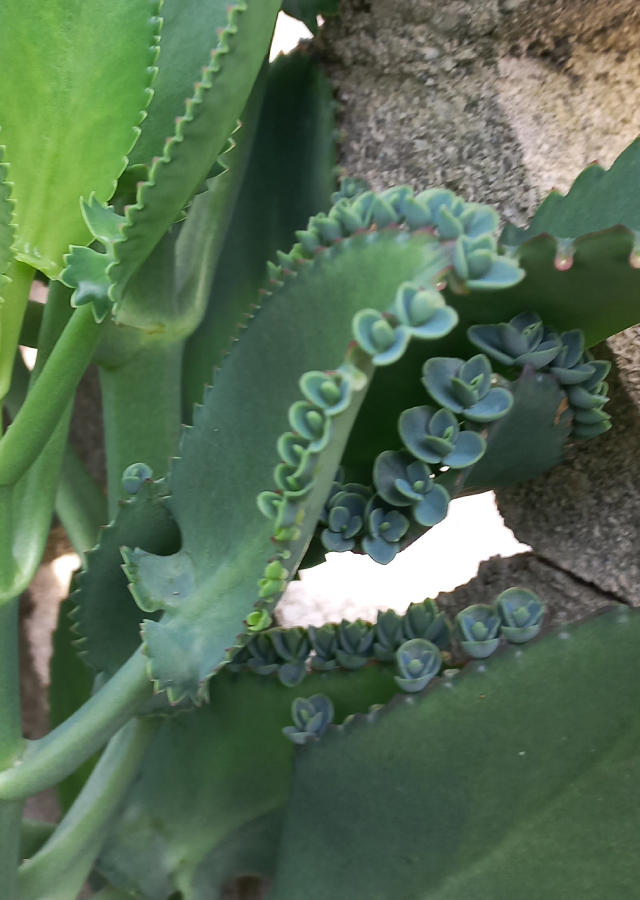
- Leaves - opposite, evenly spaced, simple, largest subpeltate; petiole subterete, 1–5 cm; blade purple-blotched abaxially, triangular to lanceolate, 5–25 cm × 3–12 cm, margins serrate, apex acute, surfaces glaucous; bulbils borne in notches of leaf margins, spurs spoon-shaped. Inflorescence is a compound cyme, paniculate, 1.5–3 dm diameter; branches up to 15 cm. Pedicels 5–15 mm.
- Flowers - pendulous, large, bisexual, calyx green or purplish, not inflated, 6–10 mm, tube 3–4 mm, lobes triangular, 3–7 mm, equaling or longer than tube, apex acute; corolla pink or lavender, 20–30 mm, not contracted basally, lobes obovate, 6–12 mm, apex rounded, apiculate. Nectar scales oblong, 1.5-2 x 0.3-1 mm. Follicles, 7-10 x 2-4 mm.
- Seed - 0.6-1 x 0.2-0.3 mm, oblong with longitudinal striae.
Cultivation
Generative propagation is by seed, and vegetative propagation is by cuttings (stem and leaf).
Chemical Constituents
Flavonoids, phenolic acids, anthocyanins, alkaloids, saponins, tannins, steroid compounds (bufadienolide), and triglycoside (kaempferol 3-O-ß-D-xylopyranosyl-(1→2)-α-L-rhamnopyranoside-7-O -ß-D-glucopyranoside).
Traditional Medicinal Uses
- Leaves extracts are commonly used to treat diseases such as bacterial, fungal, and viral infections, asthma, and ulcers.
- The leaves have antimicrobial, antifungal, anti-inflammatory, analgesic, antihypertensive, and anti-diabetic effects.
- In Germany, K. daigremontiana is one of anthroposophic medications, administered to alleviate psychic agitation, restlessness and anxiety.
- In Chinese herbal medicine, this plant has been used to alleviate vomiting and cough.
Part Used
Reference Sources
- Akentievaa, N.P., et al (2021). The Effect of Plant Extracts Kalanchoe daigremontiana and Aloe arborescens on the Metabolism of Human Multiple Myeloma Cells. Biointerface Research in Applied Chemistry, Volume 11(5), (pg.13171-13186). https://doi.org/10.33263/BRIAC115.1317113186.
- CABI. (2021). Invasive Species Compendium: Kalanchoe daigremontiana (devil's backbone). https://www.cabi.org/isc/datasheet/115049#tosummaryOfInvasiveness. 26-11-2021.
- Czepas, J.K., et.al. (2016). Antioxidant efficacy of Kalanchoe daigremontiana bufadienolide-rich fraction in
blood plasma in vitro. PHARMACEUTICAL BIOLOGY, 54(12): 3182–3188. http://dx.doi.org/10.1080/13880209.2016.1214740. - Kew Royal Botanic Gardens. (2021). Plants of the World Online: Kalanchoe daigremontiana Raym.-Hamet & H.Perrier. http://www.plantsoftheworldonline.org/taxon/urn:lsid:ipni.org:names:274315-1. 26-11-2021.