
Blue Trumpet Vine
Thunbergia grandiflora Roxb.
Acanthaceae
Location in our garden
Principal
Synonym
Pleuremidis grandiflora (Roxb.) Raf.
Thunbergia adenophora W.W.Sm.
Thunbergia cordifolia Nees.
Habitus

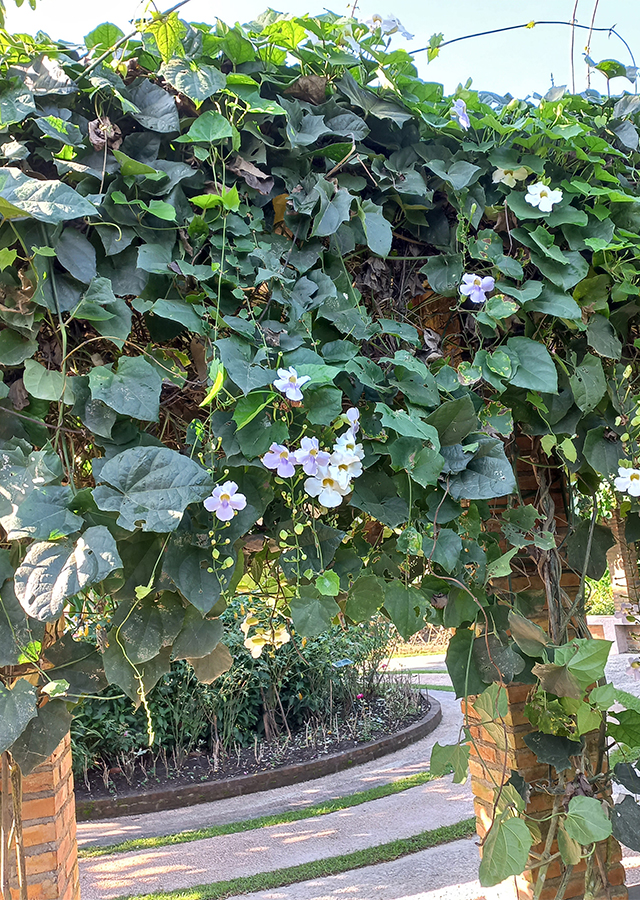
Climbers. A perennial climbing plant with stems up to 10 m or more that scramble over the ground or can twine high into the surrounding vegetation
Part Used
 Leaves
 Flowers
 Roots
Roots Sap
Sap Stem
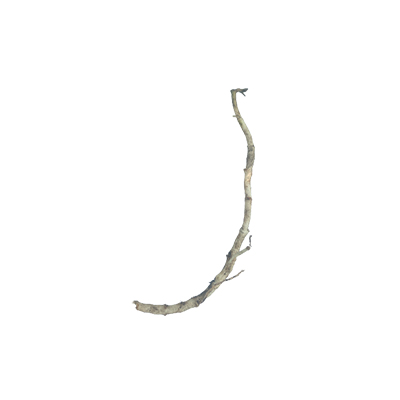
Stem
Growing Requirements
 Full Sunshine
Habitat
 Riverbanks
 Forest
 Coastal
 Roadside
 Grassland
 Terrestrial
Overview
T. grandiflora is native to India, parts of China and south Asia, but widely cultivated and naturalized in tropical and subtropical regions. Currently it can be found in Mexico, Central America, the West Indies, South America, tropical Africa, Southeastern Asia, Australia, and the Pacific Islands. The plant is sometimes harvested from the wild for local use as a food and medicine. It is commonly grown as an ornamental, being valued especially for its large, violet or white flowers.
Vernacular Names
Brisa de la mañana (Spanish), Liane de chine (French), Ristra de ajo (Dominican Republic).
Agroecology
Grows on thickets at elevations from 400 - 1,500 m in China. Succeeds in tropical and subtropical climates, where it grows at low elevations. Grows best in full sun or partial shade. Prefers a fertile, moist, but well-drained soil. Plants can flower all year round in tropical climates.
Morphology
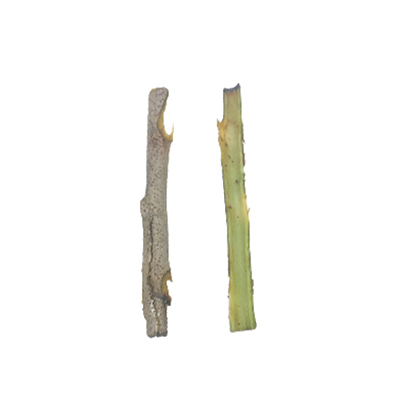
- Stems - cylindrical, up to 2.5 cm in diameter, striate, puberulous; cross section of the stem with the pith hollow and the xylem tissue with wide rays.
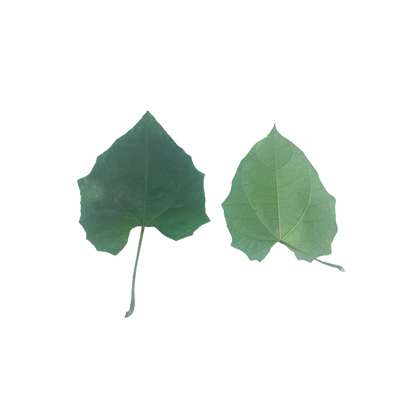
- Leaves - opposite; blades 15-26 × 13-30 cm, ovate or broadly ovate, chartaceous, the apex acute or acuminate, the base cordiform, the margins lobate-dentate, ciliate; upper surface is dark green, shiny, puberulous, with slightly prominent venation; lower surface is light green, dull, glabrous or puberulous, with prominent venation; petioles 6-12 cm long.
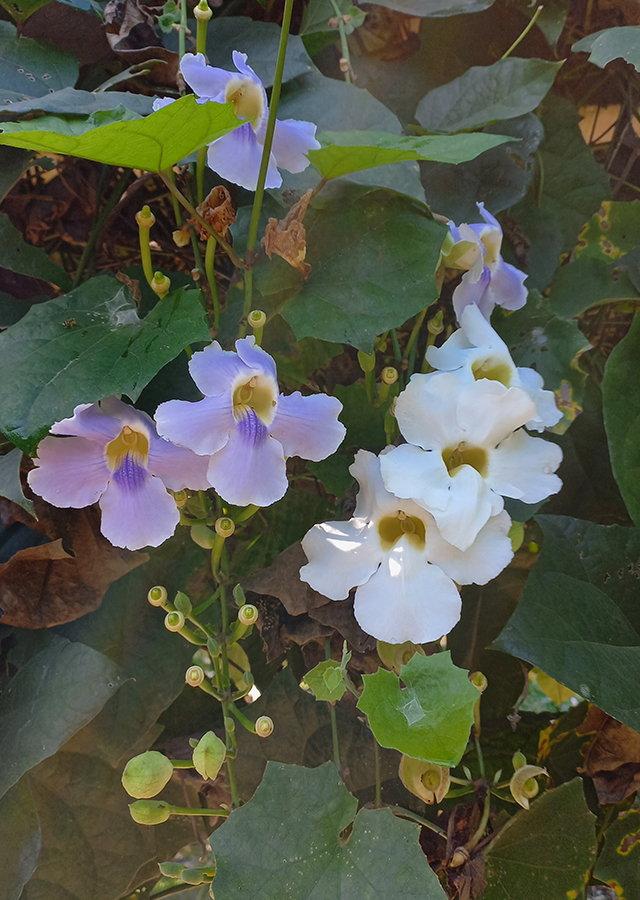
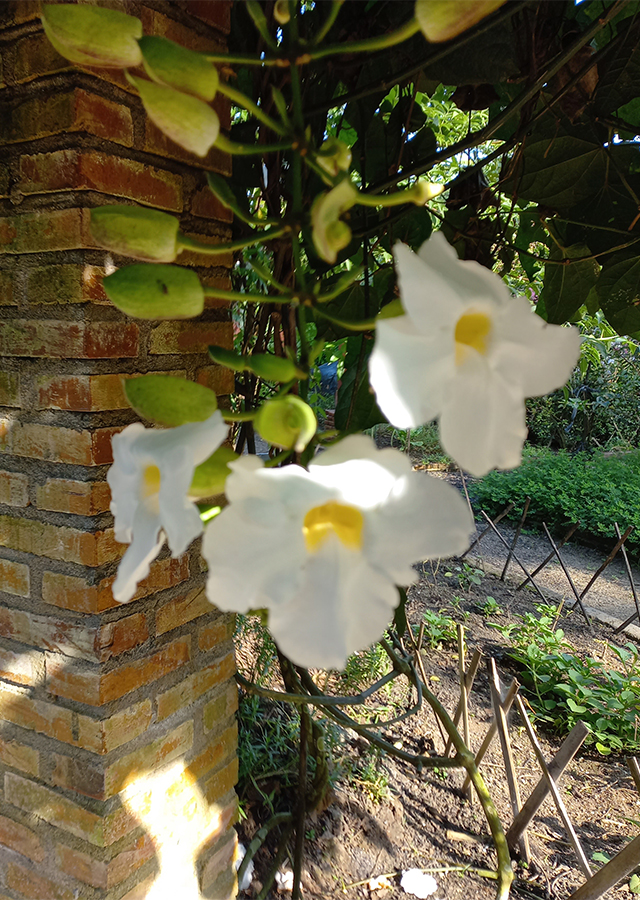
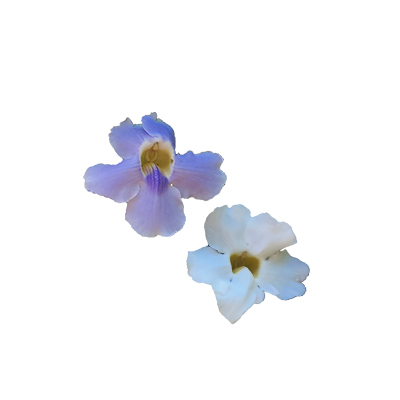
- Flowers - arranged in axillary cymes; pedicels robust, cylindrical, 4-6 cm long; bracts light green, ovate, approximately 4 cm long, covering the calyx and the corolla tube. The calyx is green with the form of a ring, 4-5 mm long; corolla lilac-blue or white, with 5 lobes, the tube 6-7 cm long, light yellow inside, narrow at the base, the limb 6-7 cm in diameter.
- Fruits - capsules, approximately 3 cm long, subglobose at the base, the upper half in the form of a beak, explosively dehiscent in two halves.
Cultivation
Propagated by seeds and cuttings.
Chemical Constituents
Alkaloids, phenols, iridoid glycosides, isounedoside, grandifloric acid, essential oils (α-3- octanol, 3,7 dimethyl 1,6-octadien-3-ol, 2-methoxy-3-(2-propenyl) phenol, methyl salicylate, ipropyl hexadecanoate).
Traditional Medicinal Uses
- The leaves, either on their own or in combination with the leaves of Abelmoschus moschatus and the seeds of Clausena lansium, are used as a remedy against snake bites. The petioles are removed and the juice of the leaves is used to massage the site of the bite, whilst the remaining pulp is then applied as a poultice.
- The dried and powdered leaves can also be used, they are moistened and applied as a poultice.
Part Used
Reference Sources
- Fern, Ken. Useful Tropical Plants. Thunbergia grandiflora. http://tropical.theferns.info/viewtropical.php?id=Thunbergia+grandiflora. 22-12-21.
- Cabi. Thunbergia grandiflora. https://www.cabi.org/isc/datasheet/117524. 22-12-21.