
Lavender Sorrel
Oxalis barrelieri L.
Oxalidaceae
Location in our garden
Beneficial Weed

Synonym
Acetosella barrelieri (L.) Kuntze
Oxalis amazonica Progel
Oxalis sepium var. picta Progel
Habitus

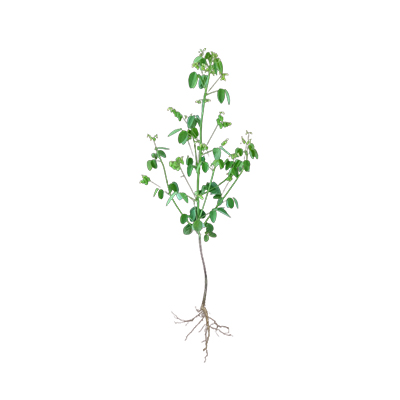
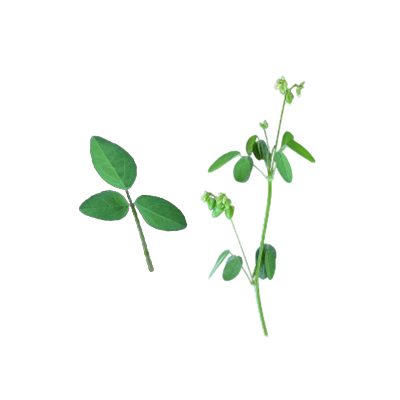
Herbaceous. An erect branched herb, often woody at the base and densely leafy from the base, perennial, growing 15 - 60 cm tall.
Part Used
 The Whole Plant
Growing Requirements
 Full Sunshine
Habitat
 Forest
 Roadside
 Terrestrial
Overview
Lavender sorrel is native to the West Indies and to Central and tropical South America (central and northern Brazil, Bolivia, Peru, Ecuador, Colombia, Venezuela, the Guyanas, through Mesoamerica to southern Mexico). It has naturalized in many areas and it was first observed in Java in 1888. In South-East Asia it is common in Indonesia (Sumatra, Bangka, Java, Irian Jaya), Peninsular Malaysia, and Papua New Guinea. Usually, the plant is harvested from the wild for local use as a food. In Indonesia, the leaves of lavender sorrel are used in salads, in particular for their sour or slightly acid taste. They are sometimes used as a substitute for tamarind. The leaves contain oxalic acid, which gives them their sharp flavour. When consumed in large quantities, they are toxic and perfectly all right in small quantities, because oxalic acid can bind up the body's supply of calcium leading to nutritional deficiency. The quantity of oxalic acid will be reduced if the leaves are cooked. Beside of that, lavender sorrel is used in the folk medicine. It used by Cameroon inhabitants (Central Africa) for diarrhea treatment.
Vernacular Names
Barrelier's woodsorrel (English), Oseille-marron, Oseille-savane, Trèfle (French), Belimbing Padang (Malay).
Agroecology
Lavender sorrel is found in gardens, along roads, in hedges, cultivated ground, village groves, estates, along rivers, and in forest clearings. It occurs at elevations from 900 - 1.220 metres. The plants is grow in full sun for best results and cannot grow in the shade. It requires very well-drained soil and moist soil. Commonly found in dry, sandy soils in some parts of the world.
Morphology
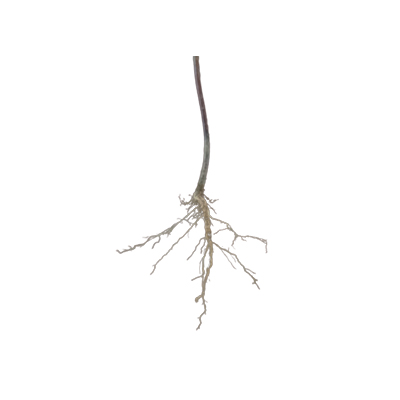
- Root - taproot.
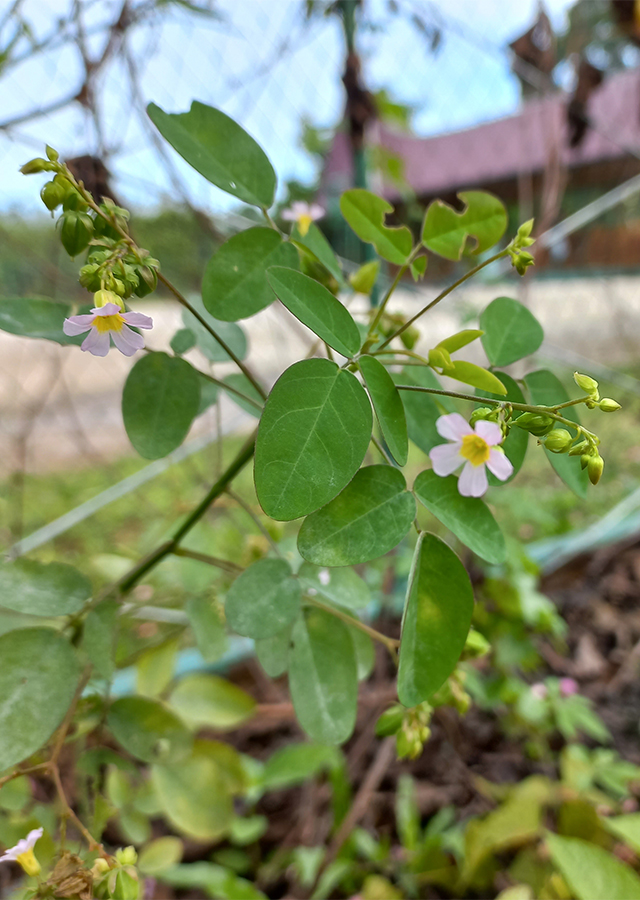
- Stem - erect, cylindrical or linear angled, slender, green.
- Leaves - subopposite, pinnately 3-foliolate, without stipules, leaflet elliptical to oblong, 1-5.5 cm × 0.5-2.5 cm, terminal one largest, base cuneate to emarginate, margin ciliate (especially at base), apex obtuse to rounded, glaucous above.
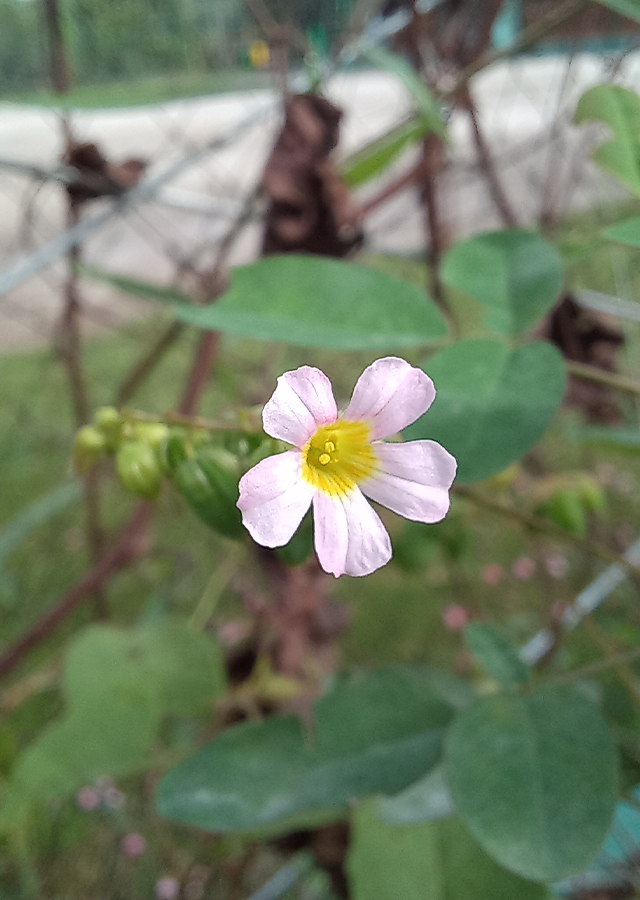
- Flowers - short tubular, petals white, pink or purplish, with a bright yellow throat. They have 5 lobes with rounded to truncated tips. Sepals linear-lanceolate, acute, puberulous. Inflorescence cymose, up to 11(-30)-flowered, pubescent, bracts opposite the pedicels, pilose.
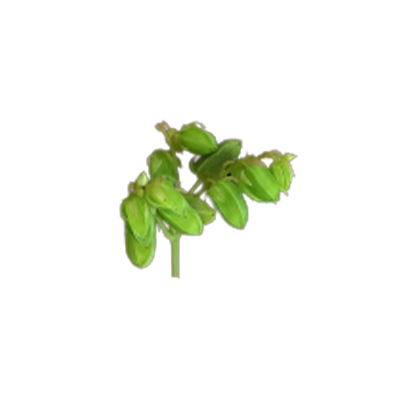
- Fruits - capsule ovoid, 5-10 mm × 3-5 mm, 5-angular, base and apex 5-lobed, glabrous. When dry, split open to release their tiny seeds.
- Seeds - usually 3 per carpel, flattened-ovoid, about 1.5-2 mm × 1 mm, 8-ribbed in zig-zag, deeply transversely striate, brownish, rugose.
Cultivation
Lavender sorrel is propagated by seed.
Chemical Constituents
Phenols, terpenoids, flavonoids, tannins, alkaloids, anthocyanidins, anthraquinones, coumarins, and saponins.
Traditional Medicinal Uses
- Studies have shown antidepressant properties.
- The decoction of Oxalis barrelieri is used as an antidiarrheal drug.
- For external medicine (herbs are mashed and then used as a dressing), is used for treating burns and cuts, insect bites, ulcers, and others.
Part Used
Reference Sources
- Useful Tropical Plants Database. 2021. Oxalis barrelieri. http://tropical.theferns.info/viewtropical.php?id=Oxalis+barrelieri. 26-10-2021.
- Flora Fauna Web. 2021. Oxalis barrelieri. https://www.nparks.gov.sg/florafaunaweb/flora/2/2/2291. 26-10-2021.
- PROSEA. 2016. Oxalis (PROSEA). [diakses 19 September 2021]. https://uses.plantnet-project.org/en/Oxalis_(PROSEA). 26-10-2021.
- Herbal Ramble. 2019. Lavender Sorrel (Oxalis barrelieri). https://herbalramble.wordpress.com/2019/03/21/lavender-sorrel-oxalis-barrelieri/. 26-10-2021.
- Tagne MAF et al. 2018. Effects of Oxalis barrelieri L. (Oxalidaceae) aqueous extract on diarrhea induced by Shigella dysenteriae type 1 in rats. Health Science Reports 1(2): e20. doi: 10.1002/hsr2.20
- Espoir A.M.R. et al. 2019. Effects of the Aqueous Extract of Oxalis Barrelieri on Some Murine Models of Acute Depression. ARC Journal of Neuroscience, 4(3): 9-19.