
Hairy Senna
Senna hirsuta (L.) H.S.Irwin & Barneby
Fabaceae
Location in our garden
Principal
Synonym
Cassia hirsuta L.
Ditremexa hirsuta (L.) Britton & Rose
Habitus

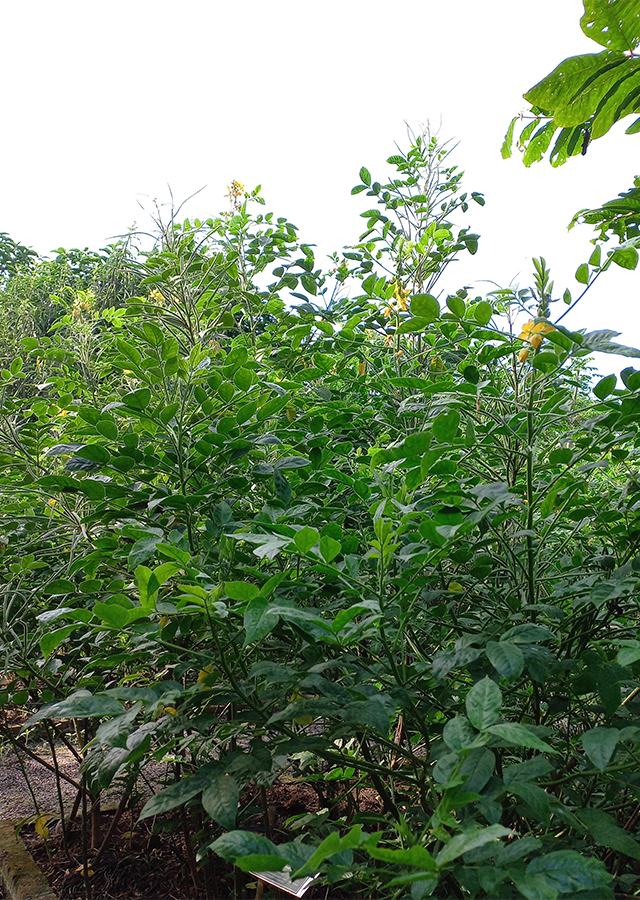
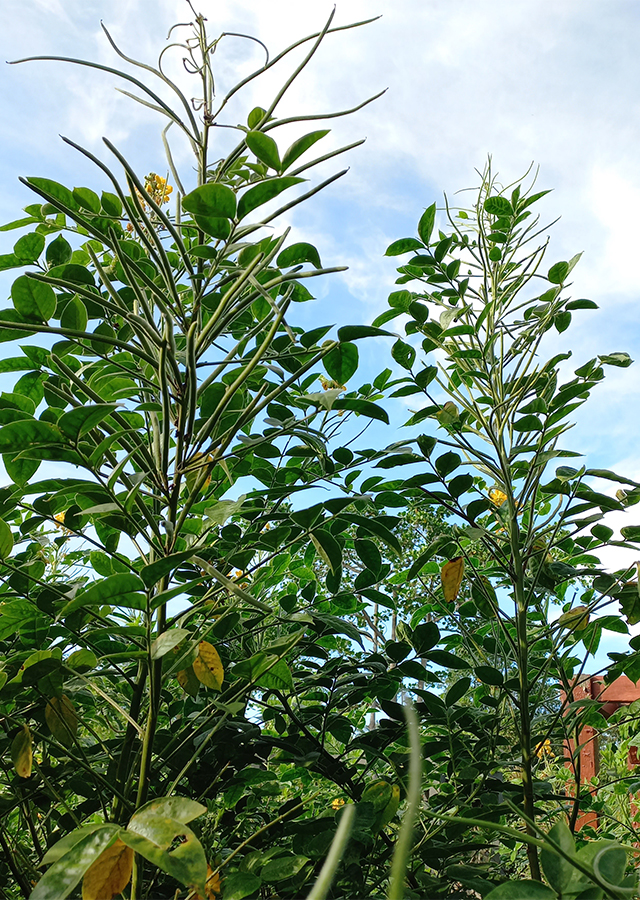
Shrubs. A fast-growing, erect or diffuse, simple or several-stemmed herb with a foetid aroma, growing up to 2,5 m tall and becoming somewhat woody with age.
Part Used
 Leaves
 Seeds
Seeds Roots
Roots
Growing Requirements
 Full Sunshine
Habitat
 Riverbanks
 Forest
 Coastal
 Roadside
 Grassland
 Terrestrial
Overview
S. hirsuta is a native of tropical America and is now distributed throughout Malesia, Indo-China, Thailand and most other countries in the Asian and African tropics. In Java, where it has long been known and has naturalized, it is more common in West Java than towards the east. The plant is gathered from the wild for local use as a food and medicine. It is also sometimes cultivated as a green manure crop.
Vernacular Names
Sinteng (Malay), Balbala tuñgan (Philippines), Phong pheng (Thai), Muồng rừng (Vietnamese)
Agroecology
The plant has often escaped from cultivation and become a weed in SE Asia and the Pacific. Succeeds in subtropical to tropical regions at elevations up to about 700 m. Prefers a sunny position. It grows spontaneously in waste locations, along roadsides, railway embankments, dry ditches, and in secondary forest. It is found in gardens and fields as a weed and prefers open locations.
Morphology
- Stems - erect or diffuse, simple, up to 2.5 m tall, becoming soft-woody with age, with a fetid smell, hairy but highly diverse in pubescence; twigs grooved and ribbed, densely hairy.
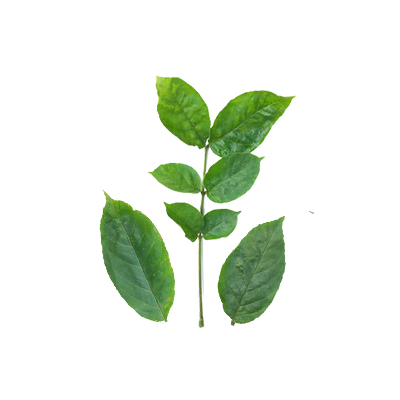
- Leaves - simply paripinnate, 10-20 cm long; stipules linear-acute, 3-15 mm long, usually not persisting; petiole stout, up to 6.5 cm long, villose, above the insertion with a sessile, oblong gland; rachis 3-16 cm long, glandless; petiolules up to 3.5 mm long, slender, villose, often not quite opposite; leaflets 2-8 pairs, strongly accrescent distally, chartaceous, lanceolate-acuminate, 2-12.5 cm × 1-5 cm, 2-6 times as long as wide, slightly unequal-sided, base acute or rounded, dark green, roughly villose on both surfaces.
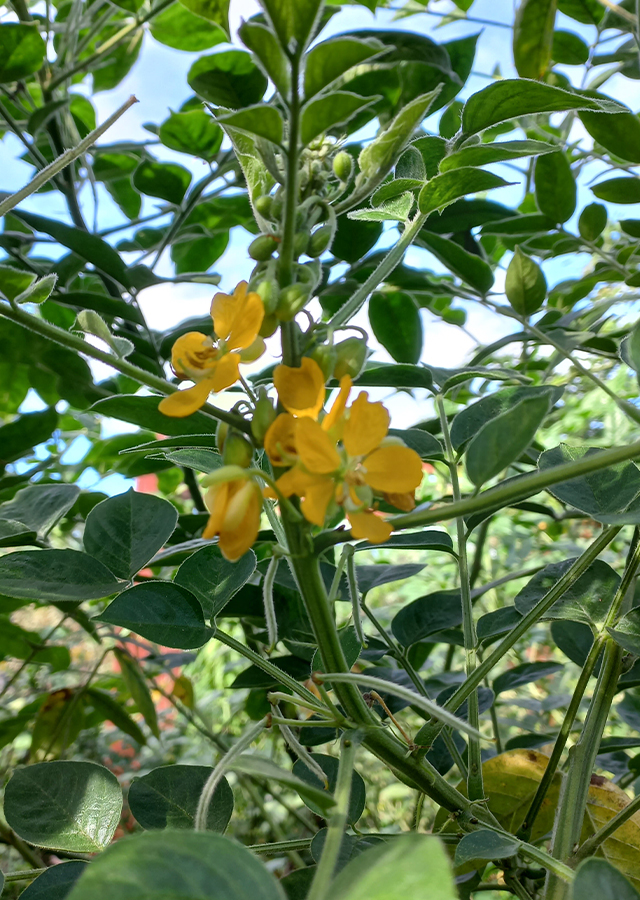
- Flowers - pedicel 1-2,5 cm long, pubescent; sepals 5, unequal, 2 outer ones small, orbicular, 4-7 mm long, hairy, 3 inner ones larger, 7-10 mm long, partly glabrous; petals 5, unequal, obovate, 8-28 m long, yellow, glabrous, short-clawed; stamens 10, 2 large with flat filaments 4-7 mm long and curved anthers 7-8 mm long opening by apical pores, 4 smaller and 4 staminodial; ovary woolly, recurved; style short, glabrous with hairy subapical stigma.
- Fruits - falcate to straight angular pod, 6-28 cm × 3-7 mm, septate, 50-90-seeded, strigose.
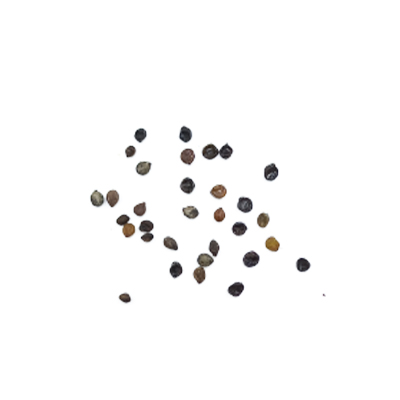
- Seeds - slightly compressed, orbicular, about 3 mm in diameter, dark olive coloured; areole narrowly elliptical, 0.5-2,5 mm long.
Cultivation
Propagated by seeds - requires pre-treatment to soften the hard seedcoat and allow the ingress of water. This can be done by soaking the seed in a small amount of nearly boiling water (which cools down quickly and does not cook the seed) and then soaking the seed for 12 - 24 hours in warm water. Alternatively, a small area of the seed coat can be abraded, being careful not to damage the embryo.
Chemical Constituents
Phenolic, flavonoid compounds, phytotoxins, tannins, chrysarobin, bi-anthraquinone, a tri-terpenoids, amino acids, steroids, glycosides, alkaloids, saponins.
Traditional Medicinal Uses
- The leaves are used medicinally for treating kidney disorders and herpes. An infusion is an effective remedy for renal calculi.
- An infusion of the leaves is applied externally to treat skin disorders and cracked nipples.
- The root is tonic. A tincture of the root is rubbed onto rheumatic areas.
- The leaf contains derived anthracenes. The seed contains a bi-anthraquinone and a tri-terpenoid, which may prove medicinally important.
Part Used

Reference Sources
- Fern, Ken. Useful Tropical Plants. (2021). Senna hirsuta. http://tropical.theferns.info/viewtropical.php?id=Senna+hirsuta. 13-10-21.
- Plant Resources of South East Asia. Senna hirsuta. https://uses.plantnet-project.org/en/Senna_hirsuta_(PROSEA). 13-10-21.