
Caribbean Lily
Xiphidium caeruleum Aubl.
Haemodoraceae
Location in our garden
Principal
Synonym
Ornithogalum rubrum Ruiz & Pav. ex D.Don
Xiphidium albidum Lam.
Xiphidium album Willd.
Habitus

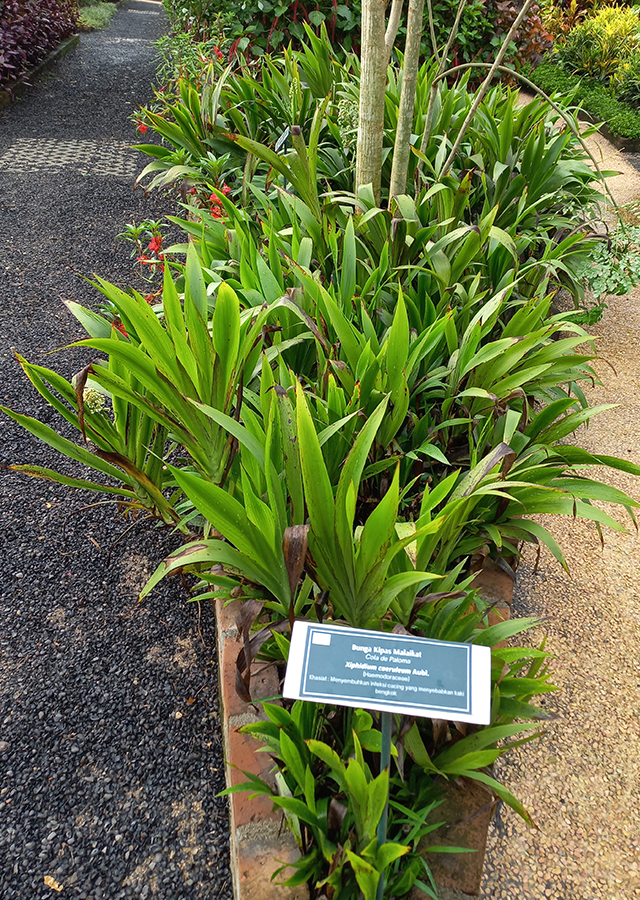
Herbaceous. An evergreen perennial herbaceous growing 0.3-1 m tall.
Part Used
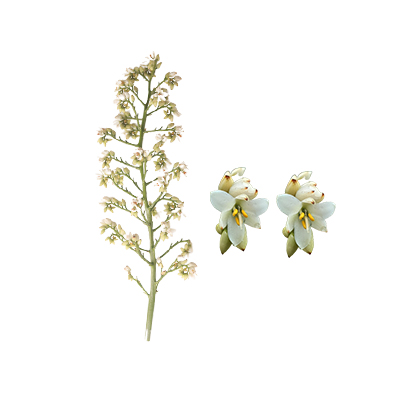
 Flowers
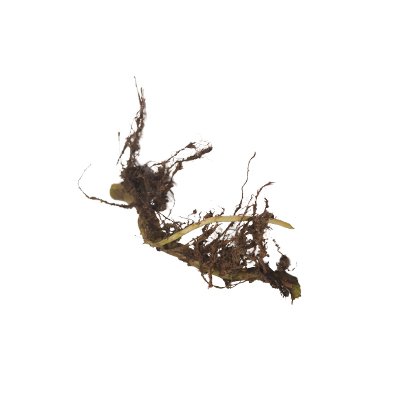
 Roots
Roots
Growing Requirements
 Full Sunshine
 Need Shade
Habitat
 Riverbanks
 Forest
 Roadside
 Terrestrial
Overview
The native range of this herb is Central Mexico to Tropical America. Xiphidium caeruleum is cultivated in several neotropical countries as an ornamental. It also has a certain utilization in the traditional medicine of the origin countries for various pathologies.
Vernacular Names
Ebesere-bina (Surinamese), Poderosa (Spanish).
Agroecology
Found in the underwood of the humid forets, at the margins ofthe footpaths and of waterstreams, from the sea level up to about 1.400 m of altitude. Grows best at the temperature of 24 - 26 °C. Preferably in position from slightly shaded to shaded, on draining soils, rich of organic substance, maintained constantly humid, even if it is able to bear short drought periods.
Morphology
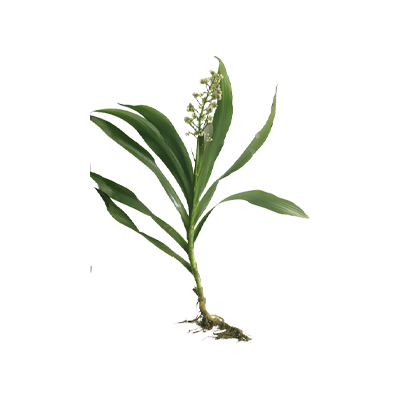
- Roots - fibrous, stolons 5-55 cm long, rooting at the nodes, each node with a membranous, brownish, ovate bract, basally sheathing, apex acuminate, 8-10(-22) mm long.
- Rhizome - cylindrical, 4-20 cm long and about 1 cm of diameter, white to brownish red inside, horizontal, creeping.
- Stem - semi-erect, 10-30 cm long, compressed.
- Leaves - alternate simple, distichous, linear with pointed apex, margin finely toothed towards the apex and bases wrapping the stem, 20-60 cm long and 1.5-6 cm broad, streaked of intense green colour and glossy.
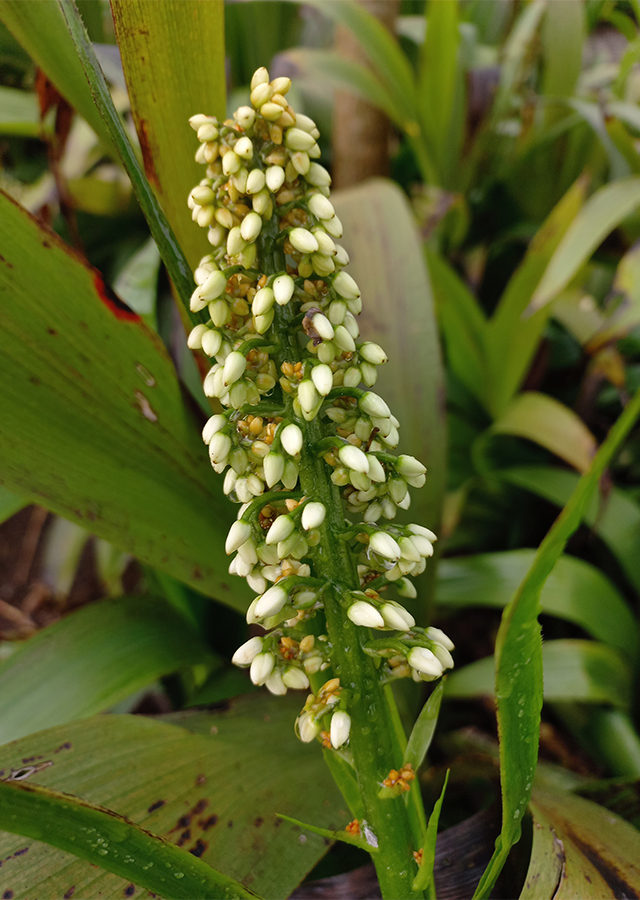
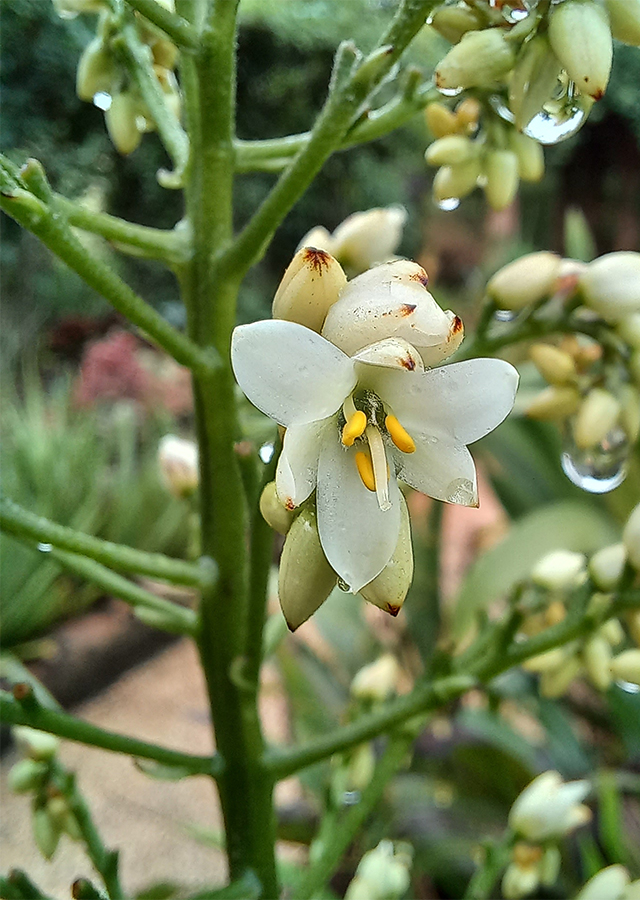
- Flower - erect terminal panicle inflorescences, 8-40 cm of diameter, with 6 ovate tepals, 3 external, 4-10 mm long and 1-4 mm broad, and 3 internal slightly smaller, 3 stamina and globose superior ovary.
- Fruits - globose trilocular dehiscent capsules, 5-10 mm of diameter, initially green, then red-orange and finally black, containing several seeds.
- Seeds - black, subglobose, tuberculate, 0.5-1 mm in diameter.
Cultivation
It reproduces by seed (generative propagation), and by rhizome division (vegetative propagation).
Chemical Constituents
Phenylphenalenones, phenylbenzoisoquinolindiones alkaloids, phenylbenzoisochromenones, and flavonoids.
Traditional Medicinal Uses
- In Guyana the plant is used to cure the worm infection which gives a curved foot.
- In Suriname the plant is a remedy (bina) against torn foot soles.
Part Used
Reference Sources
- Chen, Yu, et al. (2016). Phenylbenzoisoquinolindione alkaloids accumulate in stamens of Xiphidium caeruleum Aubl. flowers. Journal Phytochemistry, Vol.128 (pp 95-101). https://www.sciencedirect.com/science/article/abs/pii/S0031942216300917. 10-11-2021.
- Chen, Yu, et al. (2017). Cultured roots of Xiphidium caeruleum: Phenylphenalenones and their biosynthetic and extractant-dependent conversion. Journal Phytochemistry, Vol.133 (pp 15-25). DOI: 10.1016/j.phytochem.2016.10.011
- Flora of Guianas. (No date). Xiphidium caeruleum. http://portal.cybertaxonomy.org/flora-guianas/cdm_dataportal/taxon/de25a574-8447-4092-8b4c-00f47d061b6a. 09-11-2021.
- Monaco Nature Encyclopedia. (2003). Xiphidium caeruleum. https://www.monaconatureencyclopedia.com/xiphidium-caeruleum-2/?lang=en. 09-11-2021.
- National Parks of Singapore. (2021). Flora & Fauna Web: Xiphidium caeruleum Aubl. https://www.nparks.gov.sg/florafaunaweb/flora/2/5/2563. 09-11-2021.
- Royal Botanical Garden. (2017). Plants of the World Online: Xiphidium caeruleum Aubl. http://powo.science.kew.org/taxon/304977-2. 09-11-2021. 09-11-2021.