
Christmas Candlestick
Leonotis nepetifolia (L.) R.Br.
Lamiaceae
Location in our garden
Principal

Synonym
Leonurus globosus Moench
Leonurus nepetifolius (L.) Mill.
Phlomis nepetifolia L.
Habitus

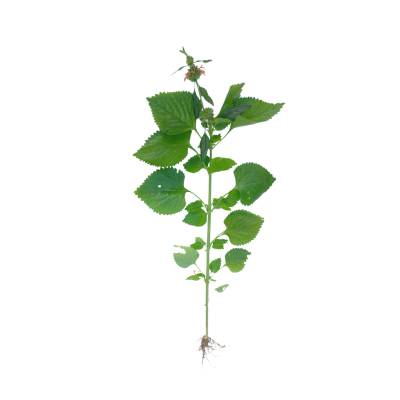
Herbaceous. An annual or short-lived perennial plant growing from 1 - 3 m tall
Part Used
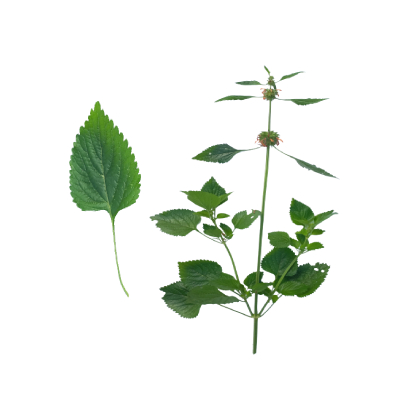
 Leaves
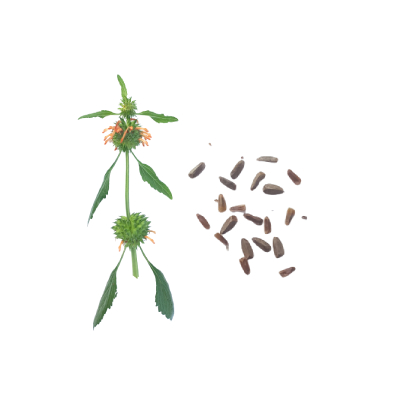
 Seeds
Seeds Flowers
 Roots
Roots The Whole Plant
Growing Requirements
 Full Sunshine
Habitat
 Riverbanks
 Roadside
 Grassland
 Terrestrial
Overview
Leonotis nepetifolia is indigenous to tropical and subtropical East Africa, as are the 30 other species in the genus. It is widely established across the tropics in Africa, South-east Asia, the Pacific islands, Australia, Central and South America, the southern USA, Mexico and the Caribbean islands. The plant is often gathered from the wild for local use as a food and medicine. It is cultivated as a medicinal plant in India, Malaysia, on the Antilles, in Brazil and Africa, and is commonly grown as an ornamental.
Vernacular Names
Botón de cadete (Spanish), Grasse mulatre (French), Zungzu (Chinese), Cordão (Portuguese), Cordão-de-frade (Brazil), Katzenminzblättriges Löwenohr (German), Bara guma (India), Chat phra in (Thai), Sư nhĩ (Vietnamese).
Agroecology
A pantropical weed, often found at roadsides and in abandoned cultivations at altitudes of up to 2,000 m. The plant forms dense thickets and is most abundant on heavily disturbed areas such as roadsides, overgrazed pastures and river levee banks. It has the potential to develop into large colonies that displace native species, particularly along riverbanks and flood plains where the spiky nature of the seed heads reduces accessibility.
Morphology
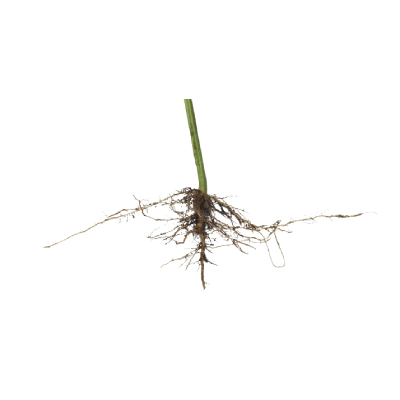
- Roots - taproot
- Stems - deeply furrowed, finely pubescent.
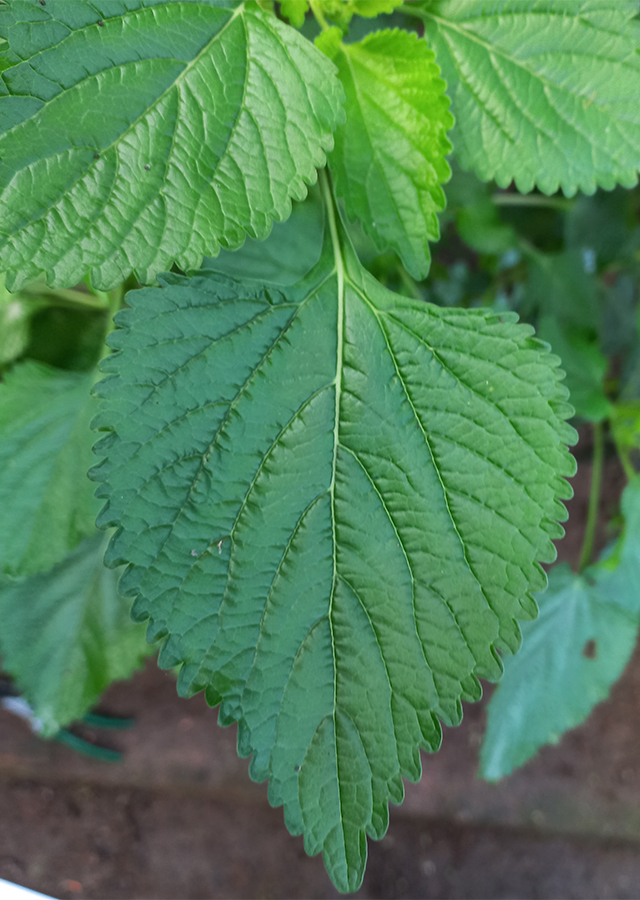
- Leaves - decussately opposite, oblong-ovate to ovate, 4.5-6(-12) cm × 3-5(-9.5) cm, rounded to truncate at base, acute to acuminate at apex, coarsely crenate-serrate, finely pubescent on both surfaces; petiole 2-7.5 cm long; stipules absent.
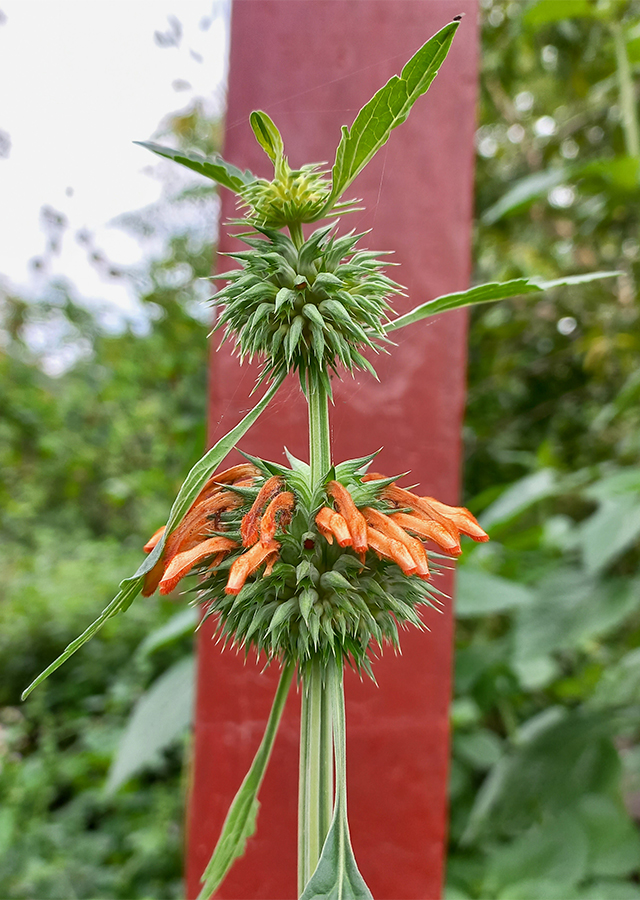
- Flowers - bisexual, zygomorphic; calyx funnel-shaped, 1.2-1.5 cm long, enlarging in fruit up to 2 cm, 8-10-toothed with unequal teeth, 8-10-veined, with long white hairs above; corolla 2-2.5 cm long, tube with 3 rings of hairs inside, 2-lipped, upper lip arched, concave, outside densely hairy, lower lip 3-lobed, orange; stamens 4, inserted on the corolla tube, didynamous, ascending under upper corolla lip; ovary superior, 4-celled, style subulate, gynobasic, upper stigmatic segment reduced to a tiny tooth.
- Fruits - consisting of 4 nutlets 2.5-3 mm long, oblong or obovoid, glabrous, dull black, enclosed in the persistent calyx.
Cultivation
Propagated by seeds - the optimal temperature for germination is at a temperature of 28-32 °C and 40-60% soil moisture for seeds aged 6 months.
Chemical Constituents
Essential oil (β-caryophyllene, -humulene, germacrene D, caryophyllene oxide, octene, (Z)-β-ocimene, -copaene, linoleic acid, oleic acid), resinic acid, diterpene labdane (nepetaefolin), antioxidative phenylethanoid glycosides acteoside, martynoside, lavandulifolioside, coumarin 6-methoxysiderin, 4,6,7-trimethoxy-5-methylchrome-2-one, iridoid glycosides, and laballenic acid.
Traditional Medicinal Uses
- The plant is used against swellings, fever, gastro-intestinal troubles and as an abortifacient.
- A decoction of the whole plant is employed to clean out the uterus; treat diarrhoea and heavy cramps; as a diuretic; and as a tonic to strengthen the back. It is used in a decoction with Heliotropium indicum o treat bed-wetting.
- The whole plant is boiled with Hyptis pectinata, Mikania micrantha and Momordica charantia and used as a wash for piles.
- The leaves and flowers are cholagogue. An infusion is used as an antidysenteric; decocted with salt or sugar in a preparation to dissolve renal calculi.
- The leaf juice is used in the treatment of thrush. In a plaster for wounds. Cooked in an infusion which is drunk to treat itches and skin diseases; for yaws.
- An ethanolic extract of the plant showed antitumor and possibly antimicrobial activity.
- In Rwanda, the leaves of this plant are used to treat pneumonia, anthrax and syphilis.
Part Used
Reference Sources
- Cabi. Leonotis nepetifolia. https://www.cabi.org/isc/datasheet/110266. 09-11-21
- Fern, Ken. Useful Tropical Plants. (2021). Leonotis nepetifolia. https://tropical.theferns.info/viewtropical.php?id=Leonotis+nepetifolia. 09-11-21
- Plant Resources of South East Asia. Leonotis nepetifolia. https://uses.plantnet-project.org/en/Leonotis_nepetifolia_(PROSEA). 09-11-21