
Jelly Ear
Auricularia auricula-judae (Bull.) Quél.
Auriculariaceae
Location in our garden
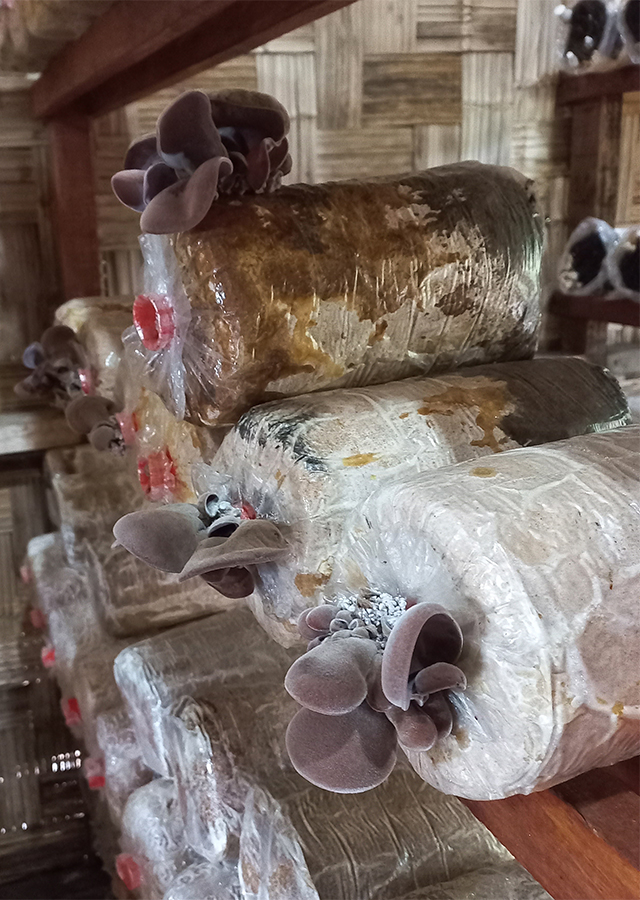
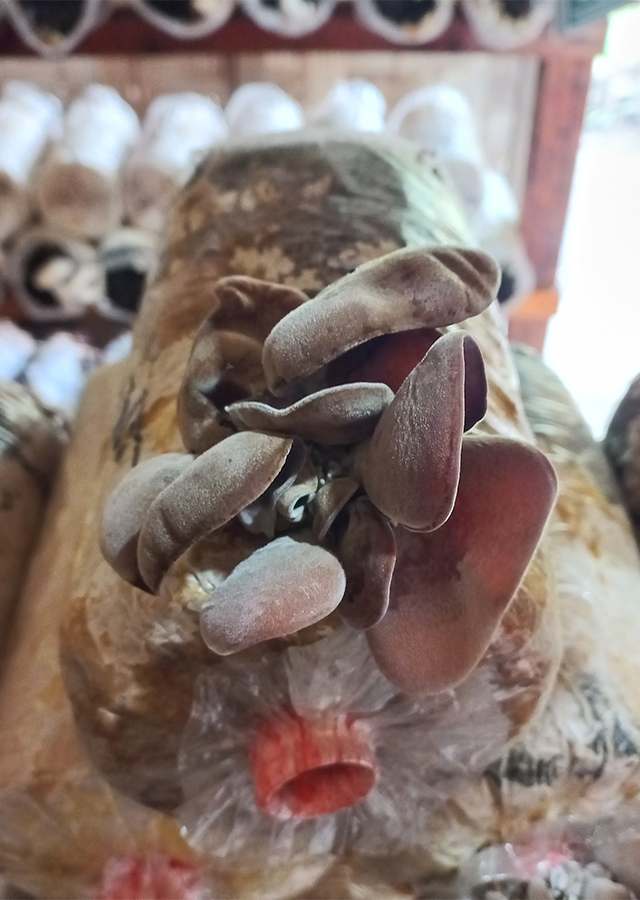
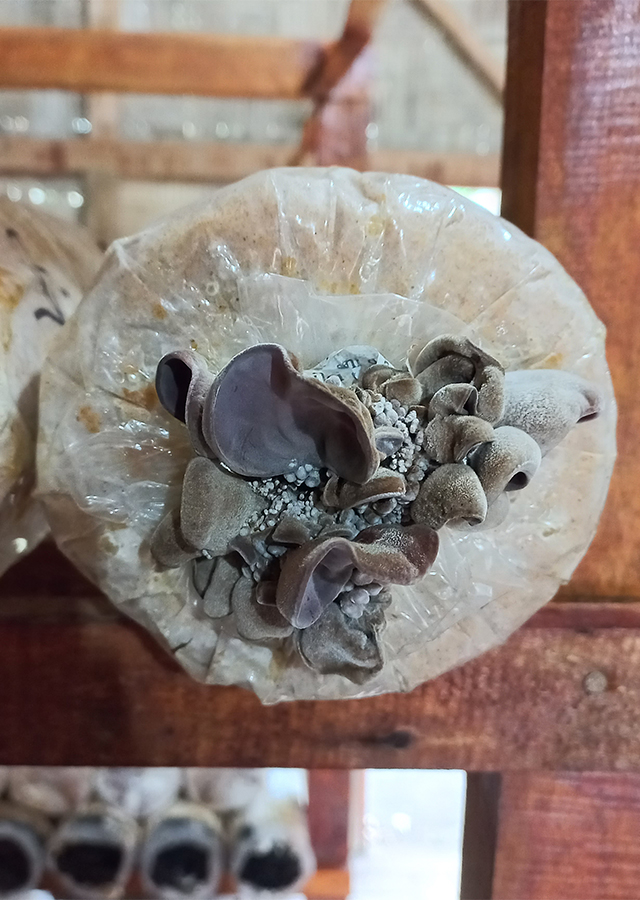
Mushroom House
Synonym
Auricularia americana Parmasto & I.Parmasto ex Audet
Auricularia auricula-judae Schrot.
Auricularia cornea Ehrenb.
Habitus

Herbaceous. Jelly ear is a saprophytic fungus. Individual lobes can grow to between 3 and 10 cm across.
Part Used
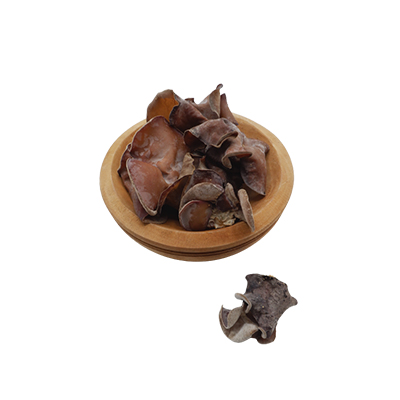
 Fruit
Fruit
Growing Requirements
 Need Shade
Habitat
 Forest
Overview
Jelly ear is native to Asia and some Pacific islands with humid climates. It is edible and often used in Asian cooking. The mushroom can be found throughout the year in temperate regions worldwide, where it grows upon both dead and living wood. The popularity of this mushroom dates back centuries especially in China were it is extremely popular, that has been a part of traditional Chinese medicine. It was used medicinally until at least the 1860s, and it was thought that fungi that looked like body parts could be used to treat that body part. It was therefore used to treat eye conditions (as eyes are gelatinous like the fungus) and throat problems (as jelly ear’s structure was considered similar to the throat’s). Herbalist John Gerard recommended a remedy for sore throats made by boiling jelly ear in milk.
Vernacular Names
Hei Mu-erh (Chinese), Ucho jidasovo (Czech), Juudaksenkorva (Finnish), Orecchio di Giuda (Italian), Uszag bzowy (Polish), Judinyl usi (Russian), Oreja de Judas (Spanish), Kikurage (Japanese).
Agroecology
Growing in tree stumps in damp moist forests. Plant is formed by multi-celled hyphae extracting nutrients from decaying tree trunks or logged timber. It is usually found in clusters, drooping from dead and dying branches, mainly of elder but sometimes on other types of hardwood, particularly beech, sycamore and ash. It likes damp, and shady conditions.
Morphology
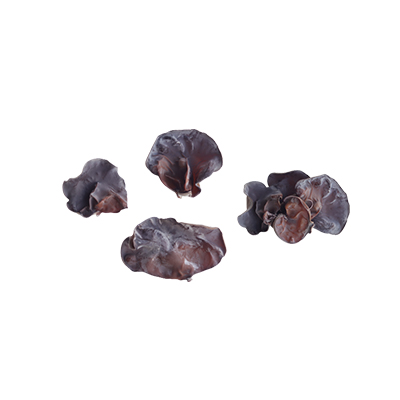
- Fruitbody/bracket - at first cup-shaped, developing lobes that make them look uncannily like human ears. Tan-brown and velvety on the outside, with a wrinkled, shiny smooth inner surface. When it gets older, the color tends to be more black. Individual lobes can grow to between 3 and 10 cm across. Rubbery, gelatinous flesh.
- Gills/spores - spores are sausage-shaped with a white spore print.
Cultivation
Vegetative propagation - grow on hardwood sawdust blocks, but fruit it at a warmer temperature of 25-30 °C. Sawdust is mixed with wheat bran (or another nitrogen source) at 5-15% and Calcium Carbonate (CaCO3) (a buffering agent) at 2-3%, and filled into autoclavable bags. The bags are sterilized for a minimum of 1 hour at 121 °C. Note sterilization exposure times vary depending on pressure and elevation. Finally, the substrate is cooled to at least 25 °C then, inoculated with grain or liquid spawn and incubated at appropriate temperature for the species until colonization is complete.
Chemical Constituents
Polysaccharides (glucose, mannose, xylose, fructose), essential amino acids, and polyphenols.
Traditional Medicinal Uses
- In Chinese traditional medicine, it is used for weakness after childbirth, cramps, numbness, dysentery, piles, enteritis, heavy menstrual bleeding, and leucorrhea. Being infused in some proper water, it is good in diseases of the eyes.It is also beneficial to people suffering from dryness, such as a dry throat, cough or mouth.
- In Ghana, used as blood tonic.
- Lower cholesterol and blood sugar
- It has a cooling effect on the blood, promoting circulation and treating bruises, which may be why it is used to treat hemorrhoids.
- Studies had showed anti-viral and anti-tumor, anticoagulant, antibacterial, antiparasitic, and antioxidant properties.
- It is considered an immune system stimulant.
Part Used
Reference Sources
- Bioweb. (2011). Auricularia auricula-judae. http://bioweb.uwlax.edu/bio203/2011/gaona_ruth/index.htm. 02-10-2021.
- First Nature. (2021). Auricularia auricula-judae (Bull.) Wettst. - Jelly Ear Fungus. https://www.first-nature.com/fungi/auricularia-auricula-judae.php. 02-10-2021.
- I Cool PDF. (2021). AURICULARIA AURICULA-JUDAE PDF. https://icooolps.info/auricularia-auricula-judae-85/. 02-10-2021.
- MIGU Adaptogen Bio-tech Co., Ltd. (2021). MIGU Botanical Extract: Auricularia Auricula Extract. http://www.fungus-extract.com/product-detail/auricularia-auricula-extract/. 02-10-2021.
- Mushroom Nutrition. (2013). AURICULARIA AURICULA. https://www.mushroomnutrition.com/auricularia-auricula. 02-10-2021.
- Stuart Xchange. (2017). Philippine Medicinal Plants: Taingan-daga (Auricularia auricula-judae Schrot.). http://www.stuartxchange.org/Taingan-daga.html. 02-10-2021.
- Woodland Trust. (2021). Jelly ear. https://www.woodlandtrust.org.uk/trees-woods-and-wildlife/fungi-and-lichens/jelly-ear/. 02-10-2021.