
Bayur Tree
Pterospermum javanicum Jungh.
Malvaceae
Location in our garden
Hardwood


Synonym
Pterospermum subinaequale Miq.
Habitus

Trees. An emergent tree of the rainforest, growing up to 59 m tall
Part Used
 Bark
Bark Flowers
 Roots
Roots Stem
Stem
Growing Requirements
 Full Sunshine
 Need Shade
Habitat
 Forest
 Terrestrial
Overview
The species is native to Bhutan, Borneo, Cambodia, India, Java, Laos, Lesser Sunda Islands, Moluccas, Myanmar, New Guinea, Peninsular Malaysia, Singapore, Sumatra, Thailand and Vietnam. It has a certain economic importance for the wood, commercially known and exported with the name of "bayur", of good quality, average hardness and density, easy to work and to refine, utilized locally in the construction of the dwellings, for beams, floors, fixtures and coatings, of boats, bridges, furniture, art objects, in the veener (technique consisting in covering a low-quality wood with thin wood sheets) and in the fabrication of the plywood. Bayur was used by the Sasak community around Gunung Rinjani National Park West Lombok for various purposes, such as traditional medicines, beverages, rigging, and building material.
Vernacular Names
Bayur (Borneo), Wadang (Java), Bolang (Bali), Letop letop (Malay), nwa-labyin (Myanmar), Bayok (Philippines).
Agroecology
Grows and spreads mainly in lowland forests. This plant is also spread in secondary forest at an altitude of 600-1,400 m above sea level. Usually Pterospermum javanicum is found growing on ridges, river banks as well as on limestone soils (limestone). Prefers open area with full sun. Thrives on moist soil conditions that are neither waterlogged nor dry, with wet to dry climates.
Morphology
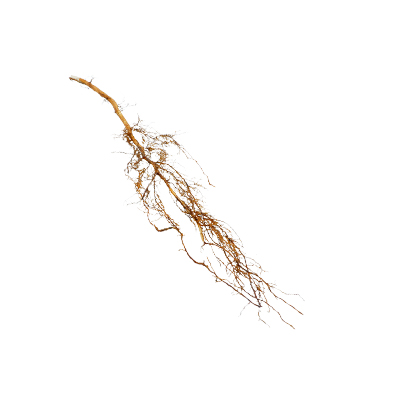
- Roots - taproot.
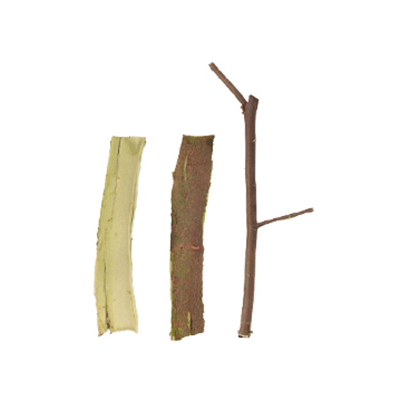
- Trunks - erect, about 1 m in diameter, brown-greyish bark.
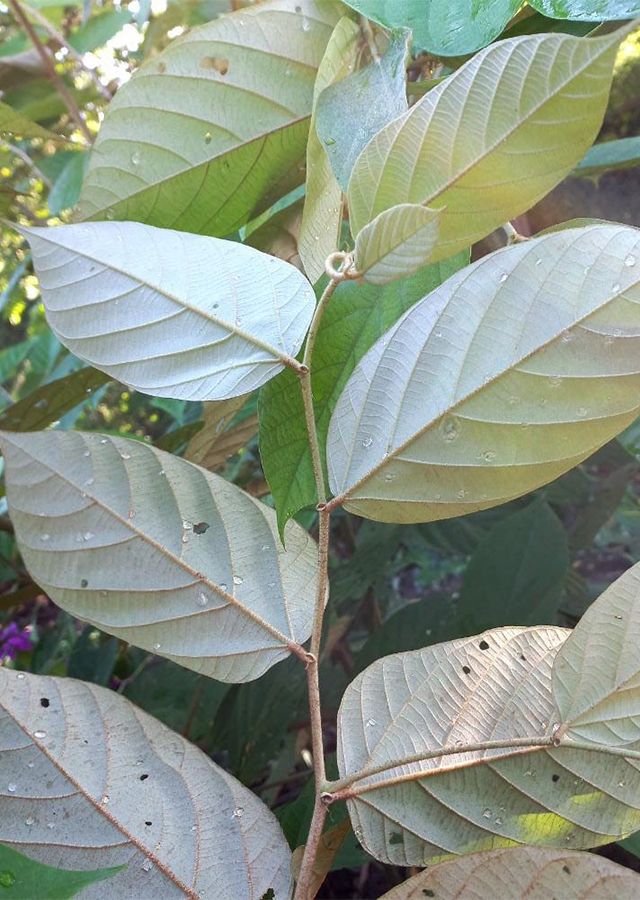
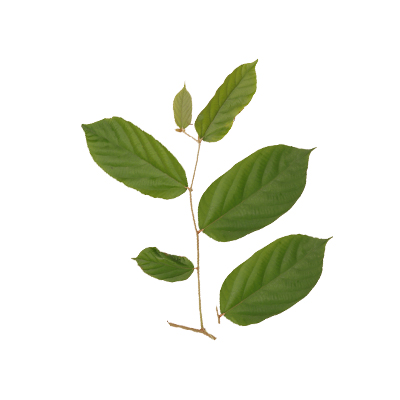
- Leaves - asymmetrical and unequal at the base. Leaves are almost glabrous and glossy on the upper side and densely hairy on the underside. Stipules are present and petiole is densely tomentose.
- Flowers - White large showy flowers on velvety peduncle, occurring at the axils of the leaves. Pedicel is short, roughly about the length of the petioles and rarely longer.
- Fruits - occur as capsule.
Cultivation
Propagated by seeds.
Chemical Constituents
Lupeyl acetate, p-n-amylphenol, lauric acid, n-(methyl-d2)-aniline, pentanal, stigmast-4-en-3-one, -sitosterol, 4,22-cholestadien-3-one.
Traditional Medicinal Uses
- The bark is used in the traditional medicine of the local population for various pathologies.
- The plant is used as cure for dysentry, toothache and Pterospermum acerifolium fer itchy drug.
Part Used
Reference Sources
- Flora & Fauna Web. Pterospermum javanicum. (2019). https://www.nparks.gov.sg/florafaunaweb/flora/4/6/4621. 05-11-21
- Fern, Ken. Useful Tropical Plants. (2014). Pterospermum javanicum. https://tropical.theferns.info/viewtropical.php?id=Pterospermum+javanicum. 05-11-21
- Monaco Nature Encyclopedia. Pterospermum javanicum. https://www.monaconatureencyclopedia.com/pterospermum-javanicum-2/?lang=en. 05-11-21