
Lark Daisy
Centratherum punctatum Cass.
Asteraceae
Location in our garden
Principal
Synonym
Ampherephis aristata Kunth
Baccharoides holtonii (Baker) Kuntze
Centratherum aristatum (Kunth) Cass.
Habitus

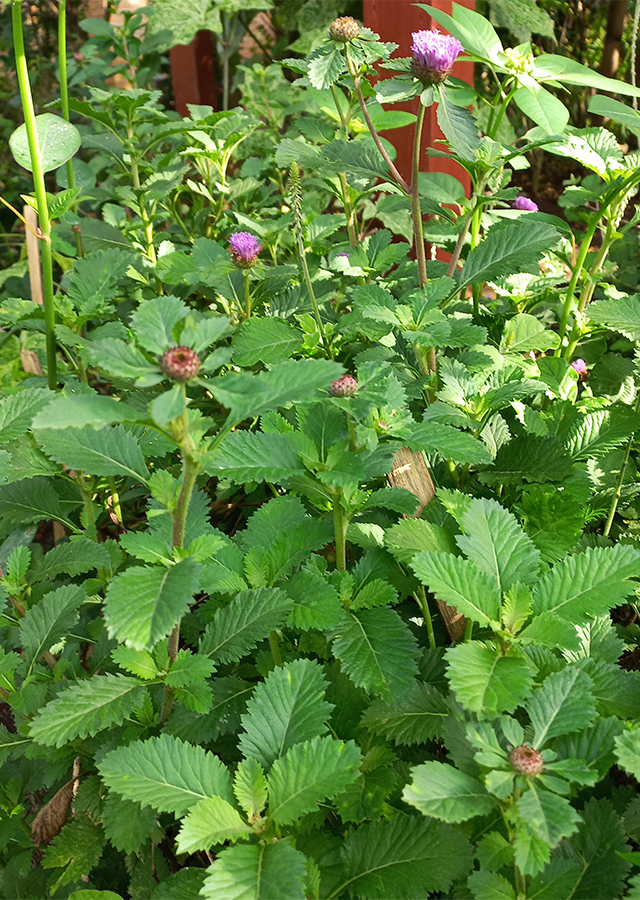
Herbaceous. Small herbaceous plant with branched growth habit, grows up to 70 cm tall.
Part Used
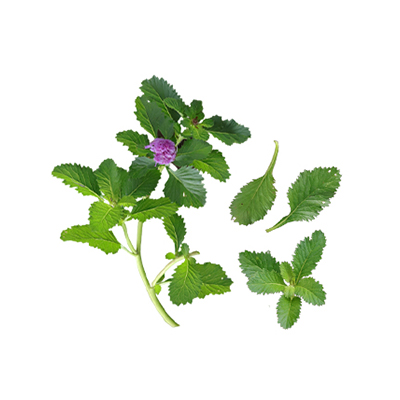
 Leaves
 Flowers
Growing Requirements
 Full Sunshine
 Drought Resistant
Habitat
 Forest
 Roadside
 Shrublands
 Terrestrial
Overview
Centratherum punctatum is thought to have come from South America, Central America, and the West Indies. The species became naturalized in Asia, Africa, Australia, Madeira, the Canary Islands, and the Pacific Islands. This plant is a weed that is generally grown as an ornamental plant, because it has a unique shape and beautiful color.
Vernacular Names
Alcanfor (Spanish), Perpetua-do-mato (Portuguese), Brazilian button flower (Australia).
Agroecology
C. punctatum grows mostly in tropical areas from sea level up to 1,200 m asl. It behaves as a weed both outside and inside its native distribution range, where can be very common in disturbed areas, forest edges, and along roadsides. Prefers full sun and moderate amount of water.
Morphology
- Stems - erect and pubescent, single- and multi- stemmed.
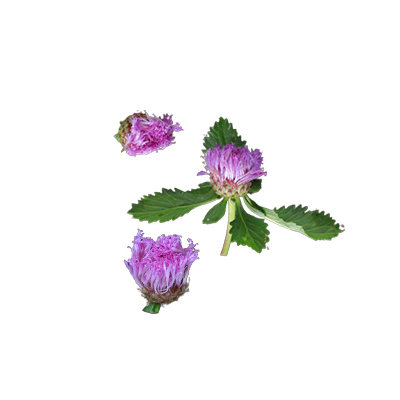
- Leaves - lanceolate to ovate or obovate, acute at the apex, cuneate at the base, margins with entire or with 4-6 pairs of teeth, 1.5-5(-6) cm long, 0.5-4 cm broad, glandular punctate and villosulous on both surfaces, lateral veins ascending, 3-6 pairs, inconspicuous.
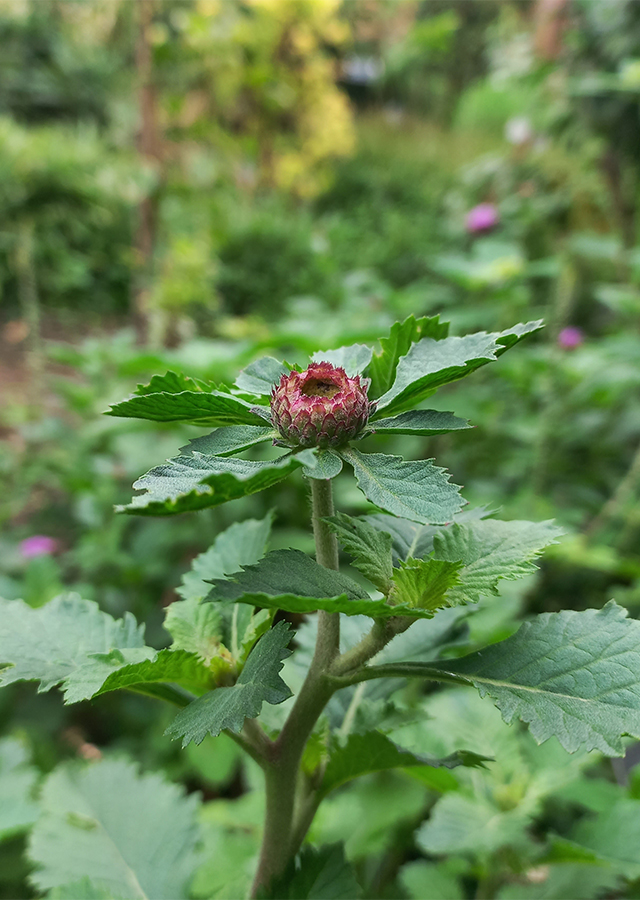
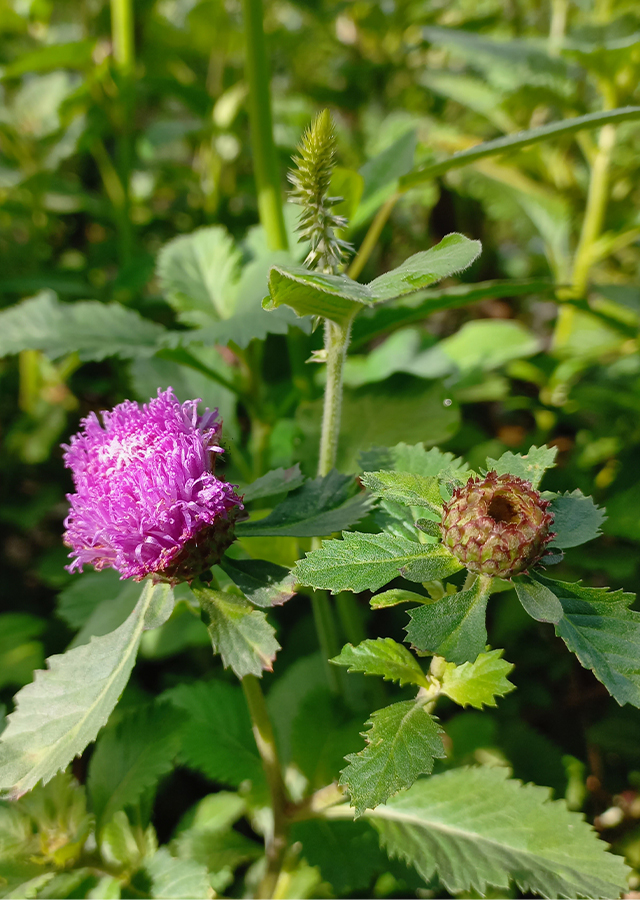
- Flowers - sessile, solitary, terminating the branches. Heads discoid with many florets; involucre broadly hemispherical, the outer involucral bracts 6-15, foliaceous, curved and spreading, the inner involucral bracts scariose, 4-6-seriate, narrowly deltoid, apically acute to obtuse, spinescent, awns 1-4 mm long, awns and involucral bracts ciliolate; receptacle flat, alveolate, naked; corolla tube narrowly cylindric, expanding slightly at the apex, purple, 5-7 mm long, 5-lobed, the lobes linear to lanceolate, 1-2 mm long; stamens 5, the anthers 1-1.5 mm long, apically acute, obtusely sagittate at base; styles 6-7 mm long, bilobed, the lobes puberulous, 1-2 mm long, acute.
- Fruits - narrowly turbinate, weakly ribbed, 1-2 mm long; pappus of deciduous filiform scales 1-2 mm long, antrorsely puberulent.
Cultivation
Propagated by seeds.
Chemical Constituents
Kaempferol-3-glucuronide, chlorogenic acid, kaempferide, isorhamnetin-3-0-rutinoside, farnesol, cyanidin-3,5-di-0-glucoside, biochanin-1, 5-Hydroxy-4'-methoxy-7-methylflavones, ergocornine, kaempferol, ferritidine, 3,4-dicaffeoylquinic acid, 7-0-methylwogonin, asiaticoside, qingyangshengenin, germacranolide derivatives, essential oils consisting of sesquiterpene hydrocarbons (β-caryophyllene, cyclosativene, α-copaene, trans-α-bergamotene, (Z)-β-farnesene, α-humulene, germacrene D, bicyclogermacrene, and δ-cadinene), oxygenated sesquiterpenes (spathulenol, viridiflorol, caryophyllene oxide, globulol, sesquisabinene, β-selinene, β-eudesmol, bicyclogermacrene, elemol), and 1,8-cineole.
Traditional Medicinal Uses
- The plant has been traditionally used as a curative against diverse disorders like inflammation, tumor, depression, and hypertension.
- Considered to have antibacterial, antifungal and antioxidant properties. They are used in treating wounds, in hair and skin care preparations, as a pain killer and also as an antidote again snake bites.
Part Used
Reference Sources
- Cabi. Centratherum punctatum. https://www.cabi.org/isc/datasheet/14608. 10-11-21.
- Flora & Fauna Web. (2021). Centratherum punctatum. https://www.nparks.gov.sg/florafaunaweb/flora/1/7/1798. 10-11-21.
- PubMed. National Library of Medicine. (2017). Centratherum punctatum. https://pubmed.ncbi.nlm.nih.gov/26984043/. 10-11-21.
- Green Cover Initiative. Centratherum punctatum. https://greencoverinitiative.com/herbs/centratherum-punctatum-larkdaisy/. 10-11-21.