
Coleus
Coleus barbatus (Andrews) Benth. ex G.Don
Lamiaceae
Location in our garden
Principal
Synonym
Plectranthus barbatus Andrews
Habitus

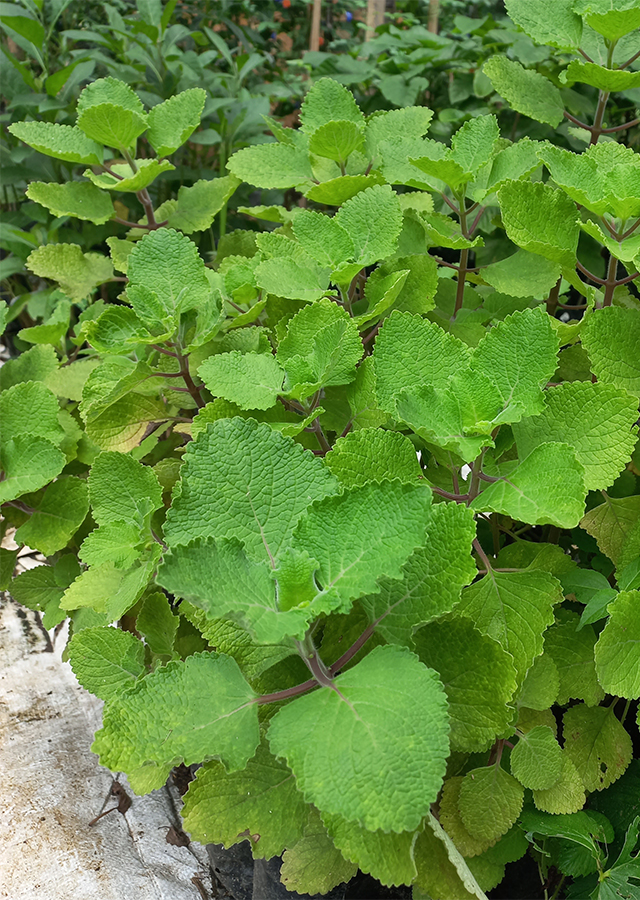
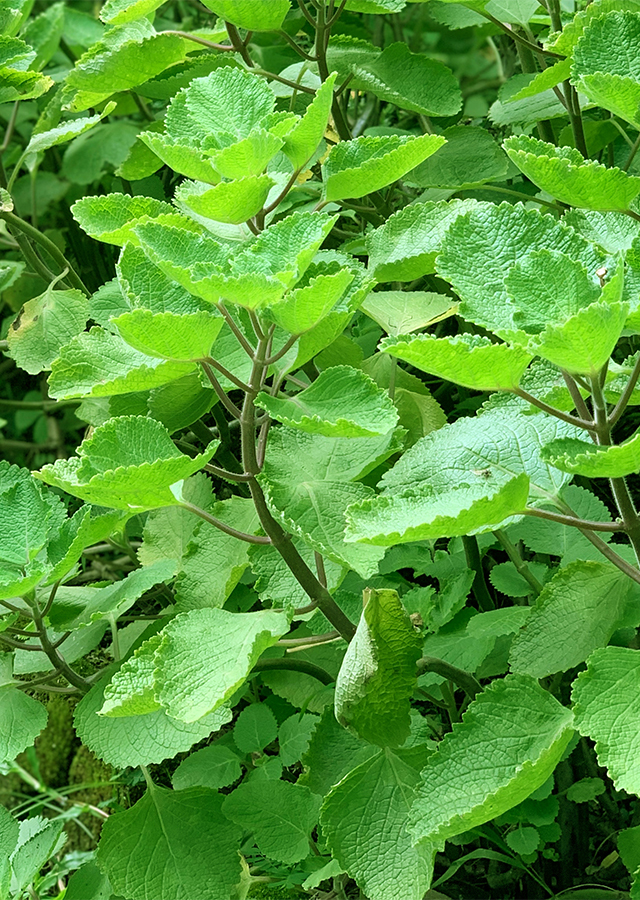
Herbaceous. An aromatic perennial semi-succulent herb up to 75 cm tall.
Part Used
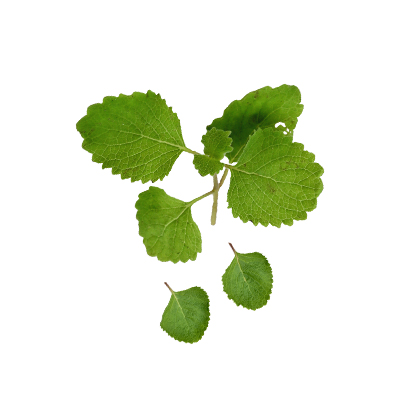
 Leaves
 Roots
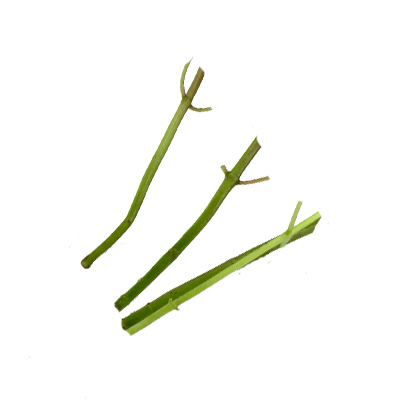
Roots Stem
Stem
Growing Requirements
 Full Sunshine
Habitat
 Riverbanks
 Roadside
Overview
This species is accepted, and its native range is Eritrea to Tanzania, Arabian Peninsula Indian Subcontinent to South Central China. The entire plant is aromatic (whether fresh or dried). The tuberous roots are eaten as a condiment in India, where they are prepared as a pickle.
Vernacular Names
No found data on this. Need further research.
Agroecology
P. barbatus occurs in open, semi-arid areas, on waste places and often on shallow, moist soil among rocks on slopes, up to 1,500 m altitude. It thrives best in porous and well-drained soils with a pH ranging from 5.5-7. It does not require very fertile soils and can be grown on soils with marginal fertility. The climate is humid with RH ranging from 83 to 95% and a temperature of 10-25 °C. The annual rainfall is 100-160 cm.
Morphology
- Roots are tuberous, fasiculated, Up to 20 cm long and 0.5-2.5 cm thick, they are conical, fusiform, straight, orangish and strongly aromatic.
- Decumbent stem rooting at lower nodes, square stems, branched, the nodes are often hairy.
- Leaves ovate-oblong, 3-9 cm × 2-5 cm, thick.
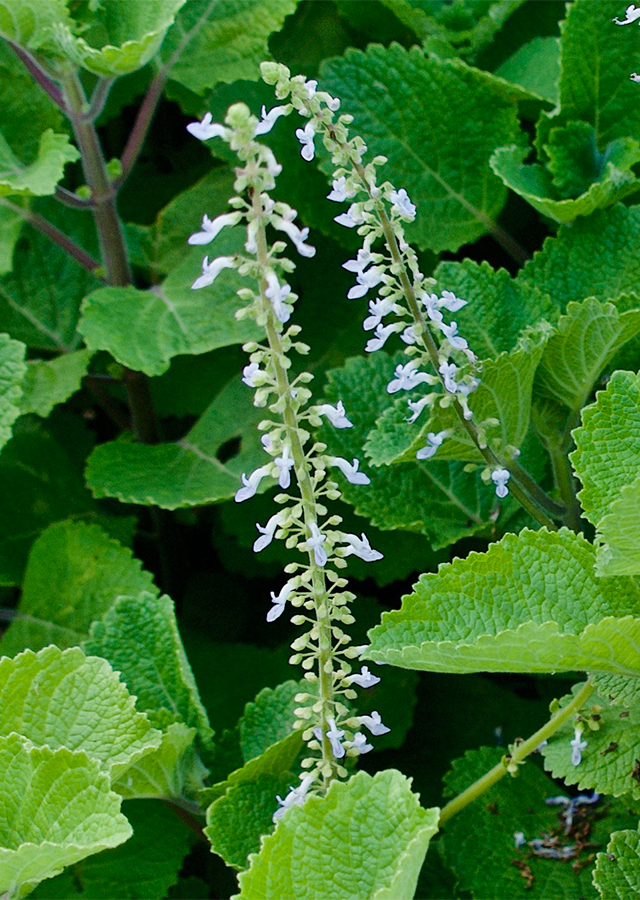
- Flowers in lax verticillasters disposed in terminal raceme-like inflorescences.Calyx 2-lipped, corolla 13-17 mm long, deep purplish-blue.
- Nutlets globose, about 1.2 mm long, granulate, blackish-brown.
Cultivation
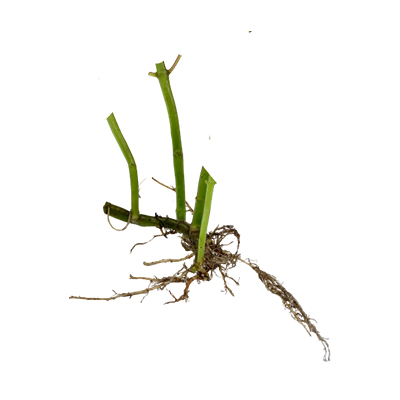
- The crop is vegetatively propagated through terminal cuttings (10 cm) or rooted cuttings.
- Planting is done during June-July, at 60 x 45 cm spacing (37,030 plants/ha). In low fertile soils, planting is done at 60 x 30 cm which requires 55, 500 plants/ha.
Chemical Constituents
- Roots: forskolin
- Leaves: (Z)-caryophyllene, germacrene D, and viridiflorol.
- Leaves ans stems: essential oils (eugenol, α-pinene, β-caryophyllene).
Traditional Medicinal Uses
- In traditional medicine in Brazil, P. barbatus is commonly used as an analgesic and to cure liver and stomach diseases.
- In India, it is considered to have anti-allergenic activity. In Ayurvedic medicine, it has been used to treat heart disease, convulsions, spasmodic pain and painful urination.
- In Egypt and Africa the leaves of C.barbatus are used as an expectorant, emmenagogue and diuretic while its foliage is employed in treating intestinal disorders.
- The essential oil had a significant toxic effect.
Part Used
Reference Sources
- Eagri. COLEUS. http://www.eagri.org/eagri50/HORT282/pdf/lec35.pdf. 24.10-2021.
- Govindarajan, M., Rajeswary, M., et all. (2015). Eugenol, α-pinene and β-caryophyllene from Plectranthus barbatus essential oil as eco-friendly larvicides against malaria, dengue and Japanese encephalitis mosquito vectors. https://link.springer.com/article/10.1007/s00436-015-4809-0. 24-10-2021.
- Kew Royal Botanic Gardens. (2021). Plants of the World Online: Coleus barbatus. http://www.plantsoftheworldonline.org/taxon/urn:lsid:ipni.org:names:60454692-2. 24-10-2021.
- Mota, L., Figueiredo, c., et all. (2014). Volatile-oils composition, and bioactivity of the essential oils of Plectranthus barbatus, P. neochilus, and P. ornatus grown in Portugal. https://pubmed.ncbi.nlm.nih.gov/24827682/. 24-10-2021.
- Rahayu, Mulyati. (2020). Plectranthus barbatus (PROSEA) https://uses.plantnet-project.org/en/Plectranthus_barbatus_(PROSEA). 24-10-2021.