
Dragon's Scale Fern
Pyrrosia piloselloides (L.) M.G.Price
Polypodiaceae
Location in our garden
Principal

Synonym
Drymoglossum heterophyllum (L.) Trimen
Drymoglossum piloselloides C.Presl
Drymoglossum rotundifolium C.Presl
Habitus

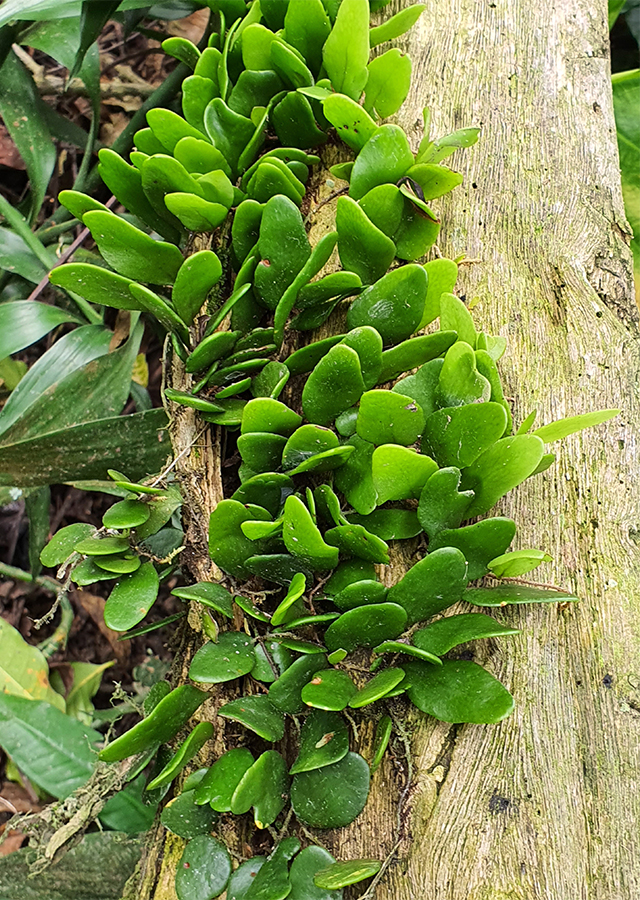
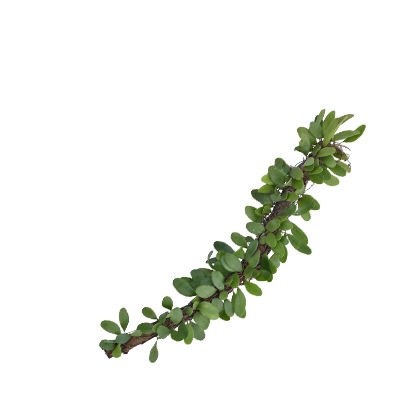
Fern. An epiphytic, evergreen, perennial creeping fern grows up to 3 - 5 cm in height.
Part Used
 Leaves
Growing Requirements
 Need Shade
Habitat
 Terrestrial
Overview
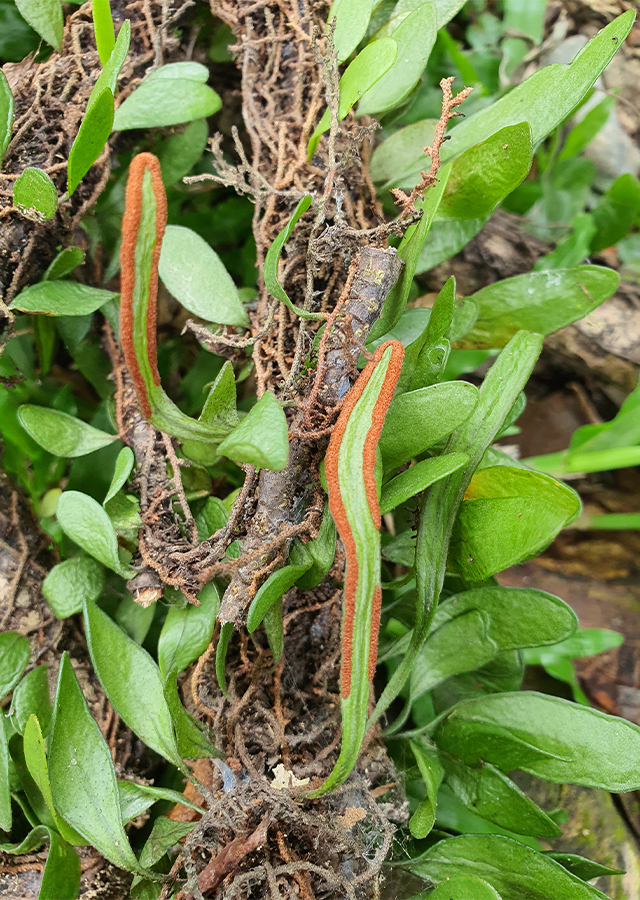
It is native from Northeastern India, throughout Southeast Asia to Papua New Guinea and northern Australia. In the wild, overlapping leaves are known to completely blanket trees, giving them an armored look like dragon scales. Pyrrosia, which is named after the orange spores, is a Greek term meaning "fire-colored" Piloselloides means "hawkweed-like" due to it resembling hawkweed's long rhizomes.
Vernacular Names
Sisik naga (Indonesian), Pokok duit-duit or Picisan (Malaysia), Pagong-pagongan (Philippines), Tenga-chara (Bangladesh), Bao shu lian (Chinese).
Agroecology
The dragon's scale fern is better wrapped or tied to a backdrop around driftwood branches. It is native to a primary rain forest (terrestrial habitat) and prefers the tropical, sub-tropical/monsoonal climate zone. They occur everywhere, including mangroves, on the trunks of old trees. Found from sea level up to an altitude of about 1,000 m in fairly exposed areas.
Morphology
- Rhizome - long and creeping with a diameter of approx. 1 mm but extremely long and strong covered with small, almost round or heart-shaped scales. Scales have a dark centre and paler edges, with relatively long hairs that are white when very young, but soon turn brown.
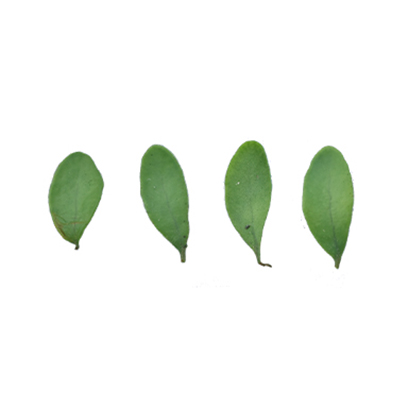
- Leaves - simple, succulent, light green, fleshy fronds are oval to circular with smooth edges (entire leaf margin). Sterile leaves are without stalks, nearly circular and about 1 cm across, fleshy and have a smooth surface. Fertile leaves have a stalk of about 1 cm in length and are narrow/elongated, 3-12 cm by 5-8 mm.
- Sori (the clusters of sporangia) - arranged in a broad band along the edge of the leaf and may be about 2.5 mm wide when mature.
Cultivation
Propagation is through spore, stem cuttings, and divisions.
Chemical Constituents
Flavonoids, tannins, steroid or triterpenoid, essential oils and glycosides (which are highly potential to act as anticancer agent), phenols, saponins.
Traditional Medicinal Uses
- Anti-inflammatory drugs for strengthening the lungs and cough, analgesics, blood cleanser, avoid bleeding (hemostatic), gingivitis cure, medication sprue, a drug for breast cancer, jaundice (prehepatic).
- Antibacterial and antifungal effects are indicated in studies.
- Its leaves are known to be used as pain and fever relievers by aboriginal Negritos and Southern Thais.
- In Indonesia, the use of leaves in the treatment of breast cancer is an ancient medical procedure.
- Local people also use it to soothe gallstones and as a poultice for skin rashes. For external uses, its leaves are either crushed or decocted for oral use.
Part Used
Reference Sources
- Arif, M.Z., Zainuddin, N.A.S.N., Zakaria, I.S., Wahab, W.N.A.W.A. & Sul'ain, M.D. (2018). Phytochemical screening and toxicological evaluation of Pyrrosia piloselloides extracts. International Medical Journal 25(3):177 - 180.
- Sul ‘ain, M.D., Zakaria, F. & Johan, M.F. (2018). Anti-proliferative effects of methanol and water extracts of Pyrrosia piloselloides on the hela human cervical carcinoma cell line. Asian Pacific Journal of Cancer Prevention 20(1):185-192.