
Batoko Plum
Flacourtia inermis Roxb.
Salicaceae
Location in our garden
Orchard
Synonym
Flacourtia quintuplinervis Turcz.
Habitus

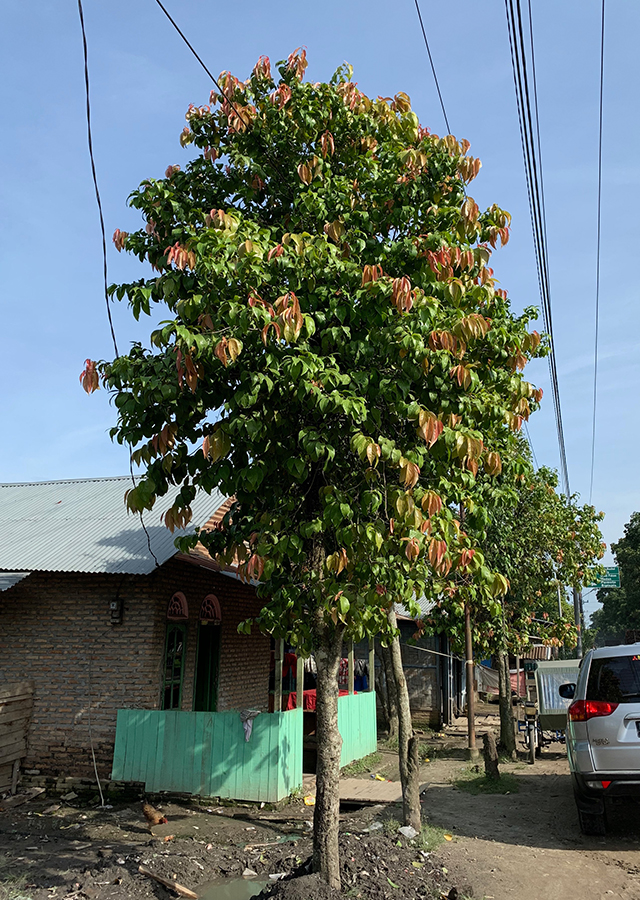
Trees. A small to medium-sized evergreen perennial shrub or tree that grows to a height of 15 m
Part Used
 Leaves
 Bark
Bark Fruit
Fruit Roots
Roots Stem
Stem
Growing Requirements
 Full Sunshine
Habitat
 Forest
Overview
Batoko plum is originated in tropical Asia including Malesia. The tree is sometimes cultivated in tropical areas, mainly from India to China, for its edible fruit. The edible fruit is usually astringent with an acid flavour, though it can be sweet, rich in an antimicrobial agent, but generally not eaten fresh but made as jams, preserves, and syrups.
Vernacular Names
Luó bǐ méi (Chinese), Prunier de la Martinique (French), Lovi-lovi (German), Cimaikkottaikkala (India), Lobeh-lobeh (Malaysia), Takhop-thai (Thai), Lobi-lobi (Indonesia).
Agroecology
A plant of hot, humid, tropical lowlands. Very susceptible to frost injury. This species grows best in full sun and moist, but well-drained soil. Mulch by adding organic compost or manure to the base of the tree.
Morphology
- Trunk - usually crooked, furrowed and gnarled upto 35 cm with brown or grey, smooth bark.
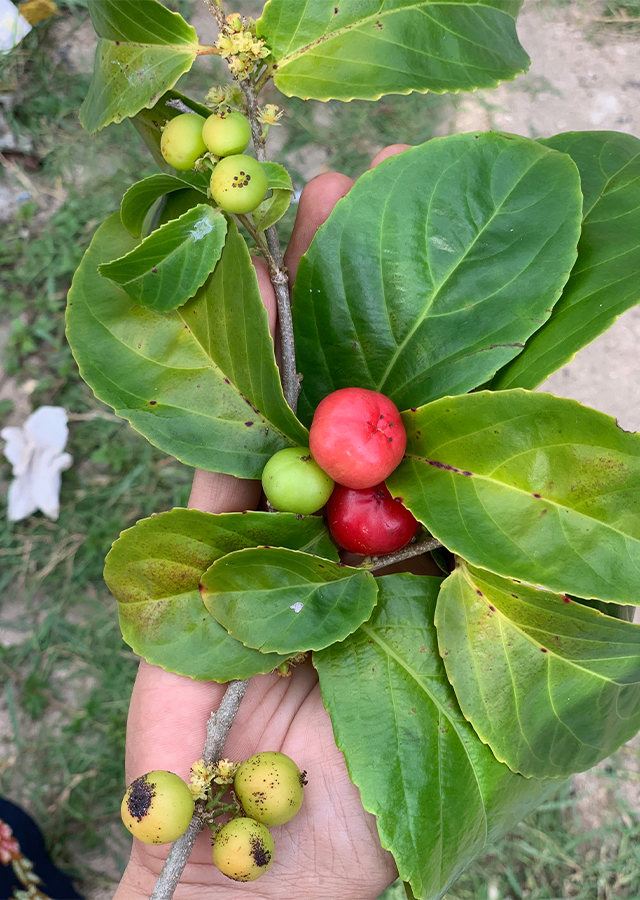
- Leaves - simple, alternate, ovate elliptical in shape, 5-20 cm long, 3-8 cm width with characteristic odour & bitter taste, petiolate with a unicostate reticulate venation. Young leaves are red and turn green when mature. The surface is glabrous with serrate margin and acuminate apex. They have a spiral arrangement and tend to hang down from the branches.
- Flowers - clusters of 2 - 8 small, unscented(3 - 5 mm in diameter) flowers, located near the base of leaves and along the length of twigs, but not at the ends. The flowers have greenish yellow sepals, but no petals.
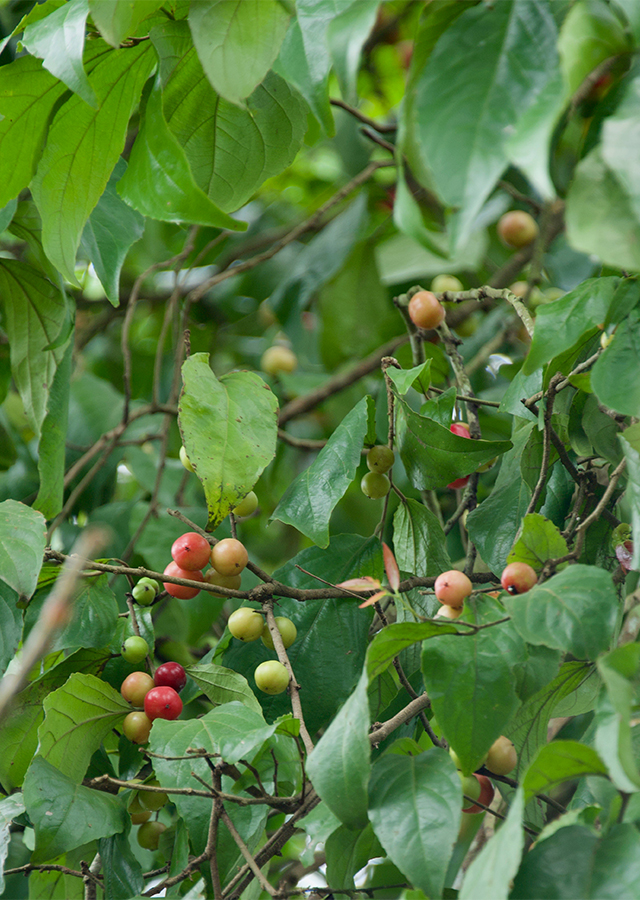
- Fruit - a globose berry, round measuring 1-3 cm in diameter that encompasses many seeds, has soft skin with smooth surface. Young fruits are yellowish green which turns to dark red to purple black when ripened and tastes sour. Fruits have 4 - 5 small black-tipped projections arranged in a circle at the apex which are the remains of the styles.
- Seeds - hard/stony, irregular, very sharp edges, 6 mm wide, 4 - 14 small seeds.
Cultivation
Propagation is by seed or air layering or budding.
Chemical Constituents
Tannins, phenols, flavonoids, mucilage, triterpenoids, sterols, alkaloids, saponins, cyanogenetic glycosides, volatile oils, quercetine, 2,3-dihydroxybenzoic acid.
Traditional Medicinal Uses
- The plant showed antibiotic, antioxidant, anti diabetic, antimicrobial activities.
- It is used to treat nausea, vomiting and throat aches.
- The leaves is used traditionally in Ayurveda in the treatment of various diseases.
- The fruits, bark, leaves and roots can be used for some health conditions especially for arthritis, cough, indigestion and diarrhoea.
- Fruit juice is used to treat diarrhoea. It is also helpful in vomiting, nausea and throat aches.
Part Used


Reference Sources
- Verheij, E.W.M. & R.E. Coronels (eds.). (1992). Plant Resources of South-East Asia. Edible Fruits and Nuts. No 2. PROSEA Foundation, Bogor.