
Downy Thorn-Apple
Datura metel L.
Solanaceae
Location in our garden
Principal
Synonym
Brugmansia chlorantha (Hook.) Melliss
Brugmansia waymanii Paxton
Datura alba Rumph. ex Nees
Habitus

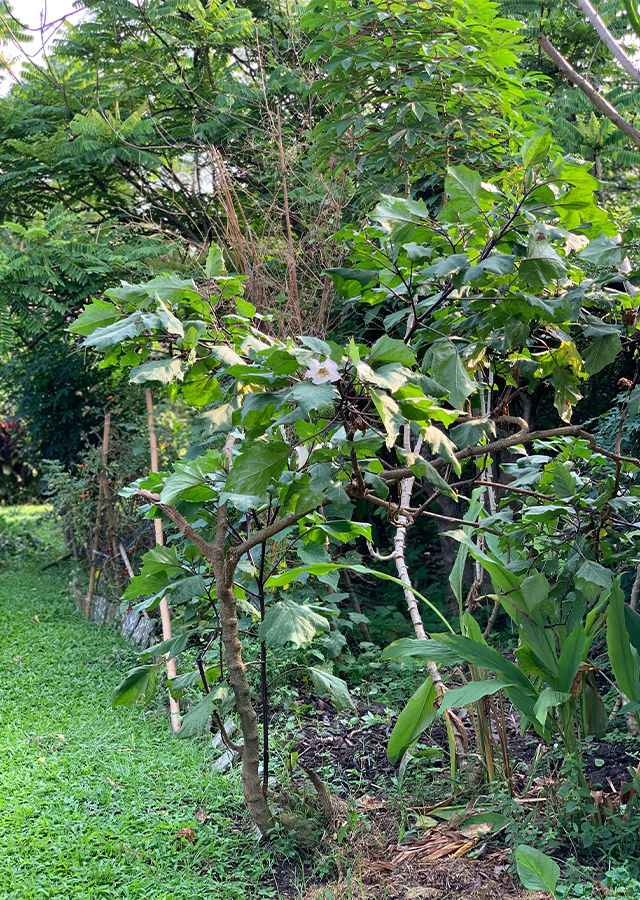
Shrubs. An erect, often much-branched, annual to short-lived perennial herbaceous shrub growing up to 2 m tall. Stout annual herb, branching above, glabrous or sparsely pubescent with simple hairs.
Part Used
 Leaves
 Seeds
Seeds Flowers
 Fruit
Fruit Roots
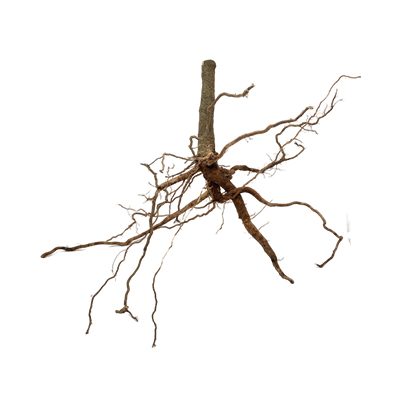
Roots
Growing Requirements
 Full Sunshine
 Need Shade
 Drought Resistant
Habitat
 Forest
 Coastal
 Roadside
 Terrestrial
Overview
Downy thorn-apple (Datura metel) is native to the Americas and invasive to many tropical regions. The poisonous herb D. metel is considered invasive to many tropical regions. Although toxic, it is a popular traditional medicine and is commonly harvested from the wild for local use, and sold in markets. It has been cultivated in Sout East Asia, such as Thailand, Malaysia, Brunei, Filipina, and Indonesia. Commonly, it is used as a pesticide constituent and planted as an ornamental plant in the home garden.
Vernacular Names
Kecubung (Indonesia), Yang jin hua (Chinese), Stramoine métel (French), Metel-stechapfel (German), Kala-dhatura (India), Hime-togarasi (Japanese), Kecubong (Malay), Talong punay (Tagalog-Philippines).
Agroecology
The species is drought tolerant but does best in full sun and rich and high humus content. Downy thorn-apple is locally abundant in waste places, roadsides, brushwood, open grassland, teak forest, and on river banks, from sea level up to 2,200 m altitude. Prefers a rich light sandy soil, well-drained soil in a fully opened or partially shaded position, and grows best in a fertile calcareous soil and pH range from neutral to very alkaline.
Morphology
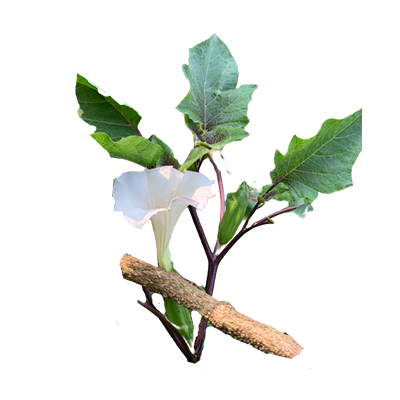
- Leaves - single, ovate to oblong-ovate, 9 to 18 cm long, with inequilateral base, pointed tip, and irregularly and shallowly lobed margins.
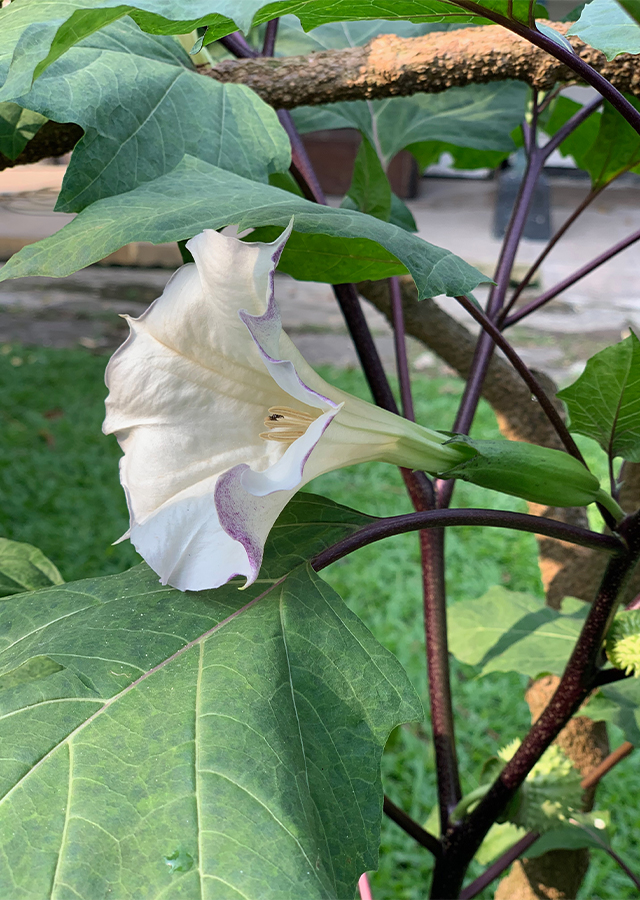
- Flowers - white or nearly purple, axillary and solitary, with a large ovary.
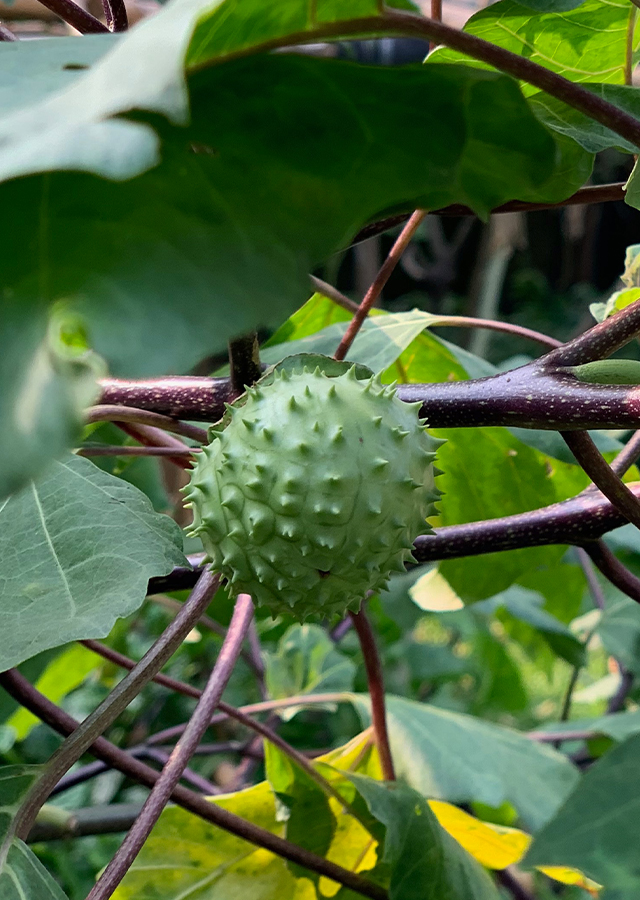
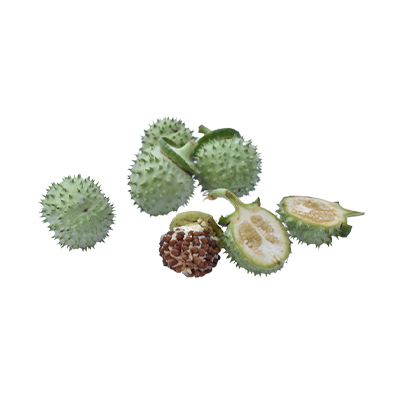
- Fruits - rounded capsules, green, about 3.5 cm in diameter and covered with stout, short spines, dehiscing at the apex when ripe forming an irregular suture.
- Seeds - numerous, closely packed, nearly smooth, and pale brown.
Cultivation
Propagated through seeds, best pre-soaked for 12 hours in warm water before sowing.
Chemical Constituents
Atropine, hyoscyamine, scopolamine, hoisin, tannins, nicotine, alkaloids, flavonoids, steroids, saponins, terpenoids, phytosterol, phenols.
Traditional Medicinal Uses
- It is anticholinergics, used to provide symptomatic relief of various gastrointestinal disorders.
- It is used in ophthalmology to dilate pupils, as an analgesic, and to prevent motion sickness, dilates the pupils, and is used in eye surgery.
- The whole plant, but especially the leaves and seed, is abortifacient, anesthetic, anodyne, antiasthmatic, antispasmodic, antitussive, bronchodilator, hallucinogenic, hypnotic, mydriatic. It is also used n the treatment of asthma, epilepsy, hysteria, insanity, heart diseases, fever with catarrh, diarrhea, skin diseases, etc.
- Parts of the plant are used in various preparations for sedating patients with mental disorders.
- The dried flowers and leaves are inhaled with preparation as a treatment for a range of conditions, especially asthma, and Parkinson's Disease.
- A poultice of the crushed leaves is used on conditions such as inflammatory swellings and rheumatic joints in order to relieve pain.
- The leaves are also applied externally to treat conditions such as hemorrhoids, boils, sores, skin diseases, rheumatism, headache, toothache, and earache.
- The seed oil is used for massaging painful body parts.
Part Used
Reference Sources
- Alam, W., Khan, H., & Khan, S.A., et al. (2021). Datura metel: A review on chemical constituents, traditional uses, and pharmacological activities. Current Pharmaceutical Design 27(22): 2545-2557.
- Bolivia Checklist. (2014). Catalogue of the Vascular Plants of Bolivia: Datura metel L. Tropicos Website: Missouri Botanical Garden and Harvard University Herbaria. http://legacy.tropicos.org/NamePage.aspx?nameid=29600006&projectid=13&langid=10 (Accessed 29-11-2021)
- CABI. (2021). Invasive Species Compendium: Datura metel (Hindu datura). Centre for Agriculture and Bioscience International (CABI) Web. https://www.cabi.org/isc/datasheet/18005#E8AE18A6-010C-4300-818D-A649914582A3 (Accessed 29-11-2021)
- Fern, K. (2019). Useful Tropical Plants: Datura metel L. Useful Tropical Plants Database Web. http://tropical.theferns.info/viewtropical.php?id=Datura+metel (Accessed 11-02-2021)
- Flora of Nicaragua. (2014). Flora of Nicaragua: Datura metel L. Tropicos Website: Missouri Botanical Garden, and Harvard University Herbaria. http://legacy.tropicos.org/NamePage.aspx?nameid=29600006&projectid=7&langid=10 (Accessed 29-11-2021)
- Flora of Panama. (2014). Flora of Panama (WFO). Tropicos Website: Missouri Botanical Garden and Harvard University Herbaria. http://www.tropicos.org/Project/FOPWFO (Accessed 29-11-2021)
- Lusweti, A., Wabuyele, E., Ssegawa, P., & Mauremootoo, J. (eds.). (2011). Datura metel (Angel's Trumpet). BioNET-EAFRINET Keys and Fact Sheets Web. https://keys.lucidcentral.org/keys/v3/eafrinet/weeds/key/weeds/Media/Html/Datura_metel_(Angels_Trumpet).htm (Accessed 29-11-2021)
- Missouri Botanical Garden. (2015). Missouri Botanical Garden: Datura metel. Missouri Botanical Garden. https://www.missouribotanicalgarden.org/PlantFinder/PlantFinderDetails.aspx?taxonid=287149 (Accessed 29-11-2021)
- Nuga, O.O., & Setshogo, M.P. (2016). Datura metel L. In: Plant Resources of Tropical Africa (PROTA), Schmelzer, G.H., & Gurib-Fakim, A. (eds.). Plant Resources of Tropical Africa (PROTA) Web. https://www.prota4u.org/database/protav8.asp?h=M4&t=Datura,metel&p=Datura+metel#Synonyms (Accessed 11-02-2021)
- Oviedo-Prieto, R, Herrera, O.P., & Caluff, M.G., et al. (2012). National list of invasive and potentially invasive plants in the Republic of Cuba - 2011. (Lista nacional de especies de plantas invasoras y potencialmente invasoras en la República de Cuba - 2011). Bissea: Boletín sobre Conservación de Plantas del Jardín Botánico Nacional de Cuba 6(Special Issue 1): 22-96.
- PFAF. (2014). Plants For A Future Database: Datura metel - L. Plants For A Future (PFAF) Web. https://pfaf.org/USER/Plant.aspx?LatinName=Datura+metel (Accessed 29-11-2021)
- Randall, R.P. (2012). A Global Compendium of Weeds. Perth: Department of Agriculture and Food Western Australia.
- StuartXchange. (2014). Philippines Medicinal Plants: Datura metel L. StuartXchange Web. http://www.stuartxchange.com/Talampunay.html (Accessed 11-02-2021)
- Vascular Plants of Antioquia. (2014). Catalogue of the Vascular Plants of the Department of Antioquia (Colombia): Datura metel L. Tropicos Website: Missouri Botanical Garden and Harvard University Herbaria. http://legacy.tropicos.org/NamePage.aspx?nameid=29600006&langid=10 (Accessed 29-11-2021)