
Bicolor Buttonweed
Dichrocephala integrifolia (L.f.) Kuntze
Asteraceae
Location in our garden
Principal
Synonym
Ethulia integrifolia (L.f.) D.Don
Hippia integrifolia L.f.
Habitus

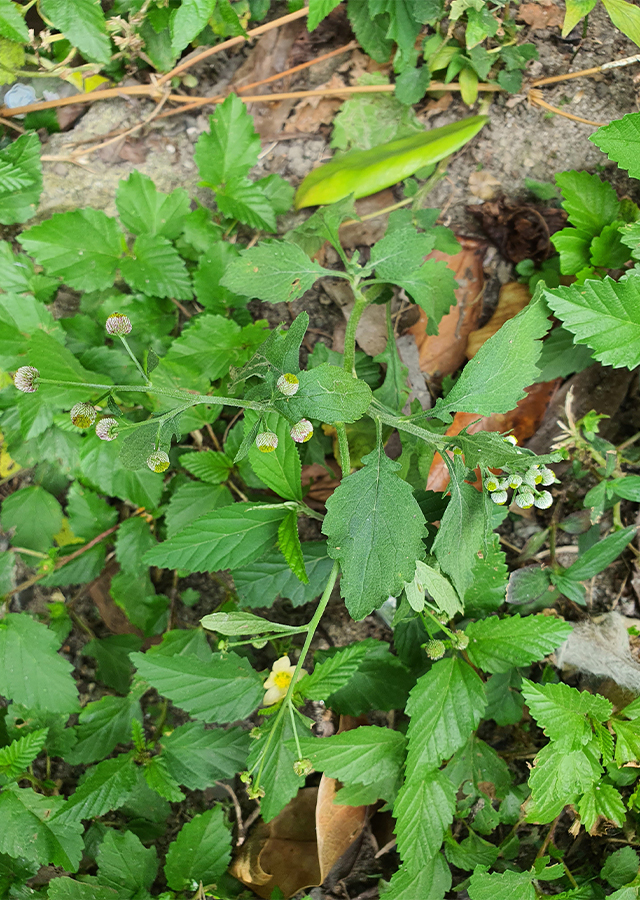
Herbaceous. An annual herb, erect or spreading, aromatic, 30-60 cm tall, occasionally to 100 cm
Part Used
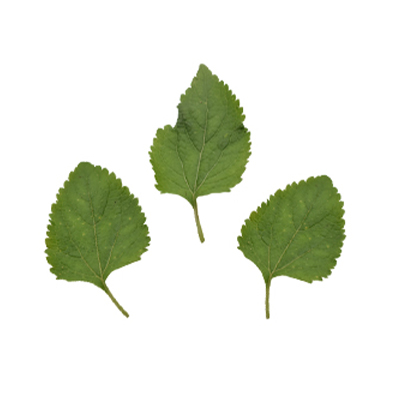
 Leaves
 Flowers
 The Whole Plant
Growing Requirements
 Need Shade
Habitat
 Forest
 Grassland
Overview
Bicolor buttonweed is native to tropical Africa and Southern Asia, It is widely spread in Southern Africa, Madagascar, Yemen, Turkey, Caucasus, Iran, China, South-East Asia, New Guinea, Australia, some Pacific Islands including Hawaii. The plant is harvested from the wild for local use as medicine.
Vernacular Names
Klet choum thorn (Cambodia), Mbag'api (Cameroon), Cho ke (Laos), Phakchee doi (Thailand), Ahidrindrina (Madagascar), Taka (Papua New Guinea), Rau chu[oo]i (Vietnamese), Jukut meurit (Sundanese-Indonesia), wedahan or seprah (Javanese_Indonesia).
Agroecology
This plant can grow in many of soil types but mostly found in clay soil. It is a common weed in rice field, grassland and other anthropogenic-disturbed land. This species can be found from low land to subalpine area.
Morphology
- Stems - smooth and hairy, often branches freely at the base, though can also be unbranched.
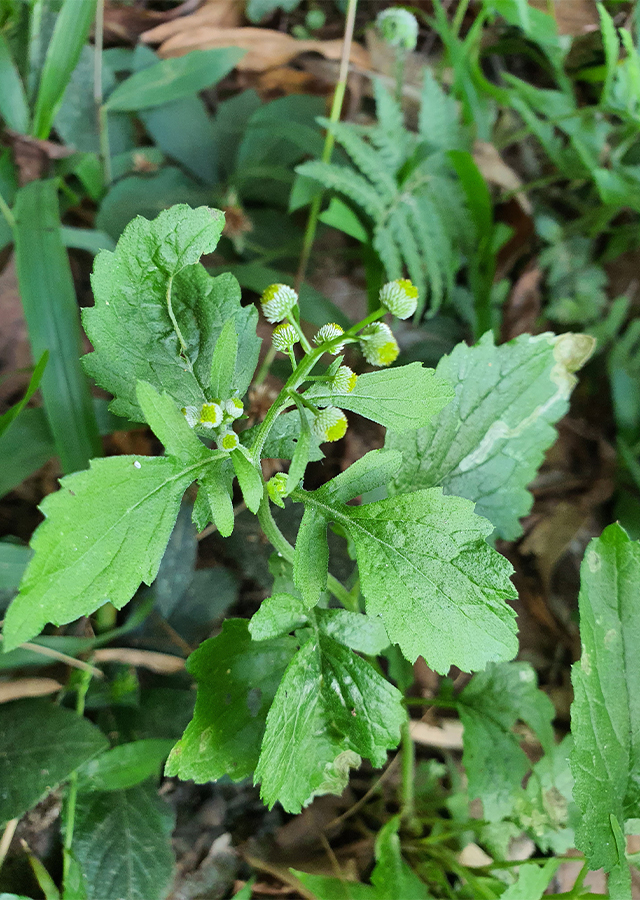
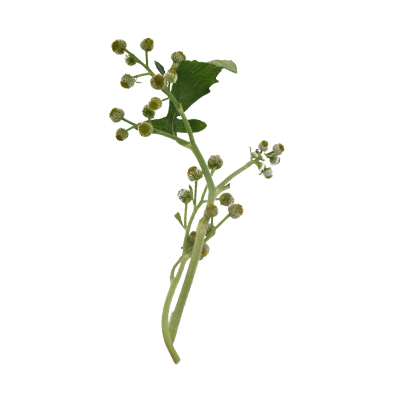
- Leaves - alternate, entire or pinnatifid, ovate or lanceolate, up to 13 cm long and 5 cm wide, the terminal lobe is large, broadly ovate and coarsely toothed, and forms new roots at the leaf nodes.
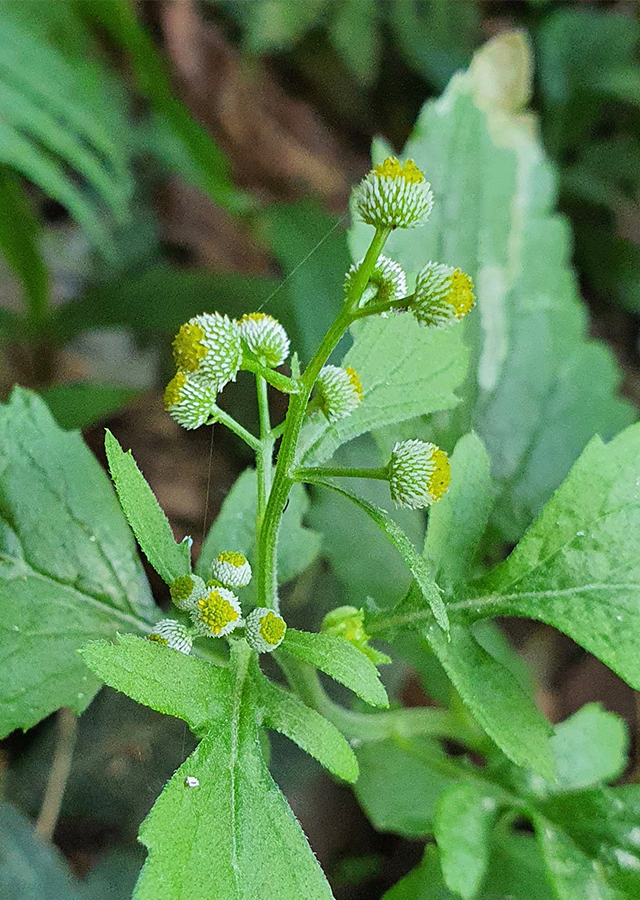
- Inflorescence - small, axillary or terminal panicleinvolucral bracts 2-seriate
- Flowers - flowering heads are yellow or purplish, rounded, and about 3 mm in diameter.
- The ray flowers are very slender, curved, and obscurely toothed. Achenes are very minuteand smooth.
- Fruits - pale yellow in colour.
Cultivation
Generative propagation is through seeds.
Chemical Constituents
Stearic acid, stigmasta-7,22-dien-3-ol, α-amyrin, epifriedelanol, methyl stearate, tritetracontane, rutin, flavonoids kaempferol 3-O-rutinoside, quercetin 3-O-rutinoside (rutin), and dicaffeoyl quinic acid.
Traditional Medicinal Uses
Medicinal Uses
- This plant is used in the treatment of dyspepsia and indigestion, as an antiphlogistic, and as an antiemetic.
- The plant contains rutin, which is known as a 'capillary protectant', that is used to treat capillary and venous disorders.
- Considered analgesic, anesthetic, anti-inflammatory, antibacterial, diuretic, sudorific, vulnerary.
Traditional Uses
- The plant juice is used as a treatment against filariasis. It is used in treating malarial fevers and, when put in the nose, is used to treat sinusitis and migraine, applied to cuts and wound.
- The dried and powdered plant is applied as a dressing on old infected wounds.
- The leaves are antiviral, applied externally, the leaves are crushed and used to treat ulcers and swellings.
- The young shoots are applied as a poultice in treating blennorrhoea, leucorrhoea, and the stings or bites of insects, spiders or scorpions.
- Decoctions of the flower buds are used as a sudorific and diuretic. The aroma of the crushed flower heads induces sneezing and thus helps to reduce nasal congestion.
Part Used
Reference Sources
- Fern, Ken. (2014). Useful Tropical Plants. Dichrocephala integrifolia. http://tropical.theferns.info/viewtropical.php?id=Dichrocephala+integrifolia 06-02-2021
- Florence, N.T, al. (2016). Research Article Dichrocephala integrifolia (Linn.f.) O. Kuntze (Asteraceae) Leaves Aqueous Extract Prevents Ethanol-induced Liver Damage in Rats. http://docsdrive.com/pdfs/pharmacologia/2016/337-343.pdf 06-02-2021
- StuartXchange. (2016). Philippine Medicinal Plants. Dichrocephala integrifolia. http://www.stuartxchange.com/Dichrocephala.html. 06-02-2021
- Schmelzer, G.H. (2002). Dichrocephala integrifolia (L.F.) Kuntze. In van Valkenburg, J.L.C.H. and Bunyapraphatsara, N. (Eds.): Plant Resources of South-East Asia (PROSEA) 12(2): 227-229.