
Snake - Needle Grass
Scleromitrion diffusum (Willd.) R.J. Wang
Rubiaceae
Location in our garden
Principal

Synonym
Hedyotis brachypoda (DC.) Sivar. & Biju
Hedyotis brachypoda R.Br. ex Wall.
Hedyotis diffusa Willd.
Habitus

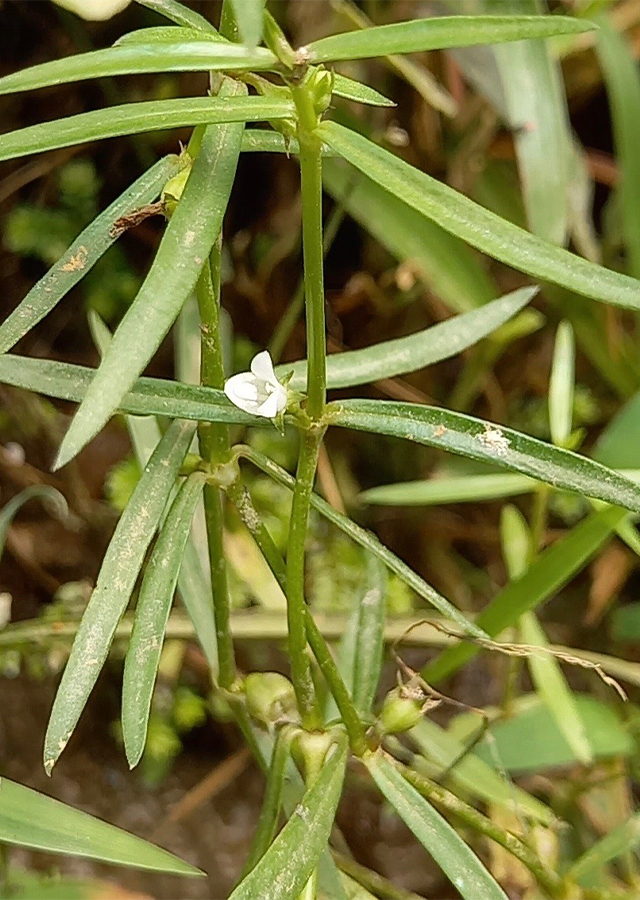
Climbers. Annual herb, reaching a length of 50 cm or less
Part Used
 The Whole Plant
Growing Requirements
 Full Sunshine
 Need Shade
Habitat
 Riverbanks
 Coastal
 Roadside
 Grassland
Overview
This plant is widely distributed in the orient and tropical Asia, such as China, Japan and Indonesia. It is a well-known Chinese medicine for thousands of years in China. The name of the plant deviates its original use, which was used to detoxify the bite of the snake. The form of the leaves also appear like small green snake tongues and are very thin.
Vernacular Names
Ulasiman-kalat (Tagalog-Philippines), Ding jing cao (Chinese), Bonjaluk (Assamese).
Agroecology
It grows in light (sandy), medium (loamy) and heavy (clay) soils, but prefers moist soil, in semi-shade area (light woodland). Suitable pH: acid, neutral and basic (alkaline) soils.
Morphology
- Stems - slightly flattened to terete, glabrescent to glabrous and the papilla was observed in the transverse section of the stem.
- Leaves - opposite, sessile or subsessile and blade drying membranous, linear, narrowly elliptic, 1–4 × 0.1–0.4 cm.
- Flowers - solitary-flowered (-or 2 or 3-flowered) inflorescens, white, 3 mm long and occurring singly in the axils of the leaves. Pedicels are about as long as the calyx. Corolla lobes are entire. Ovary is 2-celled.
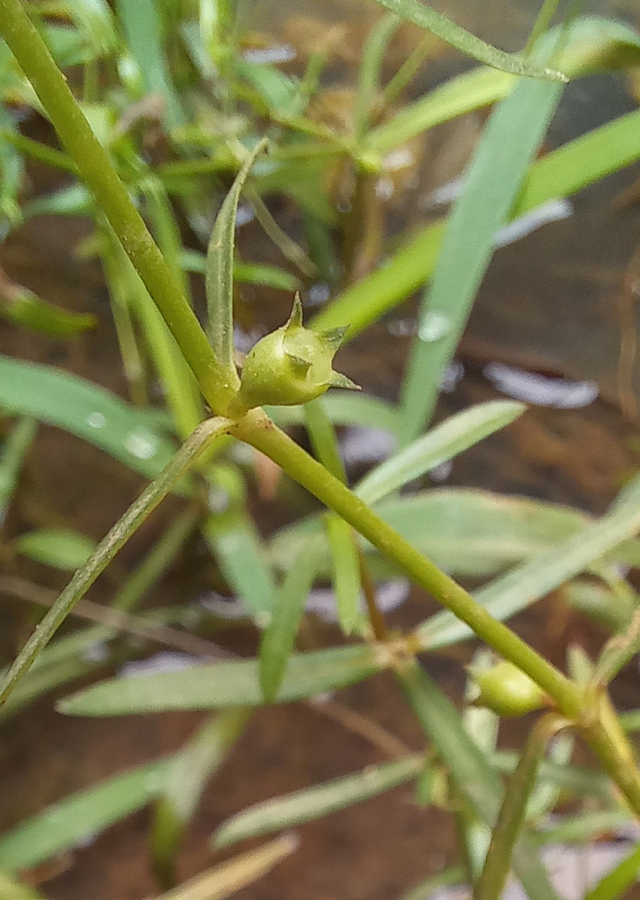
- Fruits - capsules, loculicidal, ovoid, about 4 mm long and do not protrude beyond the calyx segments.
Cultivation
Propagated by seed - sow spring in situ.
Chemical Constituents
Anthraquinones, terpenoids, flavonoids, steroid alcohols, alkanes, organic acids, coumarin, alkaloids, isoetin, aesculetin, gypsogenic acid, kaempferol.
Traditional Medicinal Uses
Medicinal Use
- It is a pleasant-tasting cooling, alterative herb that lowers fever, reduces inflammation, relieves pain and is diuretic and antibacterial.
- It acts mainly on the liver and also stimulates the immune system.
- The whole plant is anodyne, antitumor, cardiotonic, depurative, febrifuge and sedative.
- A study suggested that the plant may be effective in preventing hematopoietic damage when used in combination with radiotherapy.
Traditional Uses
- It is taken internally in the treatment of coughs, asthma, jaundice, impure blood, biliousness and cancers of the digestive tract.
- Externally, it is used in the treatment of snake bites, boils, abscesses and severe bruising.
- Plant decoction is used for biliousness and gonorrhea.
- In Chinese folk medicine, used in hepatitis and malignant tumors of the liver, lung and stomach. Also used for carbuncles, skin sores and ulcerations, tonsillitis, painful swollen throats, appendicitis, urethral affections and gynecologic infections.
- In Taiwan popularly used as anticancer medicine.
Part Used


Reference Sources
Siu, T.Y., M.H.Y. Yik, D.E. Boufford, P.C. Shaw, D.T.W. Lau. (2021). Proposal to conserve the name Hedyotis diffusa (Oldenlandia diffusa, Scleromitrion diffusum) (Rubiaceae) with a conserved type. Taxon 70(2): 443-444.