
Winterweed
Stellaria media (L.) Vill.
Caryophyllaceae
Location in our garden
Principal

Synonym
Alsine media L.
Stellaria media subsp. typica Bég.
Stellularia media (L.) Kuntze
Habitus

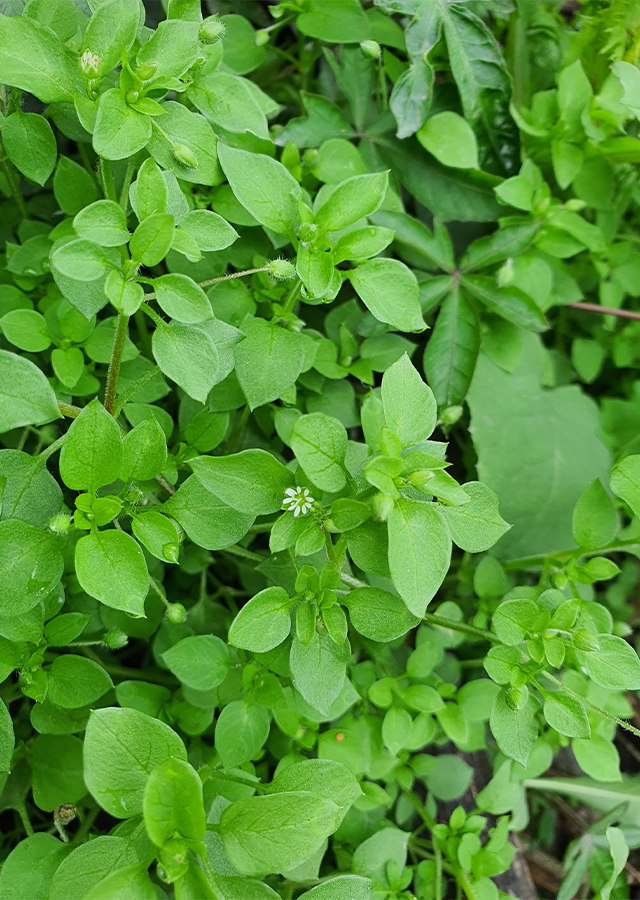
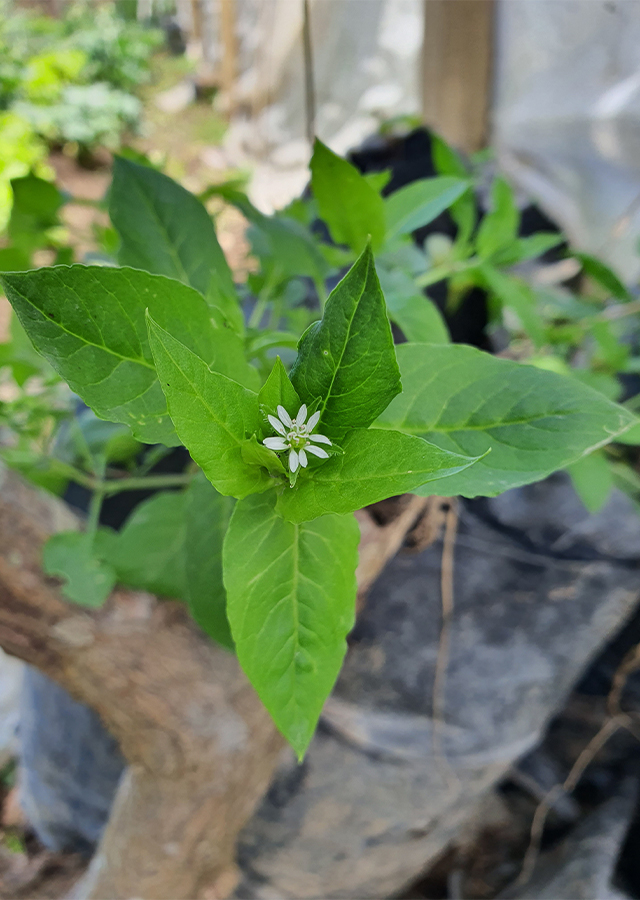
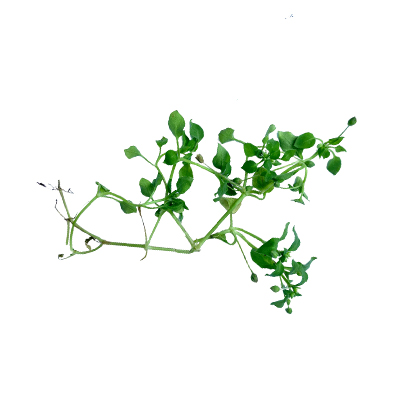
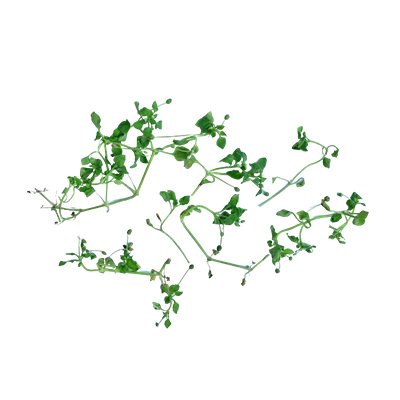
Herbaceous. S. media is a weakly tufted herb, roots fibrous, shallow, the plant sometimes taking root at the prominent joints, stems much-branched, erect, or ascending from a creeping base.
Part Used
 Leaves
 Flowers
 Roots
Roots Stem
Stem
Growing Requirements
 Full Sunshine
 Need Shade
Habitat
 Roadside
 Shrublands
 Grassland
Overview
Winterweed is native to Europe but has been spread through man's activities throughout the world, It occurs throughout Europe, except for the extreme north of Scandinavia and Russia. It extends from the tropical regions of Africa, South America, and Asia to the Arctic and sub-Antarctic islands. Chickweed can be eaten raw mixed with salad or prepared and taken as a tea.
Vernacular Names
Berillo (Spanish), Morgéline (French), Morugem (Portugese), Hakobe (Japanese), Hühnerdarm (German), Vassarv (Norway), Serce dili (Turkey).
Agroecology
Winterweed is found in cultivated fields, pastures, gardens, shady lawns, roadsides, and wasteland. It is most successful in cool, moist, and moderately shaded environments. In the tropics, it is usually only found at higher altitudes. It is one of the most aggressive weeds at 2,600 m and grows to the same altitude in Java, Indonesia. It will grow on a very wide range of substrates but prefers moist, fertile soils with a neutral pH and good aeration. A very easily grown plant, it prefers moist soil and a position in full sun or partial shade.
Morphology
- Roots - fibrous, shallow, the plant sometimes taking root at the prominent joints.
- Stems - much branched, erect or ascending from a creeping base, rather weak, minutely pubescent in longitudinal lines bearing a single row of hairs on alternating sides of successive nodes, 20 to 80 cm.
- Leaves - opposite, simple, very variable in size in different plants, smooth, or fringed with hairs near the base, ovate-elliptic, acute or shortly acuminate, 6 to 30 mm long, 3 to 15 mm wide; petiole of lower leaves 5 to 20 mm long.
- Flowers - solitary or in few-flowered, terminal, leafy cymes, white, pedicels nearly capillary, ascending, reflexed or recurved, sepals five, lanceolate-oblong, 3.5 to 6 mm long.
- Fruits - a many-seeded dry capsule, ovoid, opening by six teeth, breaking into five segments at maturity.
- Seeds - dark brown, yellowish or dull reddish-brown, nearly circular, slightly elongated toward the notch at the scar, about 1 mm across.
Cultivation
Reproduction is predominantly by seed, although short-term vegetative reproduction by vegetative fragments can occur. The first flowers may be produced within 4-5 weeks of germination, and the first mature seeds within 5-7 weeks.
Chemical Constituents
Flavonoids, carotenoids, alkaloids, essential oils (borneol, menthol, linalool, 1,8-cineole), terpene (epoxy-dehydrocanophylllene, monoterpene alcohol-ester, caryophyllene).
Traditional Medicinal Uses
- The extract was found to have antibacterial and anti-inflammation activities.
- It is evaluated for its anti-hepatoma activity on five human liver cancer cell lines.
- It is used to treat asthma and other respiratory problems such as cough and colds.
- It has long been used in folkloric medicine as a tonic to cleanse the kidney and liver.
- It is used as a poultice to treat boils, cuts, burns, abscesses, and ulcers also used to treat itchiness associated with eczema and psoriasis.
- In Asia and tropical Africa, leaves decoction is used to treat acute gastrointestinal and respiratory diseases.
- In India, a leaf decoction is used to dress deep wounds, stop bleeding and lessen tumors.
Part Used
Reference Sources
- Cabi.org. (2021). Stellaria media (common chickweed). https://www.cabi.org/isc/datasheet/51635.