
Wild Impatiens
Impatiens platypetala Lindl.
Balsaminaceae
Location in our garden
Shading Area

Synonym
Impatiens aurantiaca Teijsm. ex Koord.
Impatiens burkei Hook.f.
Impatiens elmeri Hook.f.
Habitus

Herbaceous. An erect or decumbent, herbaceous perennial herb that can grow 30-100 cm tall
Part Used
 Leaves
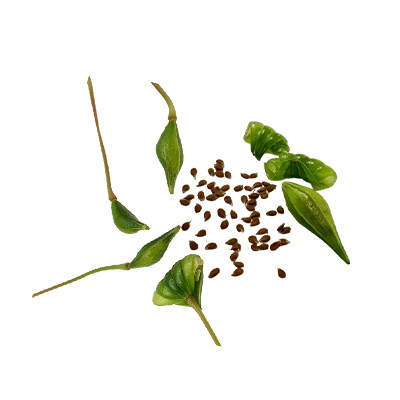
 Seeds
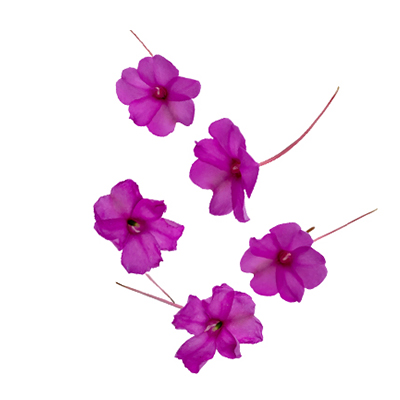
Seeds Flowers
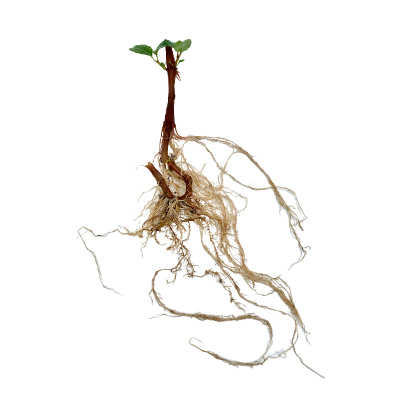
 Roots
Roots
Growing Requirements
 Need Shade
Habitat
 Riverbanks
 Forest
 Mountains
Overview
Wild impatiens are widely distributed in South-East Asia and native to the Philippines and Indonesia (Jawa, Sulawesi, Lesser Sunda Islands). This plant is harvested from the wild for local use as a medicine. The tall stature puts the blooms closer to eye level than typical Impatiens and even without flowers, still it is an attractive plant, with its glossy, ribbed leaves.
Vernacular Names
Bunga Sapa (North Sumatera), Pacar leuweung, Pacar tere (Sundanese), Pacar banyu (Javanese).
Agroecology
This plant can be found in lowland and montane forest, growing in gullies, along streams, in damp, shaded and semi-shaded localities, forest clearings, often gregarious, at elevations from 100-1,600 m. It prefers fertile, well-draining soil that's kept evenly moist. Over about 40% humidity is best.
Morphology
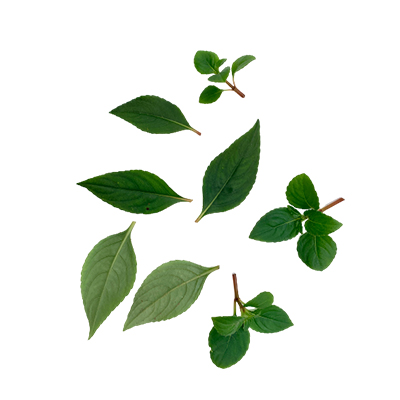
- Leaves - arranged 3-whorled but sometimes opposite, ovate to ovate-elliptical, measure 6-11.5 cm x 1-3.5 cm, attenuate at base, acute to acuminate at apex, with shallowly serrate margins and petiole 0.7-2.8 cm long.
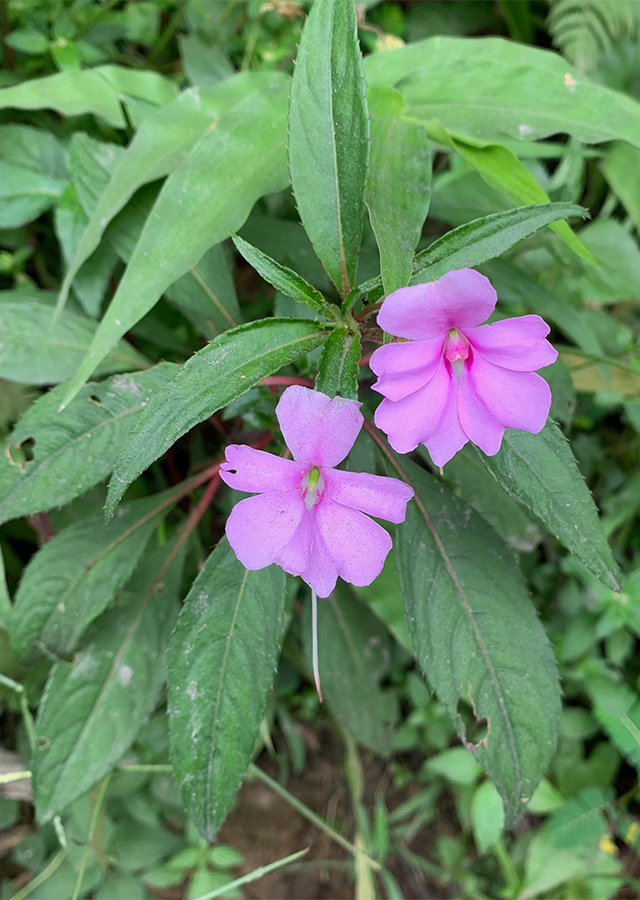
- Flowers - solitary, with slender pedicel and 4-6.5 cm long. The lateral sepals are lance-shaped to ovate, 7-12 mm long and acuminate. The lower sepal is shallowly navicular, 8-12 mm long, abruptly constricted into a curved, with slender spur 20-40 mm long, and whitish or greenish. The petals are flat and obcordate, ink, rose, purple, violet, white, or white with a coloured eye. The dorsal petal measures 11-14 mm x 7-9 mm while the lateral petals are 19-21 mm long and they are shallowly emarginated. The upper pair is slightly smaller than the lower pair.
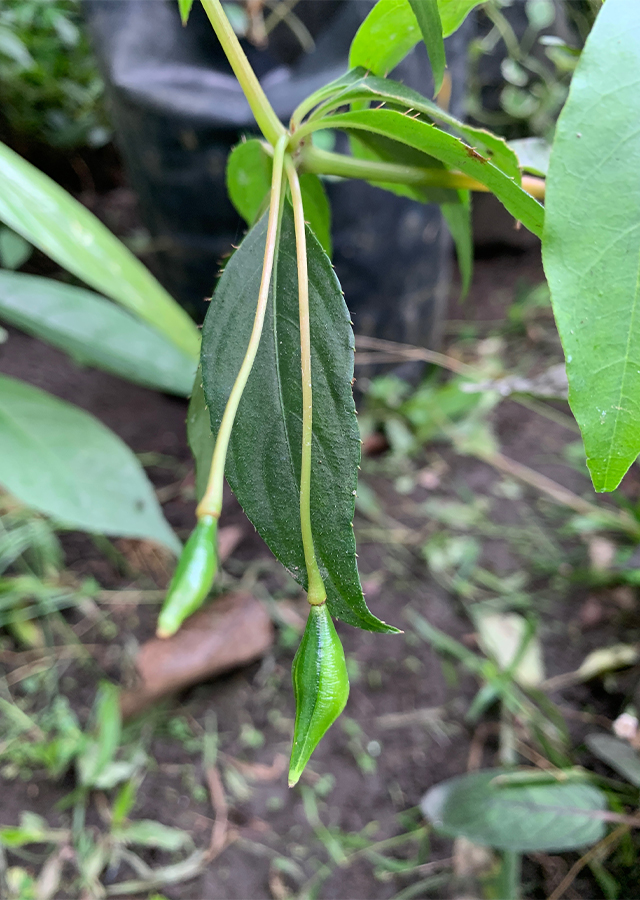
- Fruits - a fleshy capsule, dehiscent or not, with usually numerous seeds, spindle-shaped, measures 16-18 mm x 4-5 mm and smooth, pops open explosively when ripe.
Cultivation
Propagated mainly by seeds, sometimes by cuttings. The ideal temperature for germination is between 18-26 °C. For soil, use 2 parts potting soil to 1 part perlite or coarse sand.
Chemical Constituents
Flavonoids, glycosides, anthocyanins (cyanidin-3-glycoside), kaempferol, phenolic compound.
Traditional Medicinal Uses
Medicinal Uses
- The leaves are diuretic.
- The leaves have antibacterial activity
Traditional Uses
- In Java and Karo, the leaves are used for poulticing skin problems, ulcer and jaundice, and as a diuretic for children.
- In North Sumatera, the flowers are used to cure fever
- The flower can be used for jaundice.
- The leaves are used in urinary problems for children.
Part Used
Reference Sources
- Globinmed. (No date). Impatiens platypetala Lindley. https://globinmed.com/index.php?option=com_content&view=article&id=62943:impatiens-platypetala-lindley&catid=8&Itemid=319. 17-11-2020.
- Marina Silalahi, Endang C. Purba, Wendy A. Mustaqim. (2019). Impatiens platypetala. Tumbuhan Obat Sumatera Utara pp. 56-57. UKI Press. http://repository.uki.ac.id/649/1/draft_pt2.pdf. 17-11-2020.
- Taha, Rosna, M . (2016). PROSEA. Impatiens platypetala. https://uses.plantnet-project.org/en/Impatiens_platypetala_(PROSEA) 17-11-2020.
- Fern, Ken. (2019). Useful Tropical Plants. Impatiens platypetala Lindl. http://tropical.theferns.info/viewtropical.php?id=Impatiens+platypetala. 16-02-2021.