
Yellow Bells
Cascabela thevetia (L.) Lippold
Apocynaceae
Location in our garden
Principal

Synonym
Thevetia peruviana (Pers.) K.Schum.
Cascabela peruviana (Pers.) Raf.
Cerbera linearifolia Stokes
Habitus

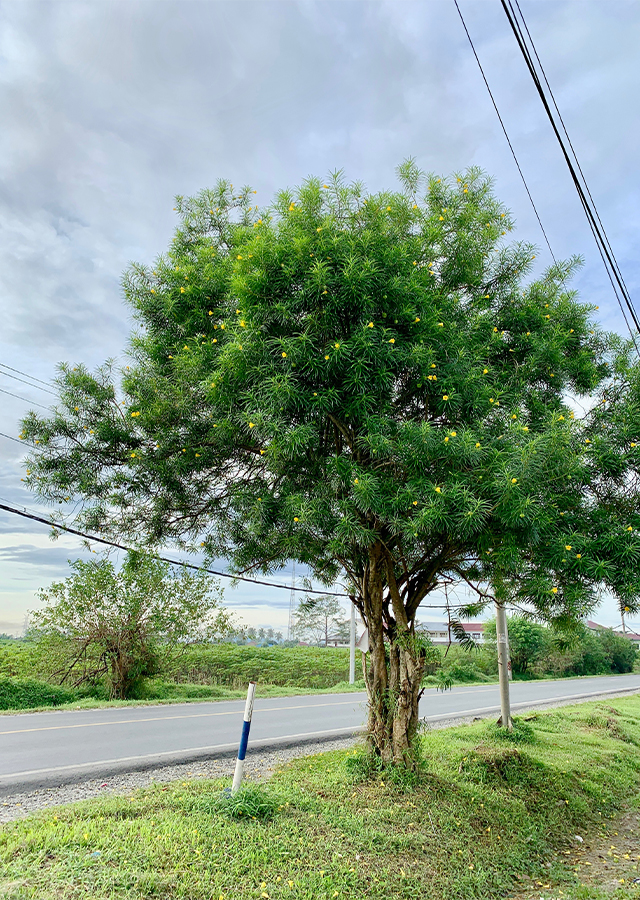
Shrubs. An evergreen shrub or small tree usually growing 3-8 m tall with a short bole
Part Used
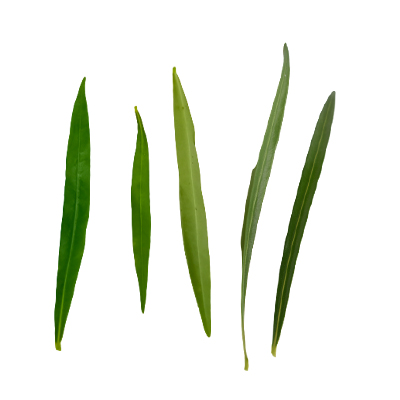
 Leaves
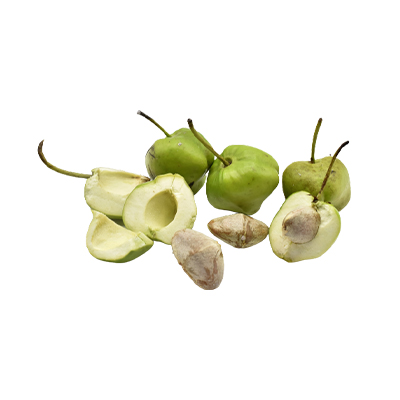
 Seeds
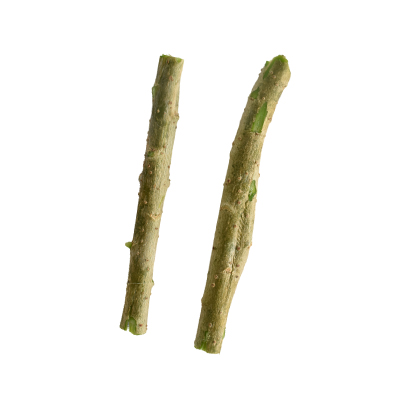
Seeds Bark
Bark Latex
Latex Roots
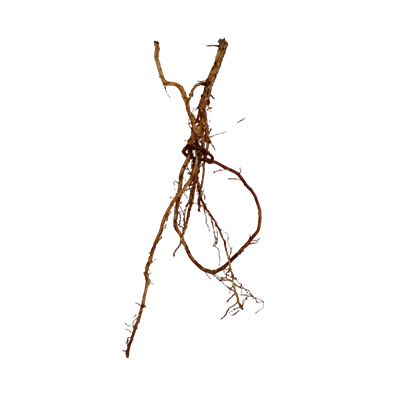
Roots
Growing Requirements
 Full Sunshine
 Need Shade
 Drought Resistant
Habitat
 Shrublands
 Grassland
Overview
This plant originally native to Mexico, and is naturalized throughout tropical America. The plant is widely used in folk medicine in Central and South America, In the Philippines and India the plant has become a household remedy for several ailments. It is sometimes cultivated for medicinal use and sold in local markets; it is also often grown as an ornamental and hedge.
Vernacular Names
Adelfa amarilla (Spanish), Arbre à lait (French), Cabalonga (Cuba), Huang hua jia zhu tao (Chinese), Loandro-amarelo (Portuguese), Cerbera (Brazilian), Caballón (Puerto Rican), Gele oleander (Dutch).
Agroecology
A plant of tropical in lowland areas. Succeeds in full sun or light shade. Prefers a fertile, well-drained loam with additional leaf mould, though plants can succeed in rather poor and dry soils as well. Tolerant of moderately saline soils. Established plants are drought tolerant.
Morphology
- Branchlets - glabrous, with grey bark and white latex.
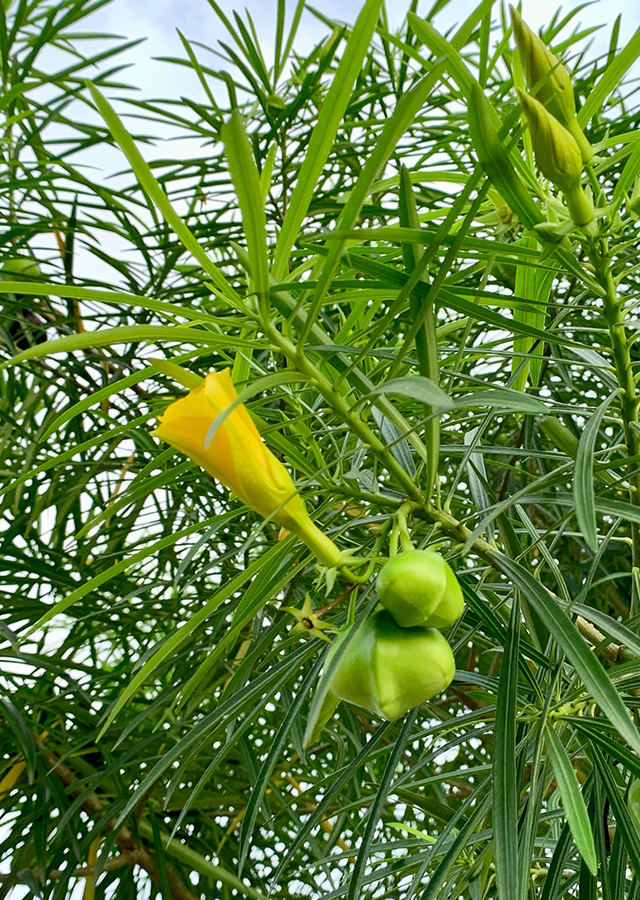
- Leaves - arranged spirally, simple and entire, almost sessile; stipules absent; blade linear-lanceolate, 6–15 cm × 0.5–1 cm, base decurrent into the short petiole, apex long-acuminate, leathery, lateral veins obscure.
- Inflorescence - a terminal or seemingly axillary cyme, few-flowered; bracts small, linear.
- Flowers - bisexual, regular, 5-merous, faintly fragrant, pedicel 1–2 cm long, sepalsovate, 1 cm long, acute, spreading
- Fruits - a depressed-globose to turnip-shaped drupe 3–4 cm in diameter, yellowish green, ripening black, 2–4-seeded within the stony endocarp.
- Seeds - obovoid, 2 cm × 1.5 cm, flattened.
Cultivation
Propagated by seeds and semi-ripe cuttings of terminal shoots.
Chemical Constituents
Roots: nerifolin, thevelene, neriperside. Barks: peruvoside, nerifolin, lupeol acetate, theviridoside. Seeds: thevetin, cerberoside, thevefolin, ruvoside, peruvoside, theveside, vertiaflavone.
Traditional Medicinal Uses
Medicinal Uses
- The bark is a powerful antiperiodic and febrifuge.
- The seeds may be used as a purgative when treating rheumatism and dropsy and as an abortifacient.
Traditional Uses
- The latex is applied to decayed teeth to relieve toothache, it is used to treat chronic sores and ulcers, and is applied to soften corns and calluses.
- Bark is used in the treatment of malarial fever and snake-bites.
- Applied externally, the juice of the macerated bark is used for treating sores.
- A decoction prepared from the bark or leaves is applied in regulated doses to loosen the bowels, as an emetic.
- Water in which the leaves and bark have been macerated is taken to cure amenorrhoea.
- The pulverized seeds are sometimes an ingredient of suppositories to alleviate haemorrhoids.
- The oil from the kernel is applied topically to treat skin complaints.
- The roots are made into a plaster which is applied to tumours.
- A decoction of the leaves is taken to treat jaundice, fever and as a purgative for intestinal worms.
- The leaf sap is used as eye drops and nose drops to cure violent headaches; it is also dropped in the nostrils to revive people who have fainted, and as a cure for colds.
- A tincture of the bark in large doses to be a violent purgative and emetic.
Part Used
Reference Sources
- CABI. (2020). Invasive Species Compendium. Cascabela thevetia(yellow oleander). https://www.cabi.org/isc/datasheet/53608. 24-02-2021.
- Fern, Ken. (2014). Useful Tropical Plants. Thevetia peruviana. http://tropical.theferns.info/viewtropical.php?id=Thevetia%20peruviana. 24-02-2021.
- Schmelzer, G.H. (2020). Pl@nt Use. Thevetia peruviana (PROTA). https://uses.plantnet-project.org/en/Thevetia_peruviana_(PROTA). 24-02-2021.