Lilac Tasselflower, Cupid's Shaving Brush
Emilia sonchifolia (L.) DC.
Asteraceae
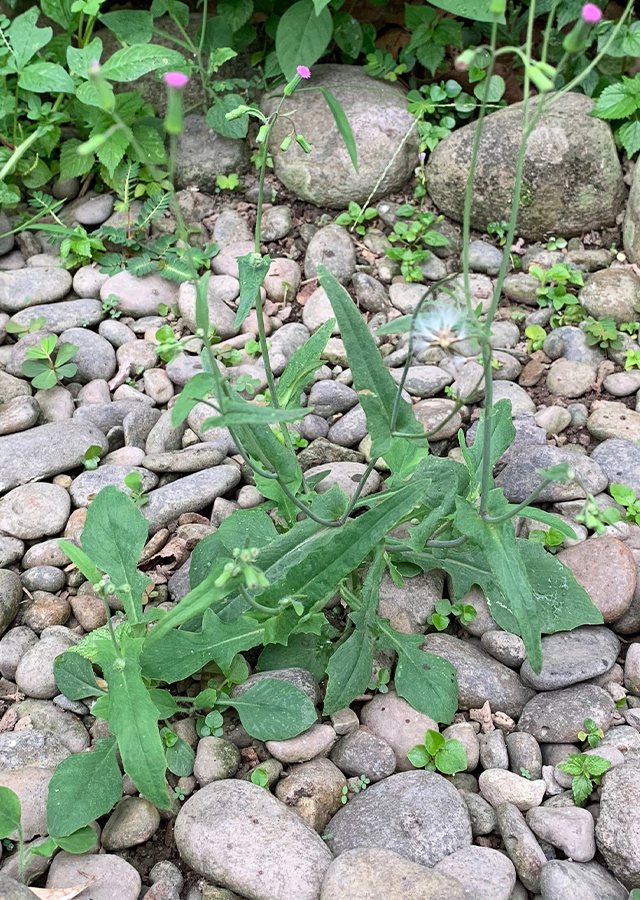
Location in our garden
Principal

Synonym
Cacalia sonchifolia L.
Crassocephalum sonchifolium (L.) Less
Emilia sonchifolia var typica Domin
Habitus

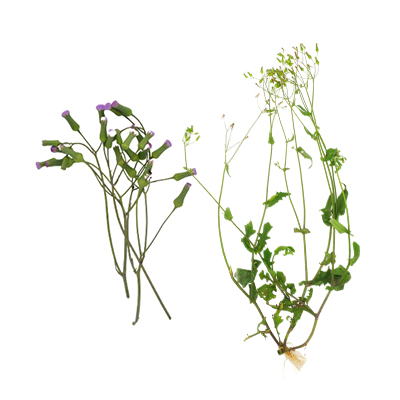
Herbaceous. An erect or ascending, variable, smooth or sparingly hairy, more or less branched, grow 10 to 150 cm high.
Part Used
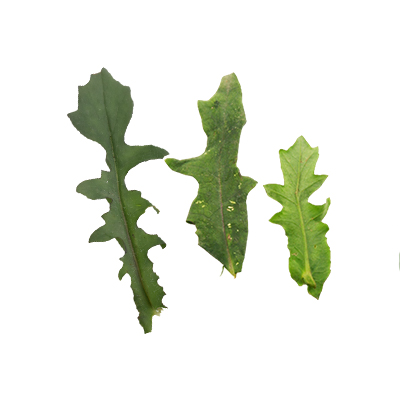
 Leaves
 Flowers
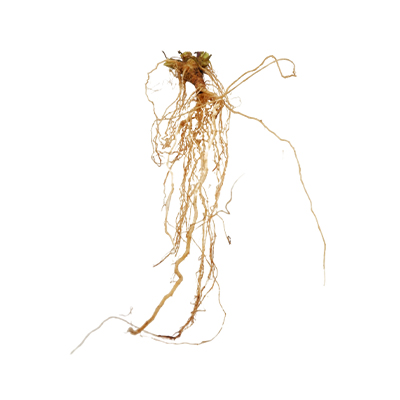
 Roots
Roots
Growing Requirements
 Full Sunshine
 Drought Resistant
Habitat
 Grassland
Overview
Lilac tasselflower or known also as Cupid's shaving brush is annual herb. Its origin is unknown, but the genus Emilia Cassini is chiefly African. This species believed to be native to China, through Asia to South-East Asia. Since spreading from its natural range, E. sonchifolia now has a pan-tropical distribution and it introduced and become naturalized elsewhere in Asia, as well as in Australia, the Pasific island, and the America. A common weed in the tropics, where it has traditional medicinal uses and also provides an edible leaf.
Vernacular Names
Yang ti cao (Chinese), Hinarakhuri (Hindi), Petit lastron, Emilie (French), Muel-schery (India), Sawi tekukur, Ketumbit jantan, Setumbak merah (Malaysia), Bon tulsi (Bangladesh), Kadupara (Sri Lanka), Co chua le (Vietnamese), Tagulinaw (Tagalog-Philippines), Tempuh wiyang, Patah kemudi (Indonesia), Kemendilan (Java-indonesia), Jonge (Sunda-Indonesia), Hangplachon, Phakdaeng (Central Thailand), Phakbang (Northern Thailand).
Agroecology
Emilia sonchifolia is a plant of the tropics, where it is found at elevations up to 3,000 m. It grows best in areas where annual daytime temperatures are within the range 20-30 °C. It prefers a mean annual rainfall in the range 1,000-2,000 mm. An easily grown plant, succeeding in most well-drained soils in a sunny positions. Plants flower better when growing on nutritionally poor soils, producing much more lush growth at the expense of flowering on rich soils. Plants are drought tolerant once establish. Prefer a pH in the range 4,5-6,5.
Morphology
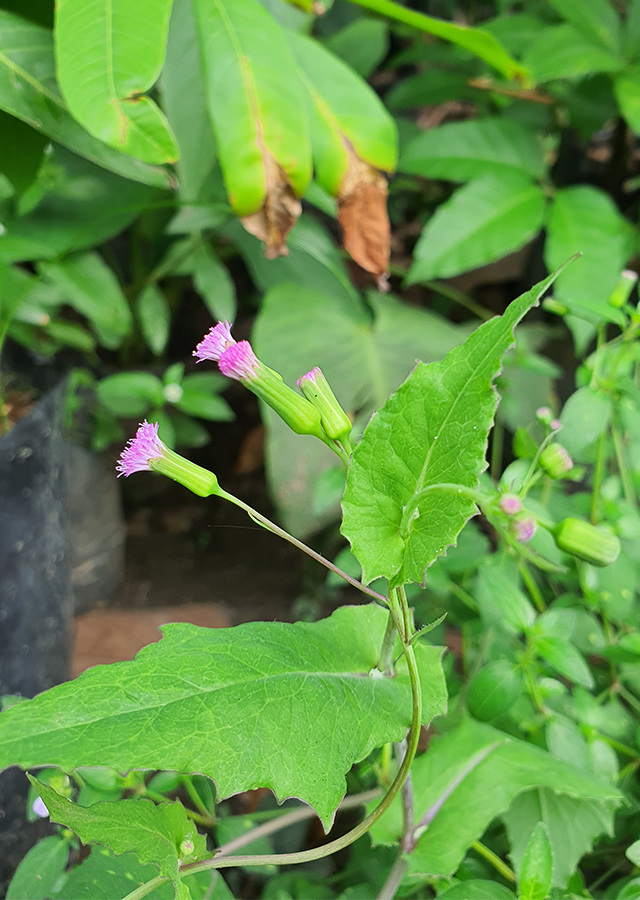
- Stems - round, 2-3 mm in diameter, solid and green. The branches are dichotomous. Involucral-bracts are green, cylindric somewhat inflated below and about as long as the purple folwers.
- Leaves - 4-16 cm x 1-8 cm, sessile, somewhat fleshy and clasping, the lower ones much smaller and usually entire. Upper leaves linear or sagittate. Undersurface is usually tinged with violet hue.
- Flowers- inflorescence terminal, few together in slender corymbs or rarely soliter. Head 20-45 flowered, subcylindrical, 8-17 mm x 4-5 mm. Peduncle filiform, 1-5 cm long. Involucral bracts 7-10, narrowly oblong-ovoid. Ray flower absent. Disk flower bisexual. Corolla tubular, 5 lobed, 8-12 mm long, light red, rarely green or white. Ovary short-hairy with 2 style arms. Stamens connate. Anthers 2-2,5 mm long with a small apical valve.
- Fruits - achenes, linear-oblongoid, 2,5-3 mm long, ribbed, pilose, brownish. Pappus hairs numerous, 6-9 mm long, white.
Cultivation
- Propagated by seeds - sow early spring in greenhouse and only just cover the seed. When large enough to hanlde, prick the seddling out into individual pots and plant them out after the last expected frosts. The seed can also be sown outdoors in situ in the middle of spring.
Chemical Constituents
- Flavonoids, tannins, alkaloids, steroids, ursolic acid, kaempferol galactoside, quercitrine, rutoside, senecionine, pyrrolizidine alkaloids.
Traditional Medicinal Uses
- Considered astringent, diuretic, expectorant, febrifuge and sudorific.
- A tea made from the leaves is used in the treatment of dysentery.
- The juice of the leaves is used in the treating eye inflammations, night blindness, cuts and wound and sore ears.
- The juice of the root is used in the treatment of diarrhoea.
- The flowers heads are chewed and kept in the mouth for about 10 minutes to protect teeth from decay.
- In the Philippines, leaves and flowers are used as styptic for cuts and wounds, especially for long standing superficial ulcers resistant to all forms of orthodox therapies.
- In Malabar plant decoction used as febrifuge. Mixed with sugar, given for bowel complaints.
- In Africa, consumed as vegetable for its laxative properties. Decoction of leaves is used for tapeworm and roundworm infestations, and is also used as febrifuge, bathing infants to prevent convulsions.
- In China, tea of whole plant is used for abscesses influenza, burns and snakebites.
- The young leaves commonly uses as vegetable, aeten raw or steamed as a side dish with rice.