
Lesser Yam
Dioscorea esculenta (Lour.) Burkill
Dioscoreaceae
Location in our garden
Principal

Synonym
Dioscorea aculeata Roxb.
Dioscorea fasciculata Roxb.
Dioscorea papillaris Blanco
Habitus

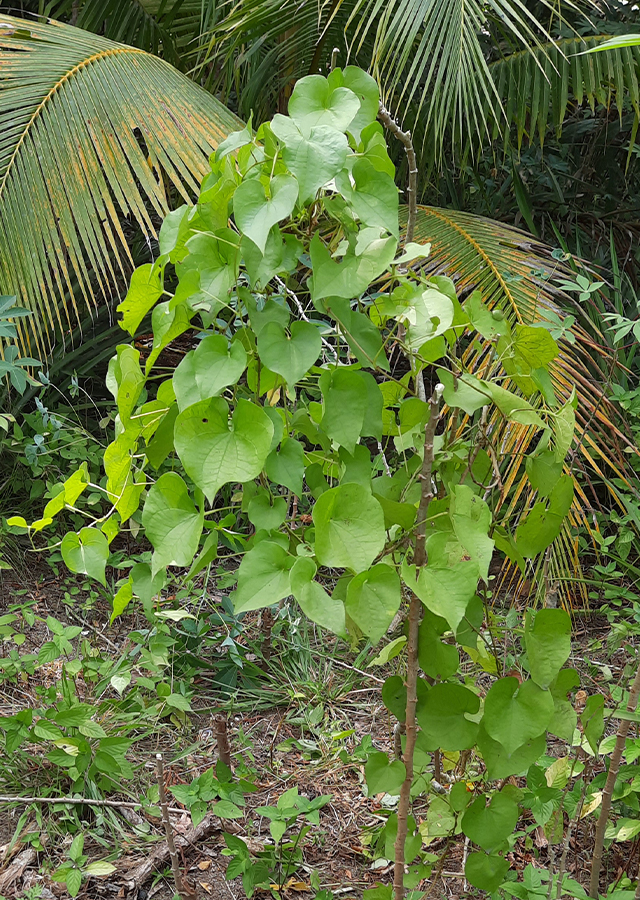
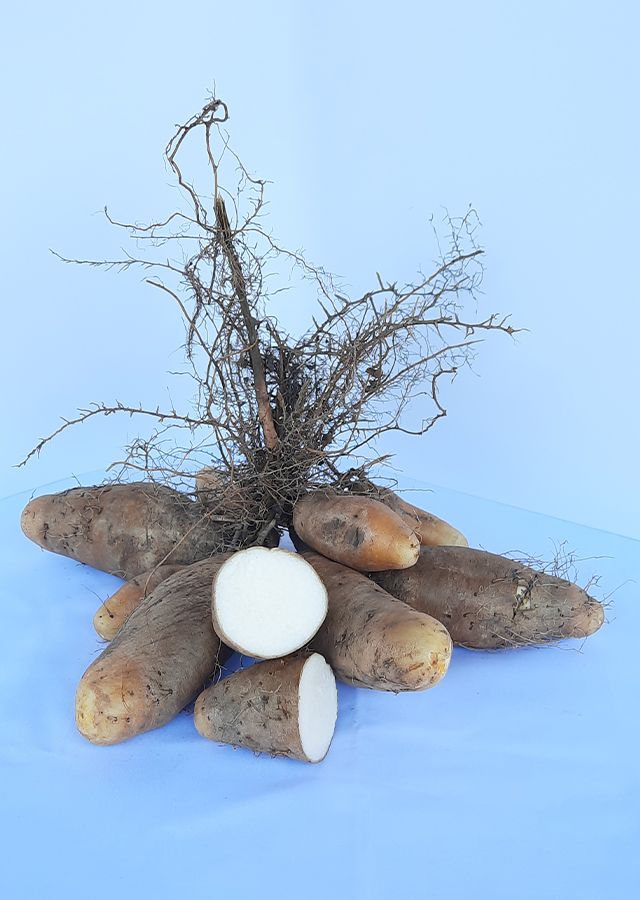
Climbers. A perennial, climbing plant producing annual stems about 3 m long from a tuberous rootstock. it has spines and can climb up to 2.4 m and spread up to 1.8 m across. The tuber has yellow or white flesh. It is a 6-10 months crop with a short dormancy period. Lacking bulbils. The flowers are pollinated by wind or insects. This plant rarely produces flowers, dioecious type so male and female plants need to be planted together if seeds are needed.
Part Used
 Seeds
Seeds Tuber
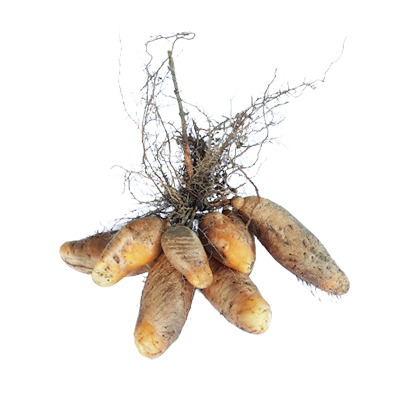
Tuber
Growing Requirements
 Full Sunshine
Habitat
 Rocky Areas
 Shrublands
 Grassland
Overview
Lesser yam is native to Thailand and Indo-China and may have originated there. It also grows wild in northern India, Myanmar, and New Guinea, but it is not known whether these are escapes from ancient cultivation or real relicts of its natural distribution area. At present, its cultivation is most important in South-East Asia (especially in New Guinea), Oceania, the Caribbean, and China.
Vernacular Names
Asiatic yam (English), Chinese yam (English), Tugi (Tagalog-Philippines), Name asiatico (Spanish), Igname de Chine (French), Yam (German), Hwà kathad (Laos), Kemarung (Malaysia), Man-chuak (Thailand), Cur tuwf (Vietnamese), Ci shu yu (Chinese).
Agroecology
A plant of the drier to wet tropical lowlands, where it is found at elevations up to 900 m. Grows best in areas where annual daytime temperatures are within the range 28-32 °C, but can tolerate 17-45 °C. Prefers a mean annual rainfall in the range 800-2,000 mm, but tolerates 600-8,000 mm. Succeeds in full sun and also in light shade. Requires a deep, well-drained, sandy loam that is not liable to water-logging. Prefers a pH in the range 5.5-6.5, tolerating 4.5 - 8.5.
Morphology
- Roots - thorny in wild plants, often thornless in cultivated plants, fibrous, mostly confined to the top 1 m of the soil.
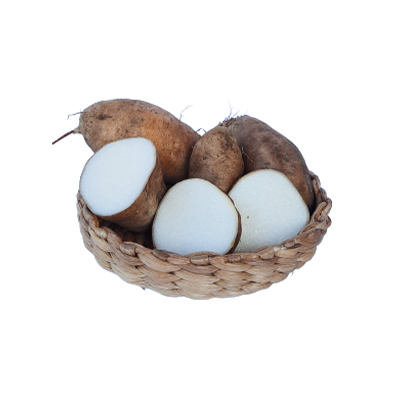
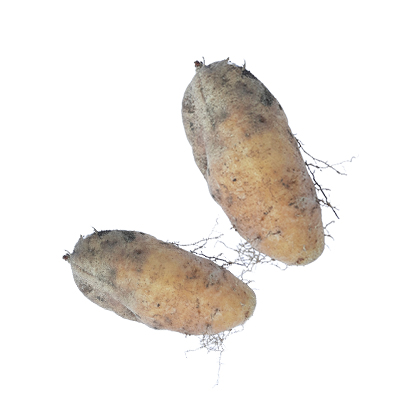
- Tubers - 4-20 per plant, thrust downwards from a corm, on stolons 5-50 cm long, mature tubers shortly cylindrical, sometimes lobed, 8-20 cm × 2-5 cm; skin brown or grey-brown, thin, flesh white.
- Stems - terete, twining to the left, prickly at the base and less so upwards.
- Leaves - alternate or opposite, simple, cordate, 10-15 cm × 10-17 cm, acuminate, 9-13-nerved, secondary veins regular but not conspicuously ladder-like; petiole 1-1.5 times as long as the blade.
- Flowers - unisexual (dioecious), arranged spirally in axillary, usually elongate spike or racemes
- Fruits - (very rare) a reflexed capsule, 27 mm × 12 mm, 3-winged, dehiscent apically at maturity.
- Seeds - winged all around.
Cultivation
Propagated by seeds and cuttings of tubers.
Chemical Constituents
Saponins, allantoin, diosgenin, ß-sitosterol, stigmasterol, cardiac glycosides, polyphenolic substances such as catechins, epicatechins, chlorogenic acids, leucoanthocyanidins and anthocyanins.
Traditional Medicinal Uses
- In West Africa, used as a crude drug for anti-inflammatory, anti-stress, anti-spasmodic, and anti-fatigue.
- The seeds may be used as a purgative when treating rheumatism and dropsy and as an abortifacient.
- It is used in special diets for persons with alimentary disorders.
- The raw tubers are applied to swellings.
- In Indo-China, a decoction of the tubers is used for rheumatism and as a diuretic.
- In China, used for beriberi.
- Tuber paste applied to ulcers, boils, abscesses.
- It is used in the treatment of menopausal symptoms and other genital organ disorders.
Part Used
Reference Sources
- CABI. (No date). Invasive Species Compendium. Dioscorea esculenta(Asiatic yam). https://www.cabi.org/isc/datasheet/19296 24-02-2021
- Chen, X., Cai, L., Zhang, Y., Su, W., Li, B., Zhou, Q. & Zhu, Q. (2020). The complete chloroplast genome sequence of the Dioscorea esculenta (Lour.) Burkill (Dioscoreaceae). Mitochondrial DNA Part B Resources 5(3): 3786-3788. http://doi.org/10.1080/23802359.2020.1832593
- Fern, Ken. (2014). Useful Tropical Plants. Dioscorea esculenta. http://tropical.theferns.info/viewtropical.php?id=Dioscorea+esculenta 24-02-2021
- I.C. Onwueme. (2018). Pl@nt Use. Dioscorea esculenta (PROSEA). https://uses.plantnet-project.org/en/Dioscorea_esculenta_(PROSEA)#:~:text=esculenta%20is%20therefore%20used%20in,swellings%2C%20especially%20on%20the%20throat. 24-02-2021
- StuartXchange. (2015). Philippine Medicinal Plants. Tugi. http://www.stuartxchange.org/Tugi.html 24-02-2021