
Elephant's Foot
Elephantopus scaber L.
Asteraceae
Location in our garden
Principal


Synonym
Elephantopus sinuatus Zoll. & Moritzi
Asterocephalus cochinchinensis Spreng.
Scabiosa cochinchinensis Lour.
Habitus

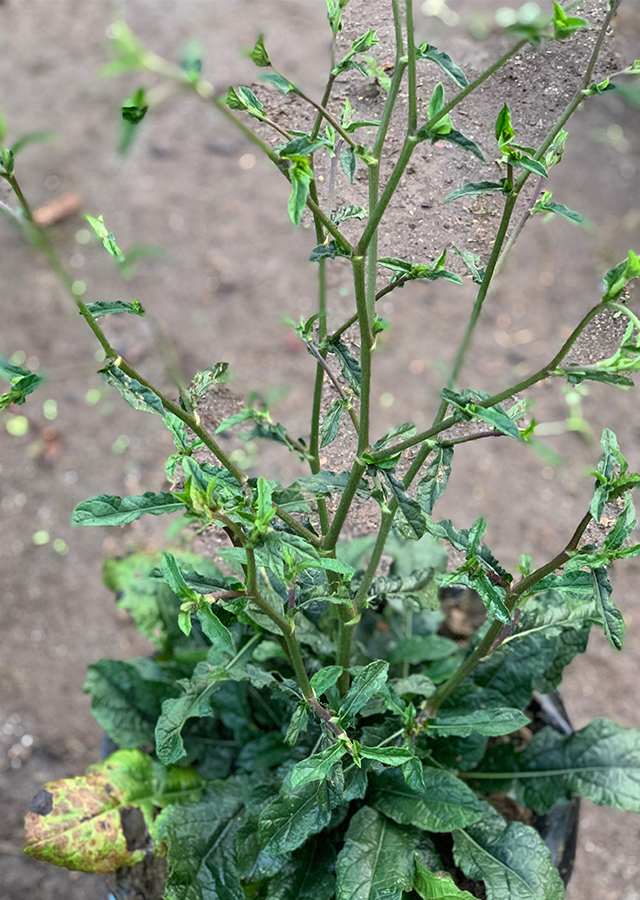
Herbaceous. A herbaceous undergrowth, erect, rigid, erect, hairy up to 80 cm high.
Part Used
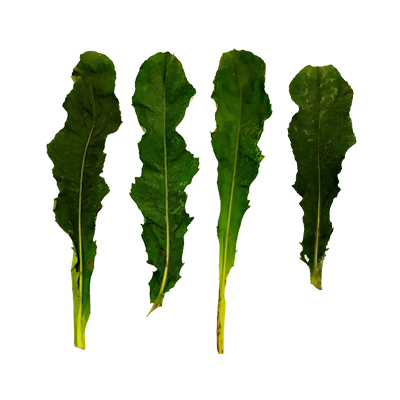
 Leaves
 Flowers
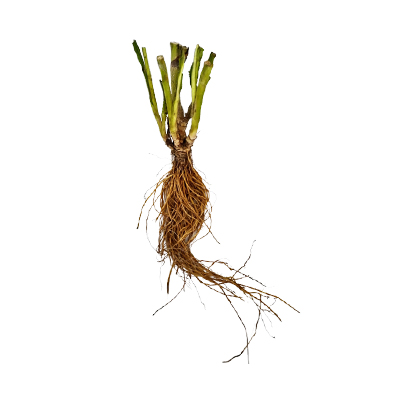
 Roots
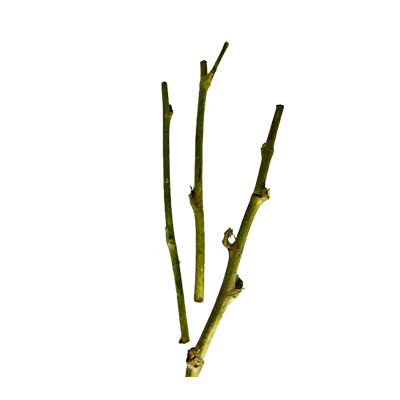
Roots Twigs
Twigs
Growing Requirements
 Full Sunshine
 High Rainfall
Habitat
 Forest
 Roadside
 Grassland
Overview
Elephant's foot native habitat is damp montane forests in subtropical or tropical climates. Tropical Africa, Eastern Asia, the Indian Subcontinent, Southeast Asia, and Australia are all home to the plant. The plant is traditionally used to treat numerous health issues.
Vernacular Names
Tapak Liman (Indonesia), Gojivha or Hastipadi (Sanskrit), Gobhi (Hindi), Didancao (China).
Agroecology
The plant may be found in shaded or open areas such as grasslands, wasteland, roadside, fields, and forest margins at up to 1.500 m elevation.
Morphology
- Stem - forked and stiff.
- Leaves - mostly emerge from the basal rosette, oblong-ovate to oblong-lance, often with a notch on the margins
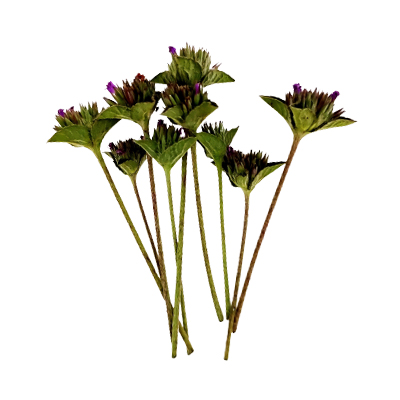
- Flowers - Flower heads many and comprised of up to 4 purple flowers, flower heads are clustered terminally at the branches end, ussualy enclosed by 3 leaf-like bracts.
- Fruits - achenes, ribbed, pappus with rigid bristles.
Cultivation
- Generatively propagate through seed.
Chemical Constituents
Sesquiterpene lactones, triterpenoids, steroids and their glycosides, flavonoids, phenolic compounds, long-chain hydrocarbons, essential oils. The essential oil is reported to contain numerous compounds such as hexadecanoic acid, isopropyl dimethyl tetrahydronaphthalenol, cyclosativene, copaene, zingiberene, phytol and octadecadienoic acid and other compounds.
Traditional Medicinal Uses
Leaves, roots and whole plant of the Elephant's foot are traditionally used to treat numerous health problems such as menstrual-related complaints, cold, headache, cough, diabetes, hepatitis, tuberculosis, gastrovascular and cardiovascular complaints, filariasis and other illnesses. The plants parts may also be applied externally as antiseptic treat wound and anti-venom. The plant also serves as a tonic, antipyretic, diuretic, antibiotics,
Part Used
Reference Sources
Hiradeve, S.M. and Rangari, V.D., 2014. Elephantopus scaber Linn.: A review on its ethnomedical, phytochemical and pharmacological profile. Journal of applied biomedicine, 12(2), pp.49-61.
Kabiru, A. and Por, L.Y., 2013. Elephantopus species: traditional uses, pharmacological actions and chemical composition. Advances in Life Science and Technology, 15(1), pp.6-13.
Tropical Plants Database, Ken Fern. tropical.theferns.info. 2021-10-29. <tropical.theferns.info/viewtropical.php?id=Elephantopus+scaber>