
Velvet Opuntia
Opuntia cochenillifera (L.) Mill.
Cactaceae
Location in our garden
Principal

Synonym
Cactus cochenillifer L.
Cactus subinermis Link ex Steud.
Nopalea brittonii Houghton
Habitus

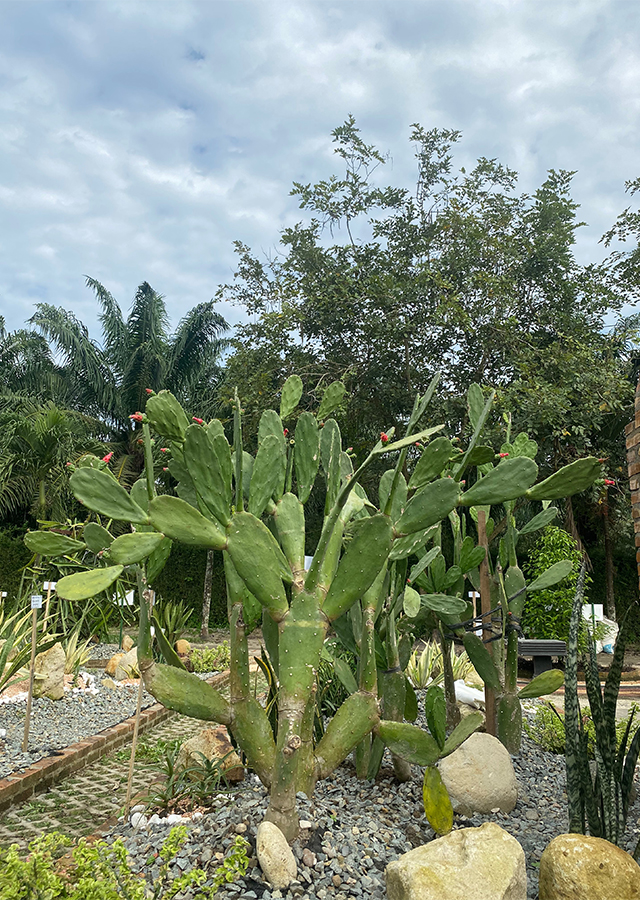
Succulent. Succulent, evergreen shrub or small tree growing 4-5 m tall
Part Used
 Seeds
Seeds Bark
Bark Flowers
 Latex
Latex Roots
Roots
Growing Requirements
 Full Sunshine
 Drought Resistant
Habitat
 Rocky Areas
 Terrestrial
Overview
Cochineal cactus is originated in Central America, Mexico. The plant has edible fruits and stems, which are gathered from the wild for local use. In the past, the plant was often grown as a host plant for the cochineal insects, these insects were then harvested, killed, and made into the red dye cochineal.
Vernacular Names
Cochineal cactus, Wooly joint prickly pear, Nopales opuntia (English), Nopal de la cochinilla (Spanish), Palma-miuda (Portuguese), Cochenillier (French).
Agroecology
Found in hammocks, fields, sandy soils. A plant of arid and semi-arid areas in the tropics, where it is found at elevations up to 1,500 m, sometimes higher. Requires a sunny position. Thriving on neglect, the plant can tolerate almost any condition so long as the soil is well-drained. Established plants are very drought tolerant.
Morphology
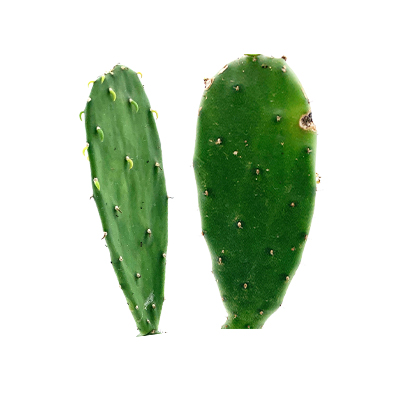
- Stems - stout, with thick joints, several main branches arising from the base; modified (called cladodes) green, fleshy, compressed, oval to egg-shaped, 8–35 cm long, and 5–12 cm wide.
- Leaves - conic, 3 to 4 mm, early deciduous.
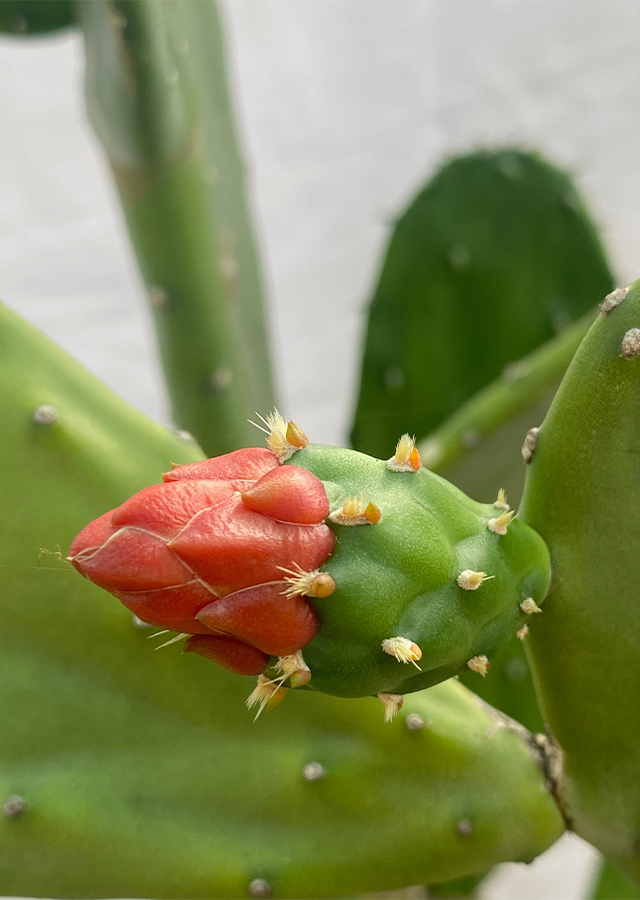
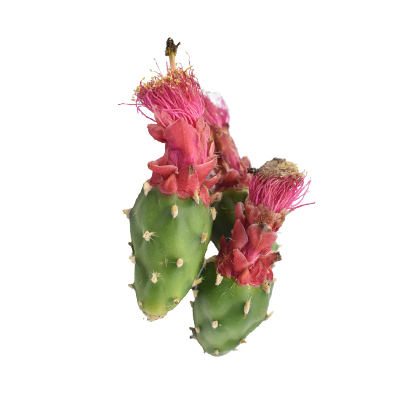
- Flowers - bright red to crimson, with many very short petals, tubular, 1.2 to 1.5 cm in diameter, lots of stamens coming out of the tube, and a long pistil.
- Fruits - red, ellipsoid, 3 to 5 × 2.5 to 3 cm, umbilicus developed but not conspicuous.
- Seeds - grey, thickened discoid, 3–9 mm long
Cultivation
Propagated by seeds - prickly pear is easily propagated and the tiniest bit of leaf will take root almost anywhere.
Chemical Constituents
Polyphenol, betalain, tokoferol, alkaloids, tannins, steroids, flavonoids, terpenes/steroids.
Traditional Medicinal Uses
Medicinal Uses
- Considered anti-inflammatory, analgesic, stomach-protective.
- Studies have shown antibacterial, antifungal, phytoremediation, glycemic, radical scavenging properties.
Traditional Uses
- The grated stem, mixed with cornmeal and soft grease, is warmed for external application to relieve heavy chest colds and fever associated with pneumonia.
- The pads are warmed and placed on the forehead as a refresher.
- The fruits and cladodes are applied in folk medicine.
- The flattened stem sections are used as poultices to treat mycoses (fungal skin infections) and fevers.
- The roasted branches are sliced and applied as a poultice to relieve pain, swelling, and localized burning sensations resulting from filaria.
- The sap of the plant is used in the treatment of baby's colds and wheezing.
- The leaves are used in the treatment of spleen problems.
Part Used

Reference Sources
- CABI. (2021). Invasive Species Compendium: Opuntia cochenillifera. https://www.cabi.org/isc/datasheet/115966. 16-02-2021
- Fern, Ken. (2019). Useful Tropical Plants: Opuntia cochenillifera. http://tropical.theferns.info/viewtropical.php?id=Opuntia+cochenillifera. 16-02-2021.
- Flowers of India. (2021). Opuntia cochenillifera. http://www.flowersofindia.net/catalog/slides/Cochineal%20Cactus.html. 16-02-2021.
- Hindawi. (2017). Opuntia cochenillifera. https://www.hindawi.com/journals/jchem/2017/4301901/. 16-02-2021.
- Invasive Species Specialist Group. (2009). Opuntia cochenillifera. http://www.iucngisd.org/gisd/species.php?sc=1425. 16-02-2021.
- StuartXchange. (2019). Philippine Medicinal Plants. Opuntia cochenillifera. http://www.stuartxchange.org/Dilang-baka.html. 16-02-2021.