
Spider Lily
Hymenocallis littoralis (Jacq.) Salisb.
Amaryllidaceae
Location in our garden
Principal
Synonym
Hymenocallis arenaria M.Roem,
Pancratium americanum Mill.
Troxistemon distichus (Sims) Raf.
Habitus

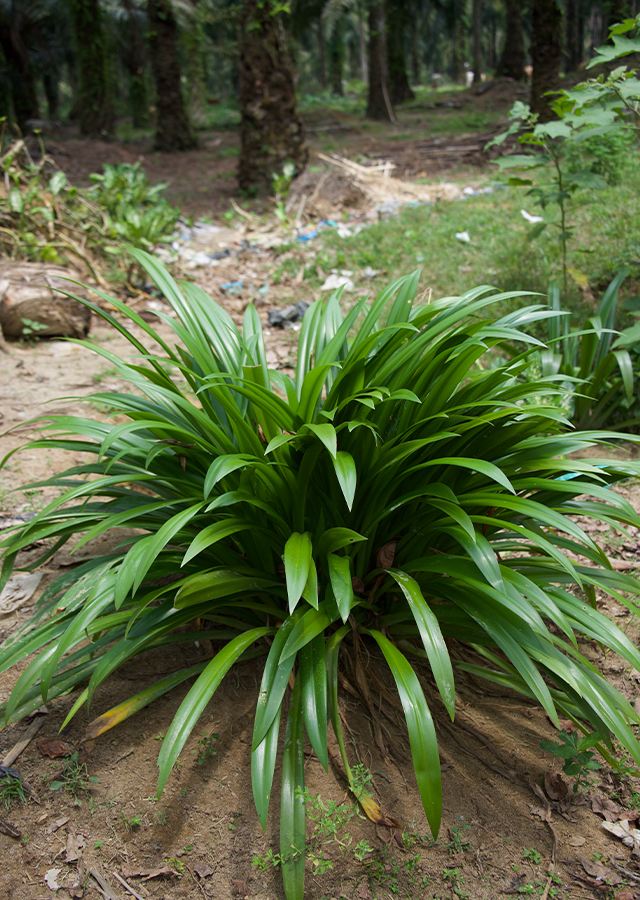
Herbaceous. A bulbous, herbaceous plant, grows up to 80 cm tall
Part Used
 Leaves
 Roots
Roots
Growing Requirements
 Full Sunshine
Habitat
 Wetland
 Riverbanks
Overview
Spider lily originates from South and Central America, but it is cultivated and naturalized in tropical Africa, Asia and the Pacific islands, and is also used as ornamental hedge in many areas. It is an interesting medicinal plant, which deserves more attention in South-East Asia. It is a source of compounds with anticancer and antiviral (including anti-HIV) activities.
Vernacular Names
Bakong (Tagalog-Philippines), Phlapphlueng teenpet (Thai), Bạch trinh biển (Vietnamese).
Agroecology
Spider lily occurs along the seashore and inland in moist, sandy locations at low altitude. It is cultivated in gardens up to 1,500 m altitude. This plant requires partial shade to full sun and temperature between 4-32 ºC.
Morphology
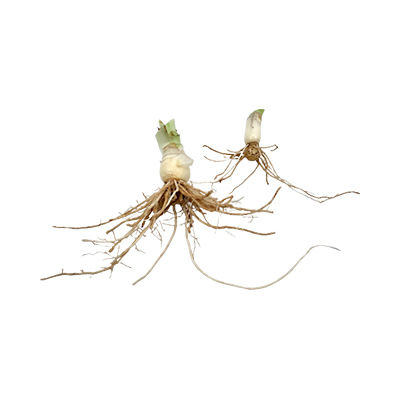
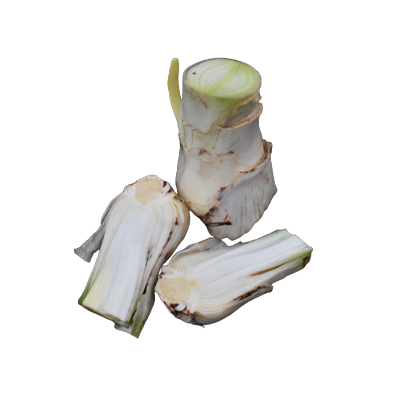
- Bulbs - spherical bulb 7.5-10 cm in diameter.
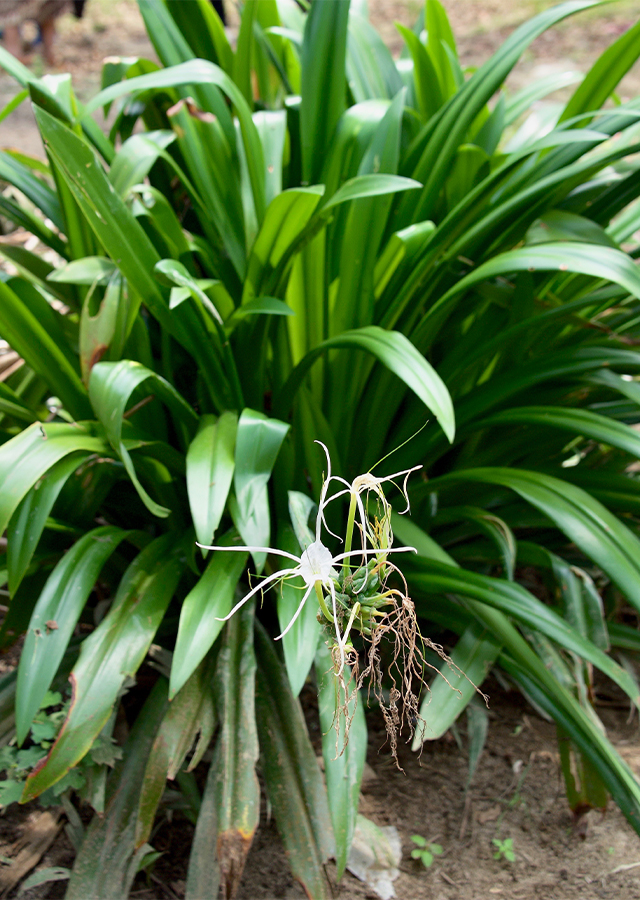
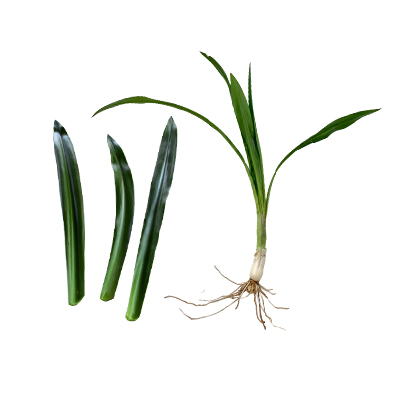
- Leaves - radical, 2-seriate, simple, lorate to linear, 40-120 cm × 1.5-5(-7) cm, acute at apex, sessile, and dark green.
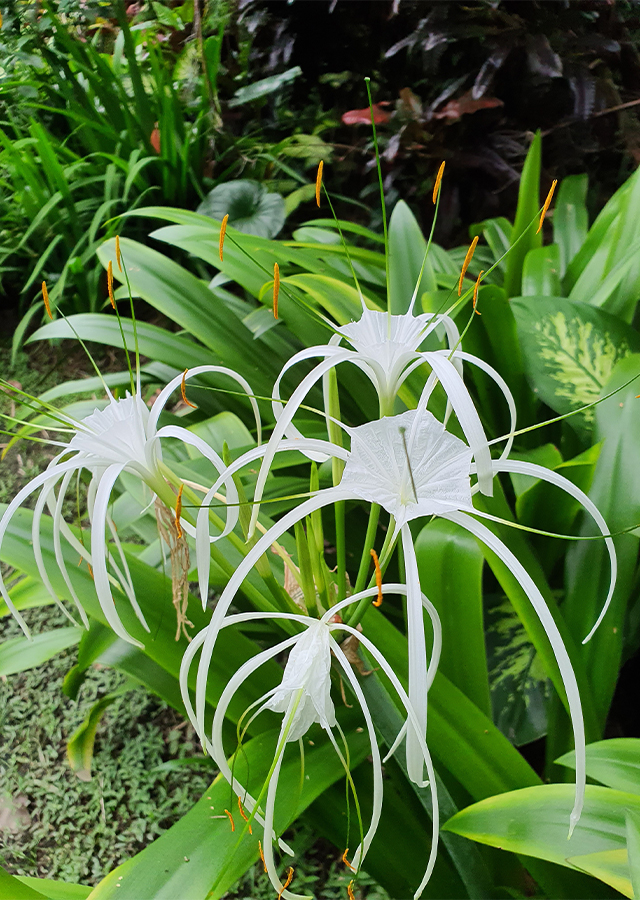
- Flowers - bisexual, large, regular, 3-merous, white, fragrant, sessile; tepals 6, equal, united into a long tube 9-17 cm long, segments linear, 7.5-12 cm long, channelled, with an apical cusp; stamens 6, inserted in the perianth throat and connate at base into a false corona 2.5-3 cm long, free part of filaments 6 cm long, anthers with orange pollen; ovary inferior, 3-celled, style filiform, slightly exceeding the stamens, stigma small and capitate.
- Fruits - fleshy capsule, finally rupturing laterally, few-seeded.
- Seeds - large, with thick, spongy, green testa.
Cultivation
This plant is propagated either by seed or by dividing bulbs. Maturity from seed takes several years. It is easier to break off a piece of the bulb and propagate from it.
Chemical Constituents
Alkaloid, lycorine, tannins, flavonoids, flavonols, saponins, steroids, cardiac glycosides, terpenoids, hippeastrine, hydroxyvittatine, demethylmaritidine, quercetin and glucoside.
Traditional Medicinal Uses
Medicinal Uses
- The plant is emetic.
- Studies on lycorine has shown antineoplastic cytotoxic, wound healing, antibacterial, and antiviral properties.
Traditional Uses
- In the Philippines, the bulb is the only part of the plant used for wound healing.
- In Lao, roots boiled in water, used for testicles too low because of excessive running.
- Mixture of oil and crushed bulbs applied on face to treat freckles and blemishes.
- The juice from the squeezed leaves is applied to cuts and wounds.
Part Used
Reference Sources
- House Plant Expert. (No date). GROWING BEACH SPIDER LILIES. https://www.houseplantsexpert.com/beach-spiderlily.html#:~:text=This%20plant%20is%20happy%20with,seed%20or%20by%20dividing%20rhizomes. 09-04-2021
- Pl@nt Use. (2016). Hymenocallis littoralis (PROSEA). https://uses.plantnet-project.org/en/Hymenocallis_littoralis_(PROSEA). 09-04-021
- Stuart Xchange. (2019). Philippine Medicinal Plant. Hymenocallis littoralis. http://www.stuartxchange.org/SpiderLily. 09-04-2021