
Smooth Rattlebox
Crotalaria pallida Aiton
Fabaceae
Location in our garden
Principal
Synonym
Habitus

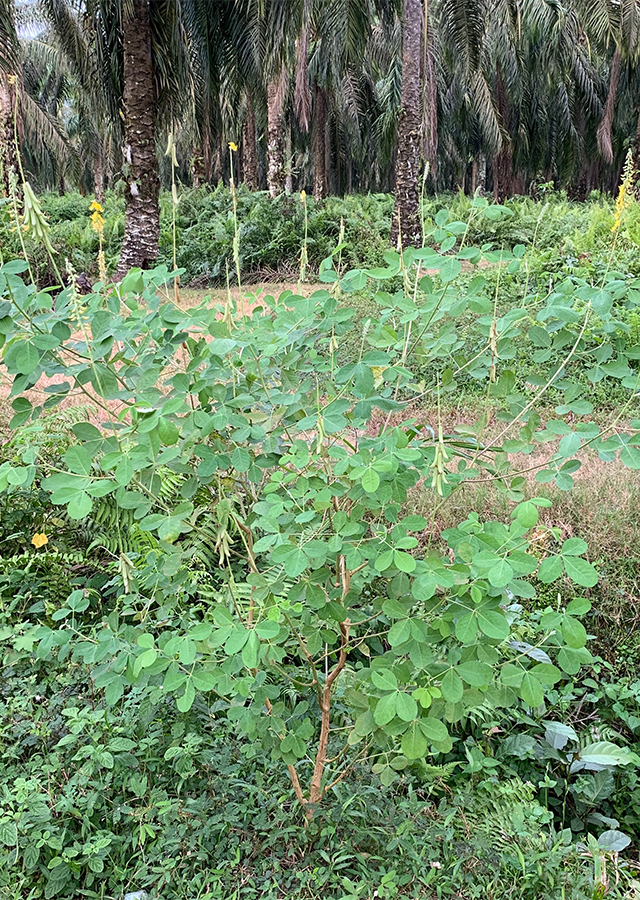
Herbaceous. An erect, herbaceous, well-branched annual plant, growing up to 3 m tall.
Part Used
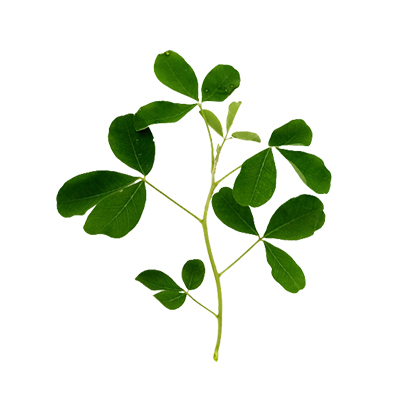
 Leaves
 Seeds
Seeds Flowers
 Roots
Roots
Growing Requirements
 Full Sunshine
Habitat
 Riverbanks
 Forest
 Grassland
Overview
The origin of this species is somewhat unclear. A source says it is from South-East Asia, while the other say it is possibly native to tropical Africa or tropical America. It is so perhaps due to its subsequent pantropical naturalization. Now it is commonly found in India, Sri Lanka and South-East Asia.
Vernacular Names
Hinghai (Thai), Zhu Shi Dou (Chinese), Gestreifte Klapperhuelse (German), Crotalaire Mucronée (French), Kekecrekan, Orok-orok, Telpok (Sundanese, Javanese, Madurese-Indonesia), Gorung-gorung (Philippines).
Agroecology
This species grows naturally on river banks, edges of lakes, extending into woodland, grassland and waste places from 0-1000 m altitude but it tolerates altitude to 1800 m. It absolutely needs light hence shade inhibits its growth strongly. It can live in a wide range of annual rainfall, from 850 mm/year to over 3000 mm/year. The average annual temperature varies from 16-26 °C.
Morphology
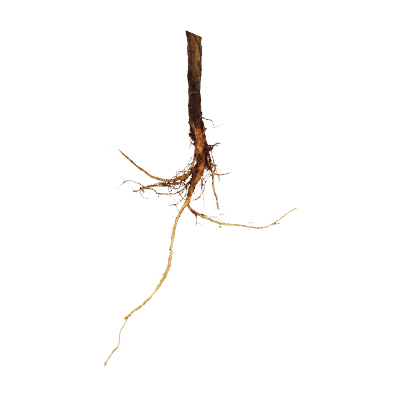
- Roots - long, strong taproot
- Stem – stout, slender longitudinal grooves, ribbed with short appressed hairs.
- Leaves - simple, trifoliolate, about 2.5-10.5 cm long, about 6-20 mm broad, elliptical to obovate, blunt or somewhat pointed, apiculate, glabrous above, thinly appressed puberulous below.
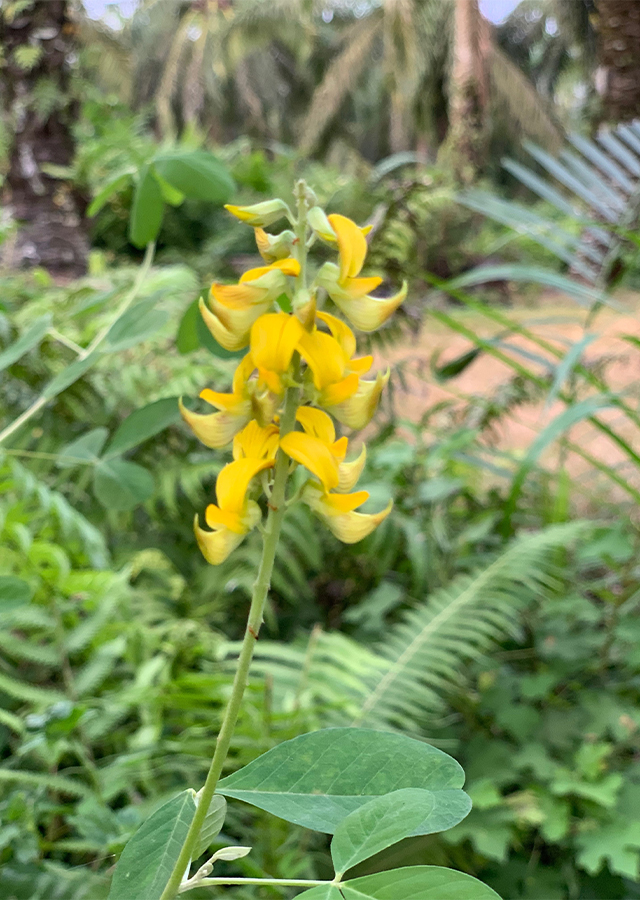
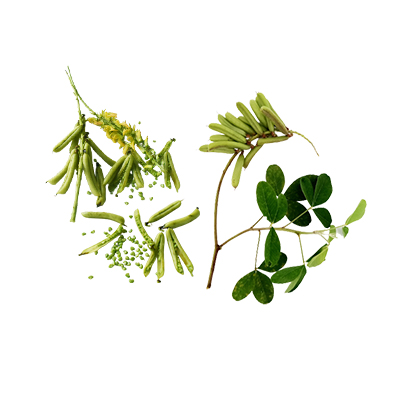
- Flowers - bisexual, zygomorphic, terminal inflorescence, 20-30-flowered, 5-merous; calyx 6-8 mm long, corolla about 1.5 cm long, yellow, often reddish-brown veined.
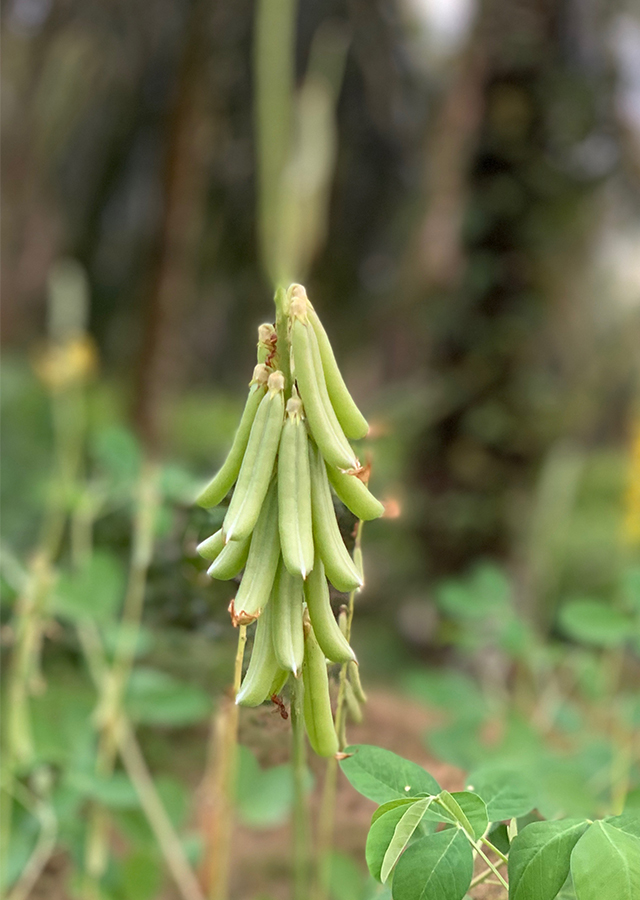
- Fruits – in the form of pods, about 3-5 cm long, 30-40-seeded, yellowish when mature.
- Seeds - heart-shaped, with narrow end strongly incurved, up to 6 mm long, dark grey-green or brown.
Cultivation
It is cultivated by seed and the seedling will emerge after 21-30 days after sowing. The germination rate of fresh seeds is higher compared to the stored ones. The 30 cm tall-plants must be topped in order to promote branching.
Chemical Constituents
Crotolidene, hydroxydihydrobovolide, octacosane, trans-phytyl palmitate, linoleic acid, methyl oleate, ethyl palmitate, and palmitic acid.
Traditional Medicinal Uses
This plant is used for the treatment of urinary problems in traditional medicine. A poultice made of pounded roots is applied to treat painful swelling of joints. While the leaves are extracted and taken as anthelminthic medicine. People in Laos use this plant to reduce fever.
Part Used
Reference Sources
Fadzil, S. R. Yap, A. C, Choo, Y. M. 2017. A New Cyclopentylidene and Other Chemical Constituents from Malaysian Crotalaria pallida (Siklopentilidena Baru dan Juzuk Kimia Lain daripada Crotalaria pallida Malaysia). Sains Malaysiana. 46(9): 1581–1586
Faridah Hanum, I. & van der Maesen, L.J.G. (Editors), 1997. Plant Resources of South-East Asia No. 11. Auxiliary Plants. Backhuys Publishers, Leiden, the Netherlands. 389 pp.