
Intoxicating Yam
Dioscorea hispida Dennst.
Dioscoreaceae
Location in our garden
Principal
Synonym
Dioscorea daemona Roxb.
Dioscorea daemona var. reticulata Hook.f.
Dioscorea hirsuta Blume
Habitus

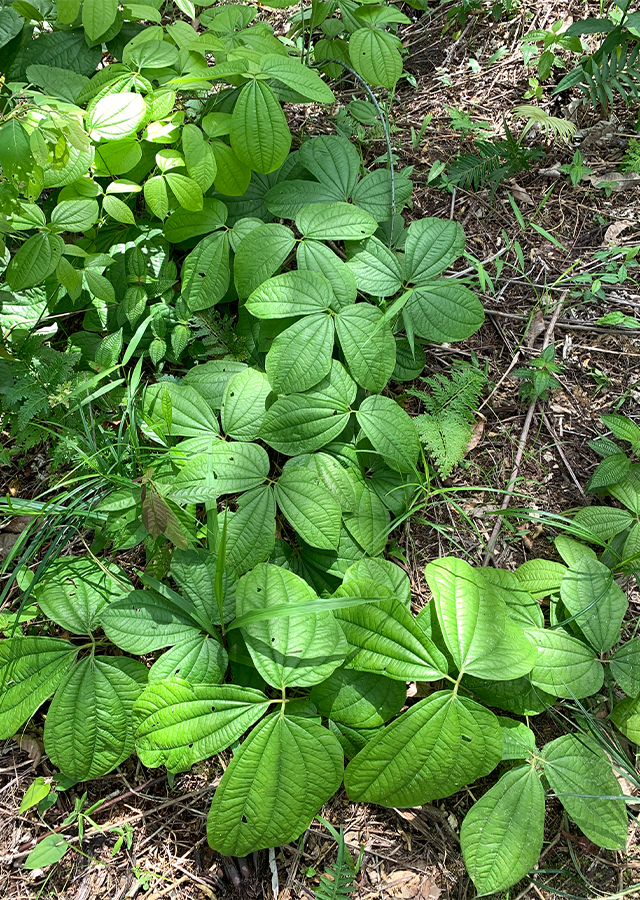
Climbers. Climbers plants with a fibrous root system, 5-20 m long
Part Used
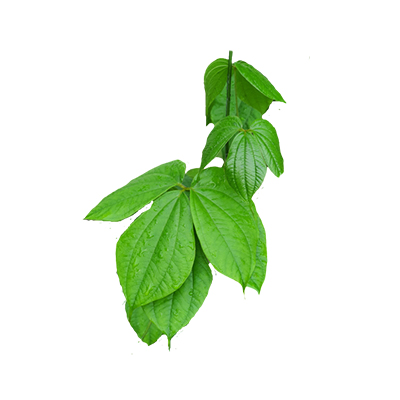
 Leaves
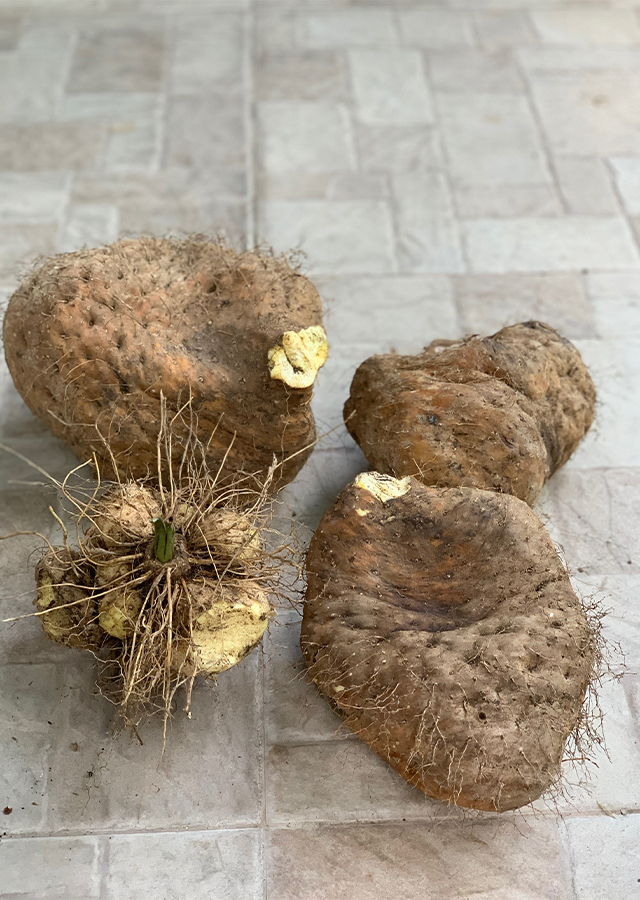
 Tuber
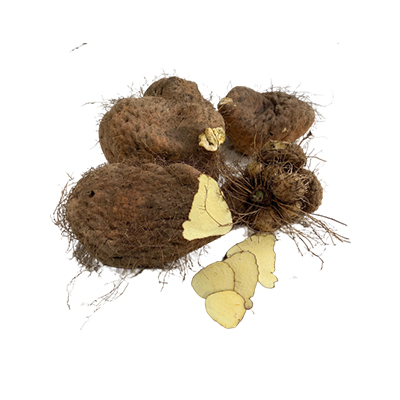
Tuber
Growing Requirements
 Full Sunshine
 Need Shade
Habitat
 Forest
Overview
The species is indigenous to tropical Asia (India) to southwest China, Taiwan, Andaman Islands to Papua New Guinea and the Philippines. Even in South-East Asia the plant is scarcely cultivated, so its spread is practically confined to its area of natural occurrence.
Vernacular Names
Kloi (Thailand), Nami (Philippines), Igname Épineuse Amčre (French), Gadog (Malay), Bittere Yamswurzel (German).
Agroecology
Its natural habitat is chiefly in tropical rain forests, thickets and scrub forests, forest margins, at low and medium altitudes; near sea level to 1,500 m. The plant thrives best on soils rich in humus. The plant is seldom cultivated, and tubers are harvested from the wild.
Morphology
- Tubers - subterranean, numerous, densely crowded in clusters, irregularly shaped and variable in size.
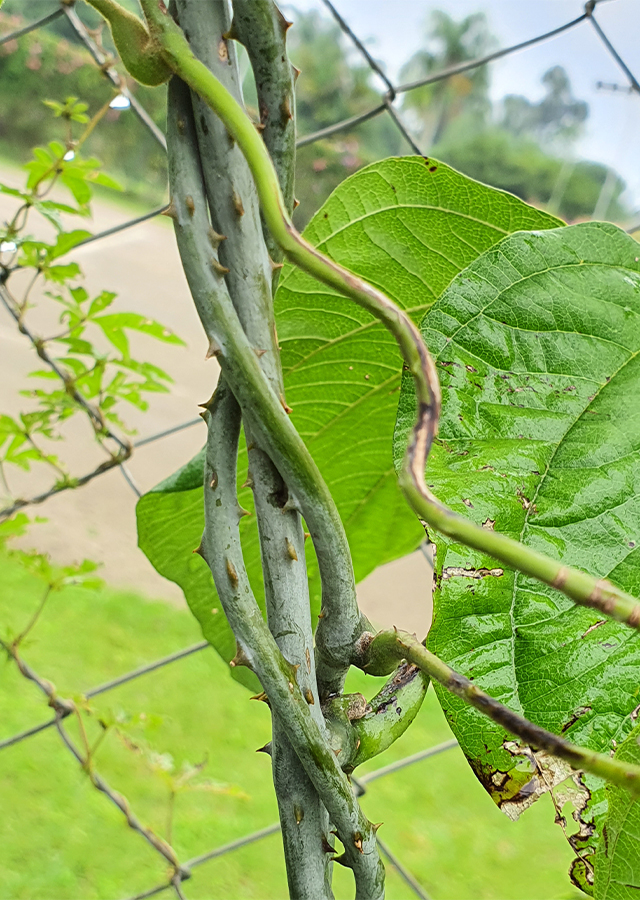
- Stems - covered with few or many short, sharp spines. Leaves - 3-foliolate, the leaflets 12 to 20 cm long, somewhat hairy, the lateral ones oblique, oblong-ovate, the terminal one equilateral, oblong to oblong-obovate.
- Flowers - small; unisexual male flowers with 6 stamens, female flowers similar to males, 3-winged, 3-celled, ovules 2 in each cell.
- Fruit - a capsule, oblong and about 5 cm long.
- Seeds - inserted near apex of capsule.
Cultivation
The plant is propagated by means of the tuber. As with other yams, best yields are obtained if planted on mounds or ridges.
Chemical Constituents
Dioscorine, alkaloids, flavonoids, saponins, tannins, diosgenin, hydroxybenzoic acid, hydroxybenzaldehyde, protocatechuic acid.
Traditional Medicinal Uses
- D. hispida exhibited convulsant activity, toxicity, analeptic action, local anaesthetic activity, adrenaline potentiating action, antidiuretic effect and anti-acetylcholine.
- Tuber, raw or cooked used as anodyne and maturative for tumors and buboes, also used arthritic and rheumatic pains. sprains and contusions.
- Use poultice of freshly pounded material or decoction as external wash.
- In Bangladesh, tubers used to kill worms in wounds. Various plant parts used in whitlow, sores, boils, and bites of rabbit, jackal or dog.
- In India, tubers used for birth control. Also used for ulcer treatment.
- Tuber paste is applied to peeling skin of feet.
- In Malaysia, pounded leaves applied to sores of yaw. In Johore, decoction of tuber used as alterative and diuretic in chronic rheumatism.Pounded leaves from intoxicating yam used for healing sores of yaw.
- Infusion of corms of detoxicated tubers used to decrease blood glucose.
- Tendril of yam have been used as deworming medicine.
- In Thailand, used to treat constipation.
Part Used
Reference Sources
- DLIUM. (2020). Gadung (Dioscorea hispida) https://www.dlium.com/2020/03/gadung-dioscorea-hispida.html. 16-01-2021.
- NCBI. (2017). Dioscorea spp. (A Wild Edible Tuber): A Study on Its Ethnopharmacological Potential and Traditional Use by the Local People of Similipal Biosphere Reserve, India. https://www.ncbi.nlm.nih.gov/pmc/articles/PMC5306286/. 17.07.2020.
- Lim, T.K., (2016). Edible Medicinal and Non-Medicinal P. lants. New York. Springer Vol.10 page 266
- Pl@nt Use. (2016). Dioscorea hispida (PROSEA). https://uses.plantnet-project.org/en/Dioscorea_hispida_(PROSEA). 17.07.2020
- Stuartxchange. (2018). Philippine Medicinal Plants. Nami. http://www.stuartxchange.org/Nami.html. 09.01.2021