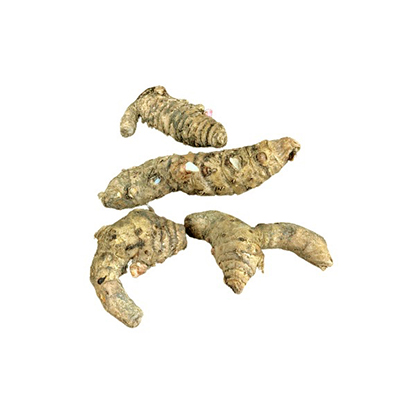
Pale Turmeric
Curcuma heyneana Valeton & Zijp
Zingiberaceae
Location in our garden
Principal

Synonym
Habitus

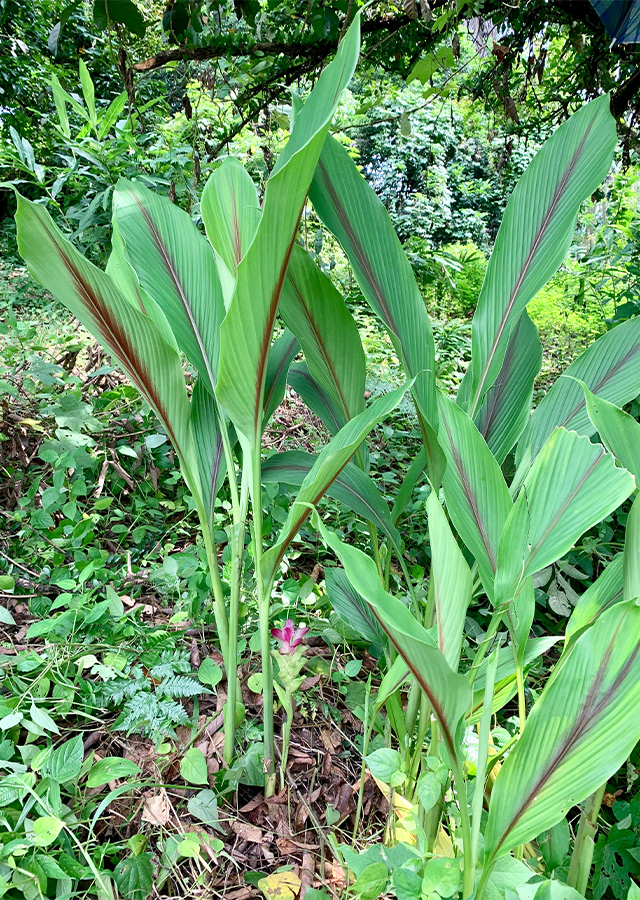
Herbaceous. Herbaceous perennial, much branched,pseudostem, growing to 1-2 m tall
Part Used
 Rhizome
Growing Requirements
 Need Shade
Habitat
 Forest
Overview
Pale turmeric is native to tropical regions, especially in Indonesia. It is traditionally
used as in skin care, for cosmetic use and body freshness, by the Javanese and
Balinese women, as well as sometimes being used for food. It can be harvested
from the wild, but is also sometimes cultivated for its rhizome in Indonesia.
Vernacular Names
Temu Giring (Javanese, Indonesia), Kuning Gajah (Indonesia)
Agroecology
Pale turmeric grows wild in secondary forest,
teak forest, and abandoned places, up to 750 m
altitude. Best grown in rich, medium moisture,
well-drained soils in part shade. Tolerates full
sun only if grown in consistently moist soils. Soil
pH affects the flower colour of most cultivars
except white (blue in highly acidic soils and lilac
to pink in slightly acidic to alkaline soils).
Morphology
- Rhizomes - outside pale yellow, inside whitish with yellowish centre to bright yellow.
- Stems - pseudostems, green in colour.
- Leaves - sheaths 22-35 cm long, blades elliptical, 17.5-42 cm x 7.5-13 cm, uniformly green.
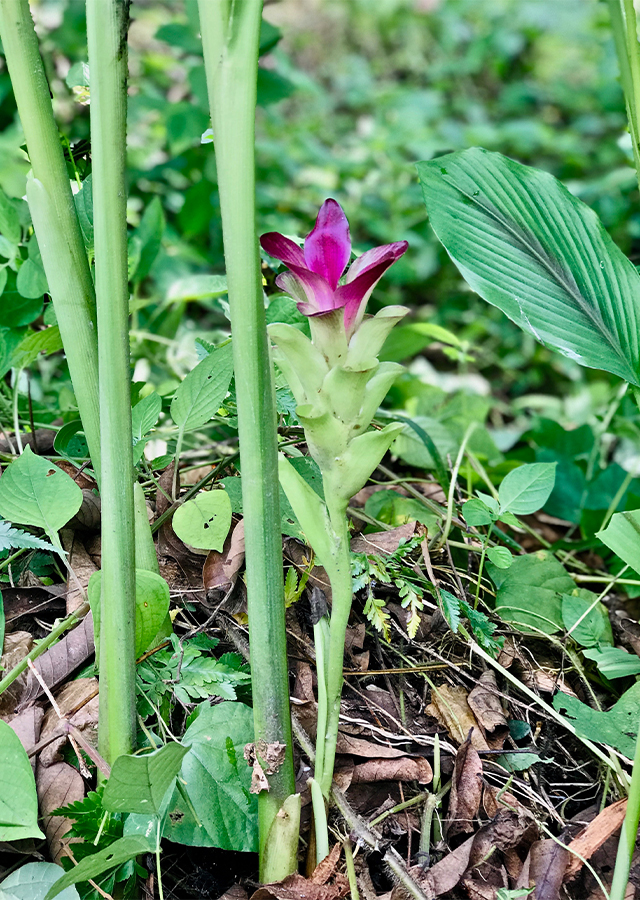
- Flowers - inflorescence on a separate shoot, bracts pale green, coma bracts palepink with a dark tip, corolla about 4 cm long, whitish. Labellum about 16 mm x 16 mm, with a dark yellow median band to yellow, anther with short spurs.Leaf - sheaths 22-35 cm long, blades elliptical, 17.5-42 cm x 7.5-13 cm, uniformly green.
Cultivation
- Propagated by seeds - best sown as soon as it is ripe. Germinates best at temperatures around 20 °C.
- Division of the rhizome when the plant is dormant.
Chemical Constituents
- Flavonoid, essential oil, curcumin, monoterpene, sesquiterpenes (germacrone, dehydrocurdione, isocurcumenol, curcumenol, curcumanolides A and B, zerumbone, oxycurcumenol), saponin, and tannin.
Traditional Medicinal Uses
- The rhizomes are considered to be anthelmintic, cooling, and detergent. As an anthelmintic, they are especially useful in the treatment of pinworms.
- The bitter rhizomes are given, together with other medicinal herbs, to treat fatty degeneration.
- Rhizomes are the principal ingredient of a body lotion or powder used in traditional Javanese skin treatment, often administered to the bride-to-be.
- It is used as a folk medicine for brides to combat fatigue. They are also often applied in modern beauty parlours.