
Orosne
Polygala paniculata L.
Polygalaceae
Location in our garden
Principal

Synonym
Polygala amaniensis Gürke ex Chodat
Polygala brasiliensis Mart.
Polygala carlotina E.H.L.Krause
Habitus

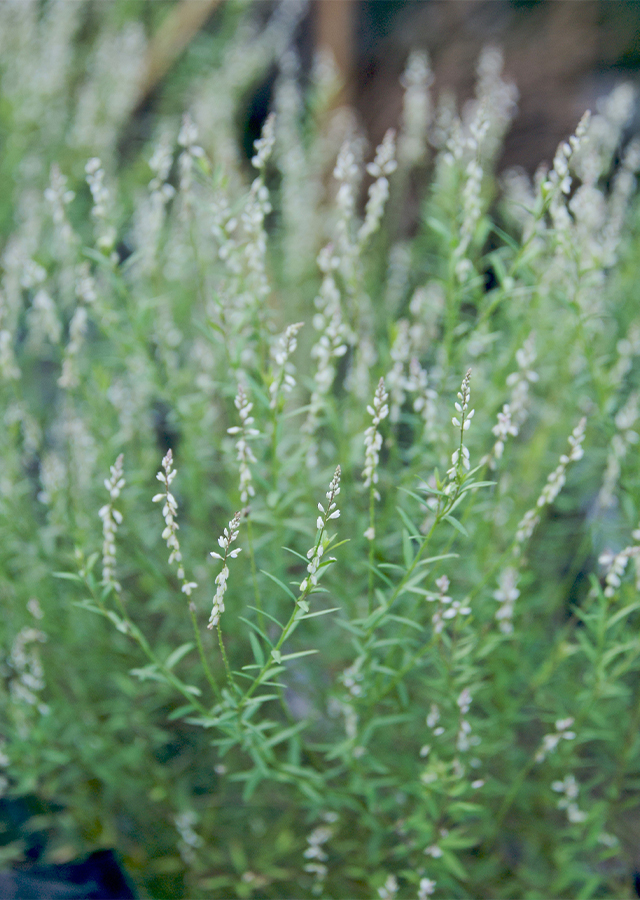
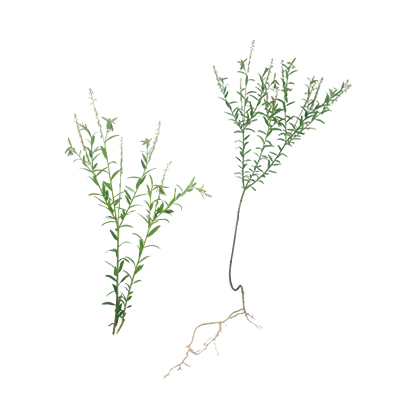
Herbaceous. An erect much-branched annual herb, woody at base, 10-50 cm tall.
Part Used
 The Whole Plant
Growing Requirements
 Need Shade
Habitat
 Roadside
 Grassland
Overview
Orosne is native to tropical America from Mexico to Brazil. It was introduced into central tropical Africa, Indo-Australia and the Pasific Islands including South-East Asia and now abundantly naturalised.
Vernacular Names
Jukut rindik, Sasapuan, Katumpang Lemah (Sundanese - Indonesian), Hierba del colico (Spanish), Essence Fragile (French), Barba-de-Sao-Pedro (Portuguese), Rispen-Kreuzblume (German), Yuan zhui hua yuan zhi (Chinese).
Agroecology
Polygala paniculata occurs in waste places, plantations and fields on different soils. Avoiding dry areas, often abundant, and from sea level up to 2,250 m altitude.
Morphology
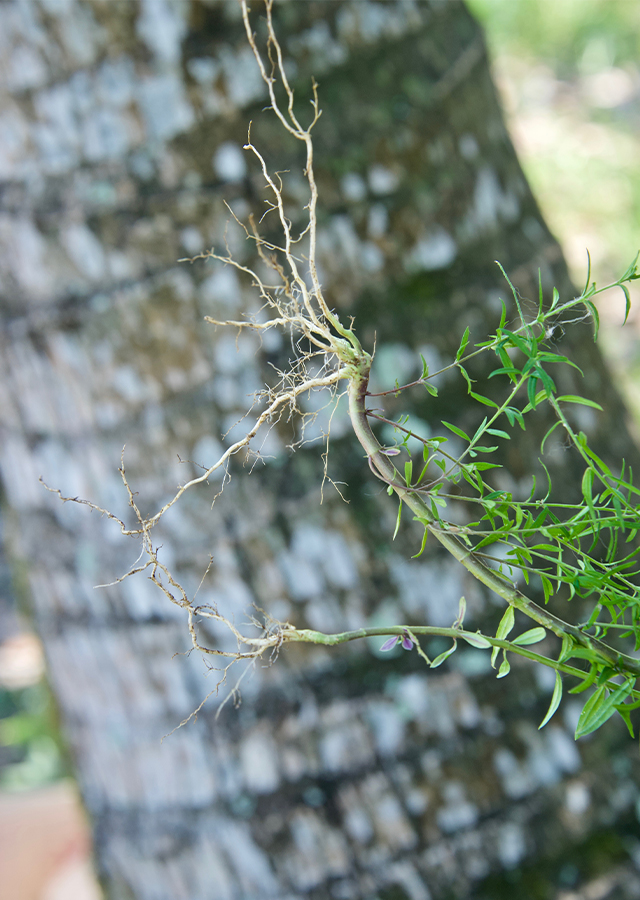
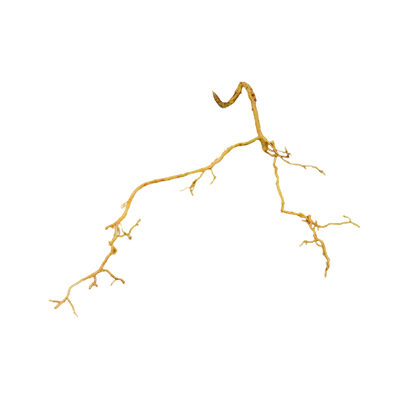
- Roots - tap root, smell of root beer is produced by the plant.
- Stems - slender, glandular-pubescent.
- Leaves - alternate, but the lower ones in 1–2 verticels of 4–5 leaves, petiolate, linear to linear-lanceolate.
- Flowers - 1.5-2 mm long, sepals lanceolate, obtuse, wings weakly 3-veined, upper petals lanceolate, whitish, often purple-tinged.
- Fruits - capsule obliquely obovate-elliptic in outline, 1.75 × 1–1.3 mm, unwinged, glabrous.
- Seeds - ellipsoid, 1.2–1.5 × 0.5 mm, sparsely pubescent; caruncle reduced to the caruncular appendages up to as long as half of the length of the seed.
Cultivation
Propagated by seed.
Chemical Constituents
Alkaloid, flavonoid, tannin, steroids, saponin, anthocyanidins delphinin-3-bioside, cyanidin- 3,5-dimonoside, coumarins aurapten, phebalosin, murrangatin, methyl salicylate.
Traditional Medicinal Uses
- The plant has antifungal and antidepressant- properties.
- Studies have shown scientific evidence for its analgesic, antiedemato-genic and gastroprotective activities.
- It is used as a medicinal plant against snake bites and blenorrhagias.
- In Peninsular Malaysia, the leaves and roots are used as a tonic.
- In Brazil, it is used as topical preparations to treat physical traumas.
- A sweetened infusion of the aerial parts is a remedy for gonorrhoea and lumbago, and the pulverized leaves may be applied to wounds.
- In New Guinea, the women eat the flowers against infertility.
Part Used
Reference Sources
- Irwanto, R.R.P. (2002). Polygala paniculata L. In: van Valkenburg, J.L.C.H. and Bunyapraphatsara, N. (Editors): Plant Resources of South-East Asia No 12(2). Medicinal and poisonous plants 2. Prosea Foundation, Bogor, Indonesia. pp. 448 - 449.
- Steenis, C.G.G.J. van (1988). Flora Malesiana Series I - Spermatophyta (Flowering Plants), Vol. 10, Part 3. Dordrecht, the Netherlands: Kluwer Academic Publishers. pp. 475-476.