
Cathedral bells
Kalanchoe pinnata (Lam.) Pers.
Crassulaceae
Location in our garden
Principal


Synonym
Bryophyllum calcicola (H.Perrier) V.V.Byalt
Bryophyllum calycinum Salisb.
Bryophyllum germinans Blanco
Habitus

Succulent. A succulent, evergreen-perennial plant, 0.4-1.4 m in height
Part Used
 Leaves
Growing Requirements
 Full Sunshine
 Need Shade
 Drought Resistant
Habitat
 Wetland
 Riverbanks
 Forest
 Coastal
 Roadside
Overview
Cathedral bells is native to Madagascar. It is used in folkloric medicine in tropical Africa, tropical America, India, China, and Australia. The only Kalanchoe species found in South America, however 200 other species are found in Africa, Madagascar, China and Java. The plant has a wide range of medicinal uses and is often harvested from the wild. It is commonly grown as an ornamental in the tropics, and as a houseplant in colder areas.
Vernacular Names
Koppata (Bangladesh), Bendingin (Brunei), Lao di sheng gen (Chinese), Bryophylle (French), Panphooti (India), Sodifafana (Madagascar), Sedingin (Malaysia), Katakataka (Philippines), Chandelier plant (South Africa), Benchachat (Thai), Cocor bebek (Indonesia).
Agroecology
K. pinnata is fairly abundant along the coast growing in sandy soils and along granite outcrops. It is also found in the temperature humid and subhumid climates of the central highlands of Madagascar, with annual rainfall between 1,000 and 2,000 mm. In Fiji, it often forms dense stands, occurring from near sea level to an elevation of 550 m as a weed of waste places, cultivated fields, and roadsides, naturalized on rocky coasts, slopes, and sometimes in a dry forest.
Morphology
- Stems - erect, more or less branched, tall hollow stem, smooth, green with dark purple blotches.
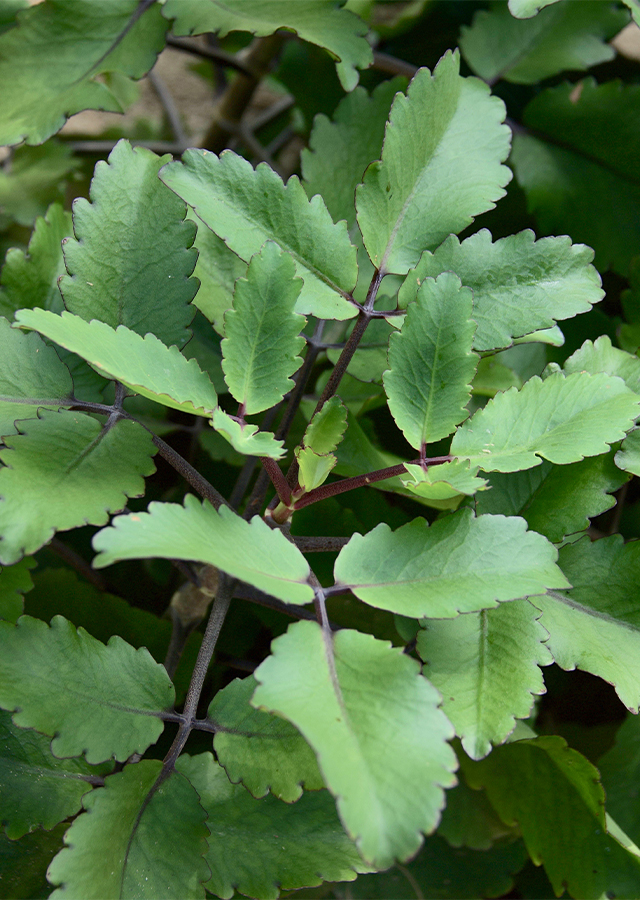
- Leaves - simple or pinnately compound, vary in size and form, with leaflets elliptic, about 10 cm long, thick, succulent, and scalloped margins. The young plants often develop at the margins of the leaves.
- Flowers - cylindric, pendulous in large, terminal panicle. Calyx is tubular, brownish or purplish, 3.5-4 cm long. Corolla is tubular, about 5 cm long.
- Fruits - a follicle with many seeds.
- Seeds - striate.
Cultivation
- Generative propagation is by seeds.
- Small plantlets can be detached from the leaf margins and grown on.
- Vegetative propagation is by stem and leaf cuttings. Just one leaf with part of its stem, when set on the soil, will produce roots and grow into a new plant.
Chemical Constituents
Alkaloids, terpenoids, flavonoids, saponins, tannins, sitosterol, ɑ-amyrin, β-amyrin acetate, bryophyllin A, arachidic acid, astragalin, benzenoid, behenic acid, steroids, butadienolides.
Traditional Medicinal Uses
- Leaves considered astringent, antiseptic, hemostatic, refrigerant, emollient, counterirritant, mucilaginous, vulnerary, depurative, disinfectant, and tonic.
- Pharmacologic studies have showed pharmacologic properties: immunomodulatory, CNS (Central Nervous System) depressant, analgesic, anti-inflammatory, anti-allergic, antianaphylactic, antileishmanial, anti-tumorous, antiulcer, antibacterial, antifungal, antiviral, febrifuge, gastroprotective, immunosuppressive, insecticidal, sedative, and muscle relaxant.
- Pounded fresh material is applied as a poultice for a variety of conditions: sprains, eczema, infections, burns, carbuncle and erysipelas, and to stop haemorrhages (to the soles of the feet).
- Leaves pounded and mixed with salt, used as plaster and applied to stomach to relieve enuresis.
- Juice of leaves is used for diarrhoea, dysentery, cholera, and lithitiasis.
Part Used

Reference Sources
- CABI. (2013). Invasive Species Compendium. Kalanchoe pinnata (cathedral bells). https://www.cabi.org>isc>datasheet/29328. 28-07-2020.
- Fern, Ken. (2019). Useful Tropical Plants. Kalanchoe pinnata. http://tropical.theferns.info/viewtropical.php?id=Kalanchoe+pinnata&redir=Bryophyllum+pinnatum. 28-07-2020.
- Globinmed. (No date). Bryophyllum pinnatum (Lam.) Oken. https://www.globinmed.com/index.php?option=com_content&view=article&id=105047:bryophyllum-pinnatum-lam-oken-r&catid=286.
- Researchgate. (2016). The "Wonder Plant" Kalanchoe pinnata (Linn.), A Review. https://www.researchgate.net/publication/299603146_The_Wonder_Plant_Kalanchoe_pinnata_Linn_Pers_A_Review. 28-07-2020.
- StuartXchange. (2019). Philippine Medicinal Plants. Katakataka. http://stuartxchange.org/Katakataka. 28-07-2020.