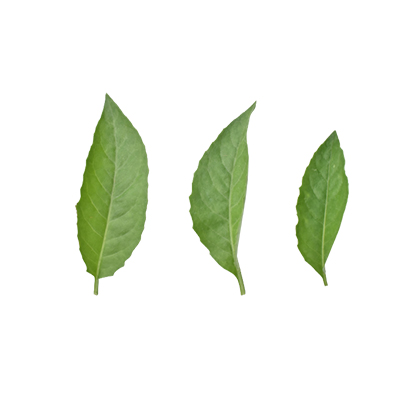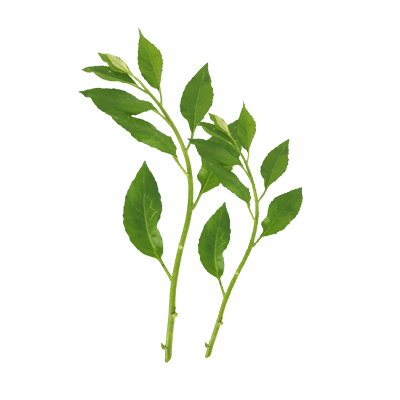
Longevity spinach
Gynura procumbens Merr.
Asteraceae
Location in our garden
Principal


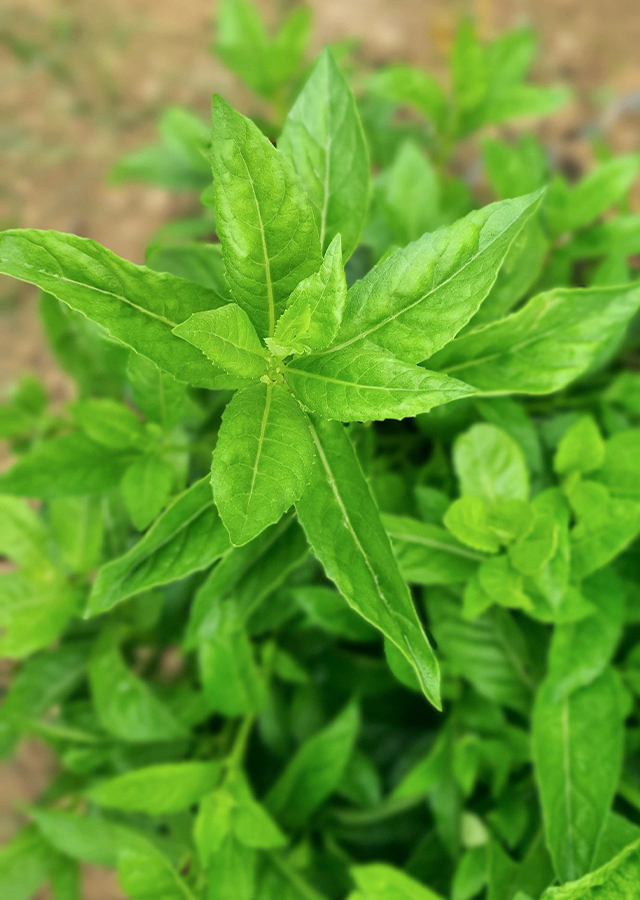
Synonym
Cacalia cylindriflora Wall.
Crassocephalum latifolium S.Moore
Gynura affinis Turcz.
Habitus

Herbaceous. A scrambling or weakly climbing, perennial herb, growing 25-30 cm tall
Part Used
 Leaves
Growing Requirements
 Need Shade
Habitat
 Riverbanks
 Forest
 Shrublands
Overview
This plant that was originally found in China, South-East Asia, and Africa has been proven to have high medicinal value. Lately, people have started to grow this plant in their very own backyards. Due to all of its benefits, it’s easy to see why the plant has gained so much popularity in households all over the world.
Vernacular Names
Chi angkam (Cambodia), Man san qi cao (Chinese), Dewa raja (Malaysia), Paetumpung (Thailand), Kim That Tai (Vietnamese)
Agroecology
Longevity spinach grows well either in the shade or full sun, but semi-shade is preferred as it tends to grow better. It can be slowly adapted to grow in full sun, so long as the plant’s roots don’t dry out. In the spring, the plant rapidly regenerates from the root system. This plant grows as an annual vegetable or can be kept potted inside during the winter months. It only requires a slight amount of care and is easily harvested by pinching off the end leaves.
Morphology
- Stems - up to 6 m long, leafy, glabrous or sparsely pubescent.
- Leaves - are stalked (the uppermost onesstalkless), ovate-elliptic or lanceolate, 3.5 to 8 centimeters long, and 0.8 to 3.5 centimeters wide, with somewhat entire or toothed margins.
- Flowering heads - are panicled, narrow, yellow, and 1 to 1.5 centimeters long.
- Involucral bracts are smooth and up to 6 millimeters long.
- Achenes - are very small and smooth, with very close and slender ribs.
- Fruit - 5—6 mm long.
Cultivation
It is quite easy to grow and propagates readily from cuttings placed in water, take cuttings with two or three leaves attached, dip the cut end in rooting hormone powder, and plant them immediately in moist soil
Chemical Constituents
Alkaloids, steroids, tannins, flavonoids, glycosides, terpenoids, Peroxidase, volatile oils, carotenoids, quercetin, apigenin, luteolin, kaempferol, astragaline, negletein, methoxycinnamic acid, phenylethyl, glucopyranoside, dicaffeoylquinic acid methyl ester, dicaffeoylquinic acid ethyl ester, protocatechuic acid and eugenol glucoside
Traditional Medicinal Uses
- G. procumbens has been reported to exhibit antihypertensive, cardioprotective, antihyperglycemic, fertility enhancement, anticancer, antimicrobial, antioxidant, organ protective, and antiinflammatory activity.
- It lowers levels of cholesterol and triglycerides in the body.
- The plant is febrifuge. It is used in the treatment of fevers, kidney troubles and dysentery.
- The semi-succulent leaves are applied externally to relieve rheumatic pains and general body-pains.
- Used for kidney problem. The plant is also used as decoction to treat dysentery. Leaves of the plant can be eaten to treat diabetes and hypertension