
Cloves
Syzygium aromaticum (L.) Merr. & L.M.Perry
Myrtaceae
Location in our garden
Orchard
Synonym
Caryophyllus aromaticus L.
Caryophyllus hortensis Noronha
Eugenia aromatica (L.) Baill.
Habitus

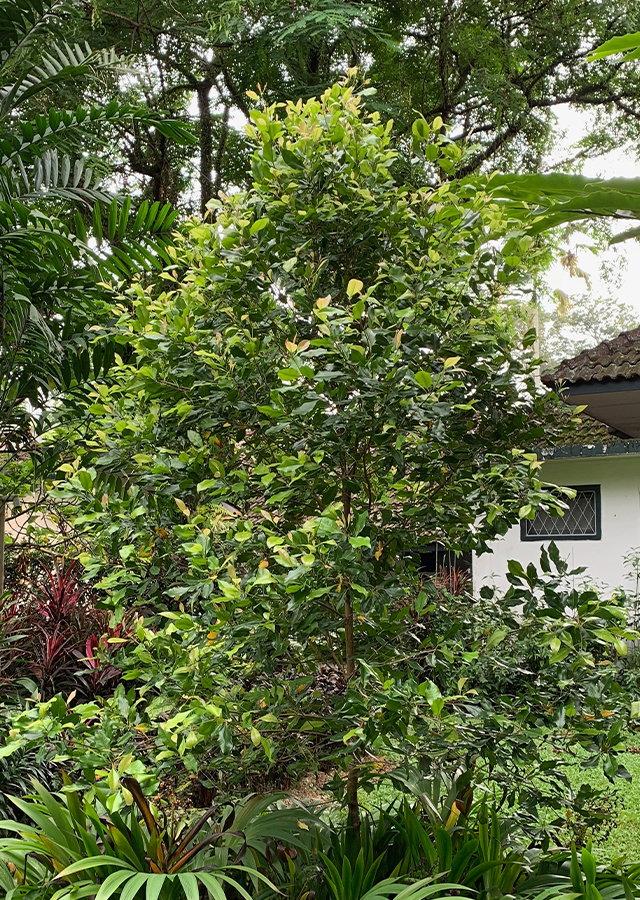
Trees. An evergreen tree, perennial, 6–15 m tall, can grow up to 30 m tall
Part Used
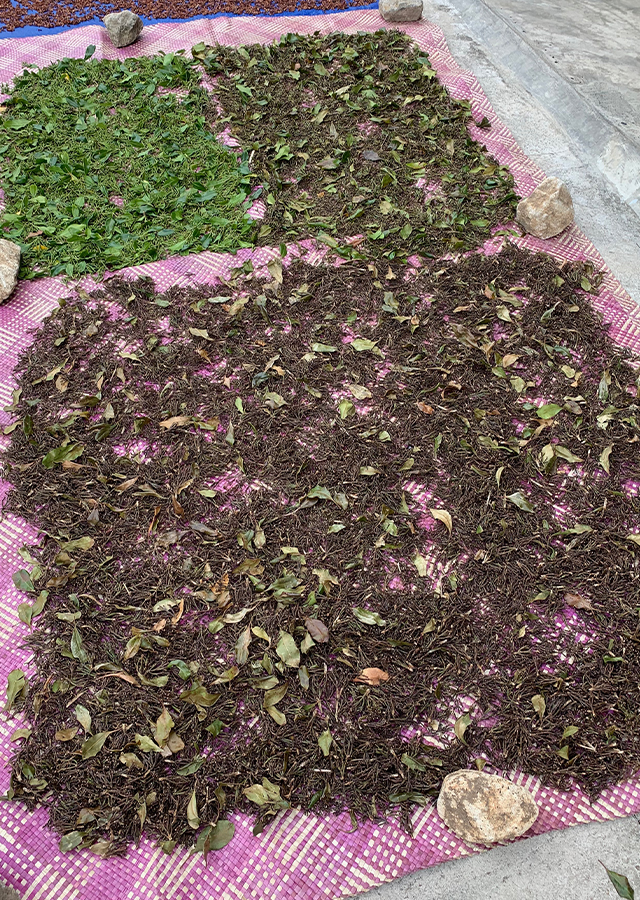
 Leaves
 Bark
Bark Flowers
Growing Requirements
 Full Sunshine
 Need Shade
Habitat
 Terrestrial
Overview
Cloves are native to Indonesia and occur especially in the North and Central Maluku (Moluccas) and Papua Barat (Papua). It is one of the most valuable spices that has been used for centuries as food preservative and for many medicinal purposes. The plant has been introduced and now widely cultivated around the world.
Vernacular Names
Ding xiang (Chinese), Kruidnagel (Dutch), Kruidnagel (Dutch), Clous de Girofle (French), Gewürznelke (German), Lavamg (Hindi), Kuroobu (Japanese), Bunga cengkeh (Malaysia).
Agroecology
Being strictly a tropical species, clove requires a warm humid tropical climate with an annual rainfall from 1,500 to 2,500 mm. It grows well from mean sea level up to an elevation of 1,000 m. In its native habitat it is commonly found in woodlands and rainforests. It prefers well-drained, deep loamy soils with high humus content and black loams of semi-forest regions and will also grow on loose well-drained lateritic soils.
Morphology
- Roots - tap root with lateral root.
- Stem - straight with smooth grey bark, widely branched.
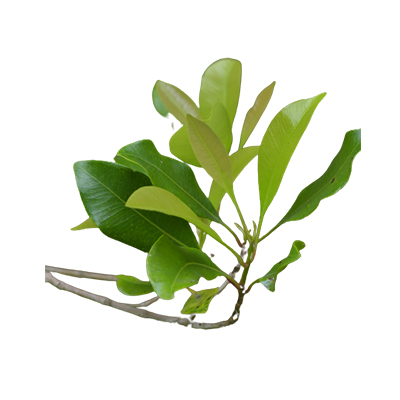
- Leaves - large, pinkish-bronze when young turning to lime green with age.
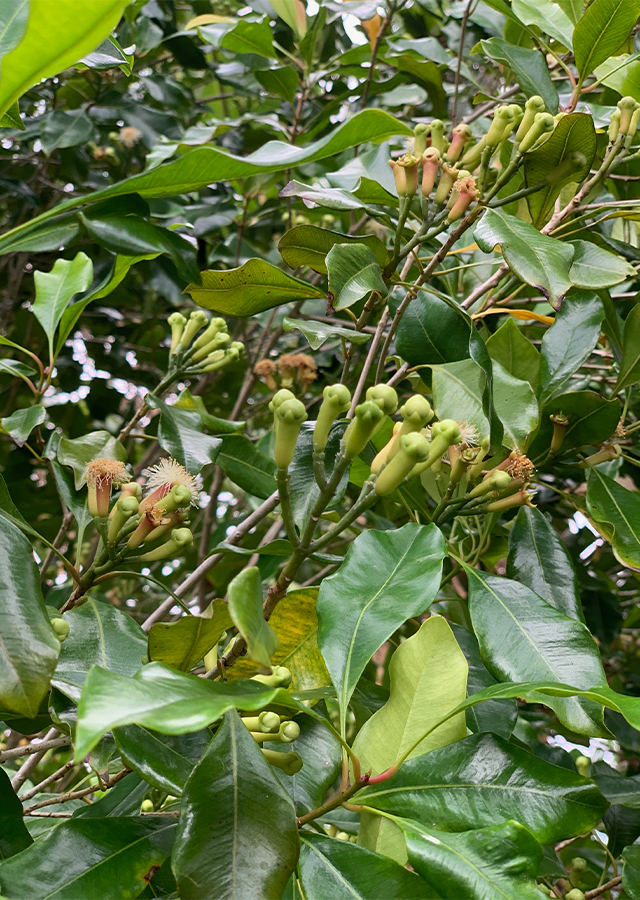
- Flowers - unisexual, consist of a long calyx that terminates into four spreading sepals, and four unopened petals that form a central small ball. The buds are pale yellowish-green turning green and then develop into a bright crimson colour when they are ready for harvesting.
- Fruits - berry purplish, elliptical.
- Seeds - two seeds per fruit.
Cultivation
- Propagated through seed.
- First harvest after 7 to 8 years, but it can take up to 20 years.
Chemical Constituents
Saponins, tannins, flavonoids (kaempferol, quercetin), polyphenol, eugenol asetat, β-cariofileno, phenolic acid (caffeic, ferulic, elagic, salicylic acids, gallic acid), volatile oils (eugenol, acetyl eugenol).
Traditional Medicinal Uses
- Studies have shown antitumor, analgesic, antioxidant, fertility, antipyretic, antidepressant, antiobesity, aphrodisiac, spermatogenesis, insecticidal, neuropharmacological, biopreservative, dental antimicrobial, larvicidal, insecticidal, antimutagenic, glucose lowering, anthelmintic, antiviral, chemopreventive effects, mosquito repellent.
- Treatment of inflammation, parasites, cancer, and diabetes.
- It has been used for centuries in the treatment of vomiting, flatulence, nausea, liver, bowel, and stomach disorders, and as a stimulant for the nerves. Also applied externally against rheumatism and myalgia.
- In tropical Asia, cloves have been documented to relieve different microorganisms as scabies, cholera, malaria, and tuberculosis.
- In America, it is used in inhibiting food-borne pathogens to treat viruses, worms, candida, and different bacterial, and protozoan infections.
- Cloves or clove oil are used as a first aid remedy for toothache and to treat mucosal inflammations of the mouth and throat.
Part Used
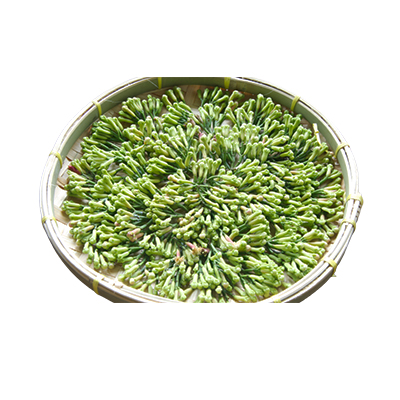
Reference Sources
- Batiha, G.E.S., Alkazmi, L.M., Wasef, L.G., et.al. (2020). Syzygium aromaticum L. (Myrtaceae): Traditional Uses, Bioactive Chemical Constituents, Pharmacological and Toxicological Activities. https://www.ncbi.nlm.nih.gov/pmc/articles/PMC7072209/. 09-01-2021.
- Fern, Ken. (2019). Syzygium aromaticum. http://tropical.theferns.info/viewtropical.php?id=Syzygium+aromaticum. 09-01-2021.
- Indiaagronet. (No date). Horticulture: Spices & Condiments Clove. https://www.indiaagronet.com/horticulture/CONTENTS/clove.htm. 09-01-2021.
- Jirovetz, L., Buchbauer,G., Stoilova,I., et.al. (2006). Chemical composition and antioxidant properties of clove leaf essential oil. https://pubmed.ncbi.nlm.nih.gov/16910723/. 09-01-2021.
- Lim, T. K. (2014). Edible Medicinal and Non Medicinal Plants: Vol. 8, Flowers. Springer. DOI 10.1007/978-94-017-8748-2_1. pp. 460-482.
- TNAU Agritech Portal. (No date). Clove (Syzigium aromaticum) Myrtaceae. http://agritech.tnau.ac.in/horticulture/horti_spice%20crops_clove.html 09-01-2021.
- Wyk, B.E.V. and Wink, M. (2017). Medicinal Plants of the World. CABI, UK & USA.