
Fleabane
Erigeron sumatrensis Retz.
Asteraceae
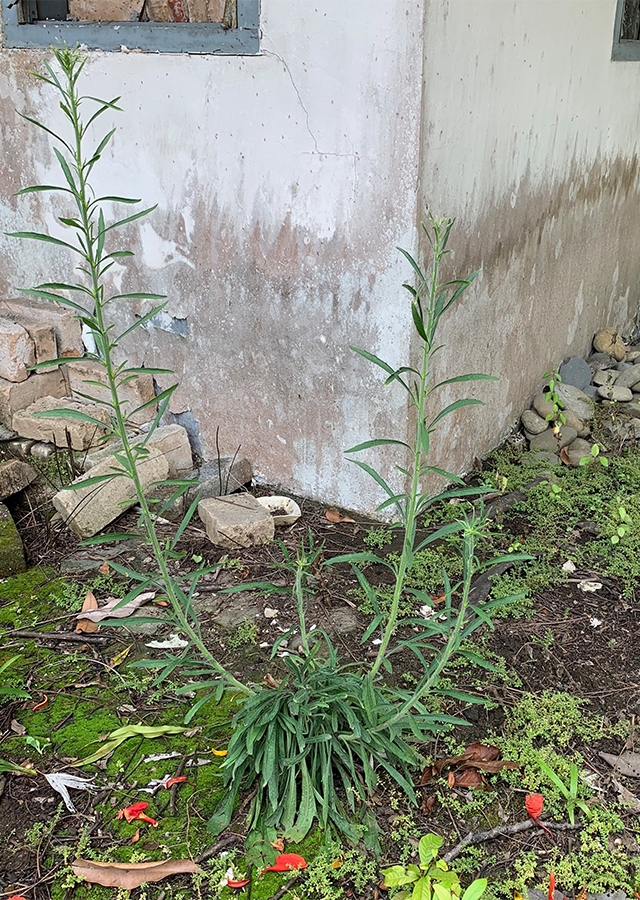
Location in our garden
Principal

Synonym
Aster ambiguus E.H.L.Krause
Baccharis ivifolia Blanco
Conyza albida Willd. ex Spreng.
Habitus

Herbaceous. An erect annual or short-lived perennial herbaceous plant, can grow up to 3 m tall
Part Used
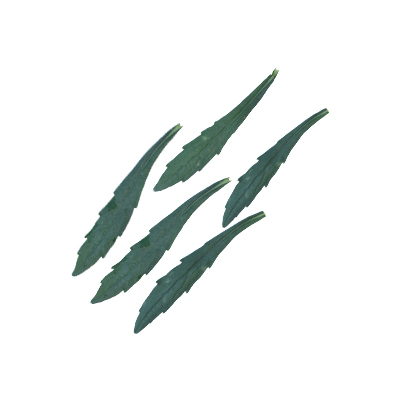
 Leaves
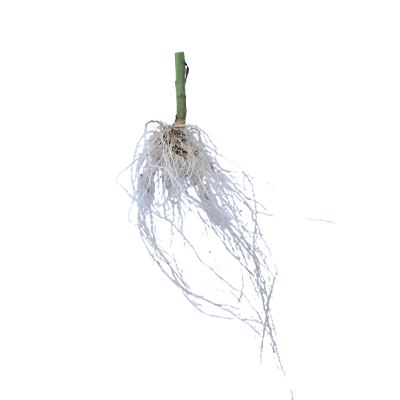
 Roots
Roots Sap
Sap
Growing Requirements
 Full Sunshine
 Need Shade
Habitat
 Forest
 Roadside
 Grassland
Overview
In spite of its name, E. sumatrensis originates in sub-tropical South America rather than Indonesia. It is a pantropical weed and well adapted to disturband. The plant is a source for an essential oil, which is noted to have antimicrobial and antifungal effects and thus possible to pharmaceutical uses. The plant is used commercially as a food flavouring.
Vernacular Names
Fleabane (Eng), Hoge fijnstraal (Dutch), Erigeron blanc (French), Sumatra-berufkraut (German), Ooarechinogiku (Japanese), and Pichana (Peru), sawi bulan, chapa (Malaysia), Jalantir, Si tuduh langit (Indonesia).
Agroecology
It is widely naturalised in temperate to tropical areas around the world. Its habitat is in light soils on waste and cultivated land, also on walls, avoiding acid soils, on sandy soils near coast, sand dunes, and open grassy hills, in villages, gardens, and waste places, and along roadsides. It prefers a well-drained light or medium neutral to alkaline soil in a sunny position, though it tolerates most conditions.
Morphology
- Roots - long taproot.
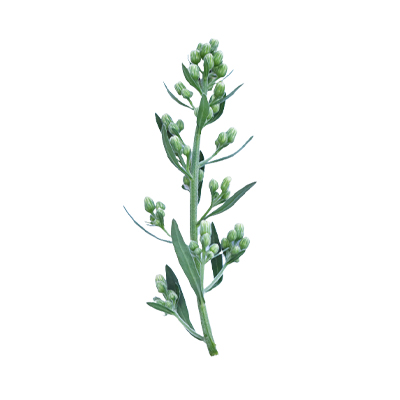
- Stems – erect herb, strongly branched in upper part.
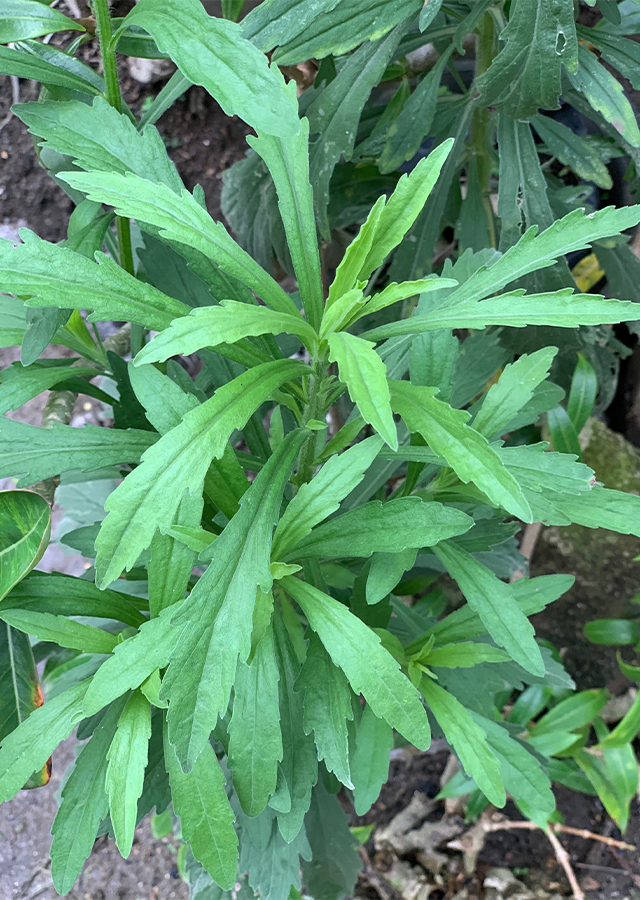
- Leaves – alternate, simple, oblanceolate to linearoblanceolate, 3-12 cm x 0.3-3 cm, gradually tapering at base, larger one parsely coarsely dentate serrate in the upper part, smaller one often entire, grey-hairy on both sides, sessile; stipules absent.
- Flowers – Inflorescence a small cylindrical head 5-6 mm long, many flower together arranged in a long leafy panicle, many-flowered, shortly peduncled. Flower all tubular,.c. 4 mm long; marginal flowers female corolla with 2-lobed apex, pale yellow to purplish, shortly exserted from the involucre; disk flowers bisexual or male, with narrowly funnel-shaped corolla widening into 5 lobes, pale yellow; stamen 5, forming a tube, exserted.
- Fruits- a small, compressed, ellipsoid achene, 1.5-2 mm long, pale tan (generally some with red ribs), sparsely minutely strigose or glabrous; pappus bristles 15-25, 3-4 mm, cream to tan.
- Seeds - heads like dandelions, but straw coloured and smaller. It has no seed dormancy, and the fruits are wind dispersed.
Cultivation
It is known as weed in Indonesia and can be propagated by seeds. Seed dispersal is by wind
Chemical Constituents
Saponins, glycoside, triterpenoids, flavonoids, lachnophyllum lactone, osthol.
Traditional Medicinal Uses
Medicinal Uses
- The whole plant is antirheumatic, astringent, balsamic, diuretic, emmenagogue, styptic, tonic and vermifuge.
- The leaves are hypoglycaemic. The essential oil found in the leaves is used in the treatment of diarrhoea, dysentery and internal haemorrhages. It is a uterine stimulant and is also valuable in the treatment of inflamed tonsils plus ulceration and inflammation of the throat.
Part Used
Reference Sources
- CABI. (No date). Invasive Species Compendium. Conyza sumatrensis. https://www.cabi.org/isc/datasheet/15252. 16-01-2021
- Fern, Ken. (2014). Useful Tropical Plants Database. Conyza canadensis (L.) Cronquist. http://tropical.theferns.info/viewtropical.php?id=Conyza+canadensis. 16-01-2021
- GBIF. (No date). Erigeron sumatrensis Retz. https://www.gbif.org/species/3146683. 16-01-2021
- The Jepson Herbarium. (No date). Erigeron sumatrensis. https://ucjeps.berkeley.edu/eflora. 16-01-2021.
- University of California (The Jepson Herbarium). (No date). Erigeron sumatrensis. https://ucjeps.berkeley.edu/eflora/eflora_display.php?tid=91898. 16.01.2021.
Van Valkenburg JLCH. 2003. Title of article. In: Lemmens. R.H.M.J. and Bunyapraphatsara. N. (Editors): Plant Resources of South-East Asia No. 12(3). Medicinal and poisonous plants 3. Prosea Foundation. Bogor. Indonesia. pp . 134-135.