
Rose-Myrtle
Rhodomyrtus tomentosa (Aiton) Hassk.
Myrtaceae
Location in our garden
Principal
Synonym
Cynomyrtus tomentosa (Aiton) Scriv.
Myrtus tomentosa Aiton
Habitus

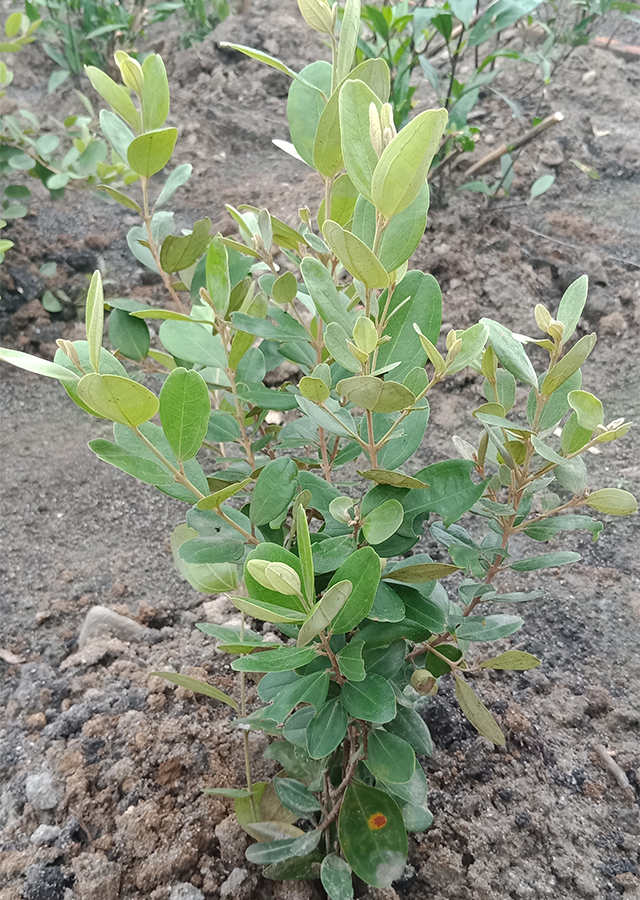
Shrubs. An evergreen small perennial shrub or tree, up to 2–3 m tall
Part Used
 Leaves
 Fruit
Fruit Roots
Roots
Growing Requirements
 Full Sunshine
 High Rainfall
Habitat
 Wetland
 Forest
 Coastal
 Shrublands
Overview
Native to Southern and South-Eastern Asia, Downy rose-myrtle is an attractive member of the Myrtaceae family, with thick tomentose leaves and showy rose-pink flowers, cultivated as an ornamental and occasionally for its edible fruits. In Hawaii and Florida, it is classified as a noxious state weed and has also been shown to be a concern in Raiatea, French Polynesia. It is classified as a weed in Malaysia and Thailand in its native Asian range.
Vernacular Names
Feijoa (French), Filzige Rosenmyrte (German),Tao jin niang (Chinese), Karamunting (Malaysia), Phruat (Thailand), Sim (Vietnamese).
Agroecology
Downy myrtle thrives along the shore and on river banks, in open, frequently eroded sandy sites. Where it grows, it seems that other plants do not compete with it, hence there are almost pure stands. Tolerates full sun and inundation. In such harsh conditions, it is typically found up to elevations of 300 m, rarely up to 1,300 m.
Morphology
- Stems - dense, short, soft hairs on young stems.
- Leaves - leathery, elliptic to ovate-elliptic or obovate-elliptic, 5–8 cm long, 1.5–4 cm wide, 3(–5)-nerved.
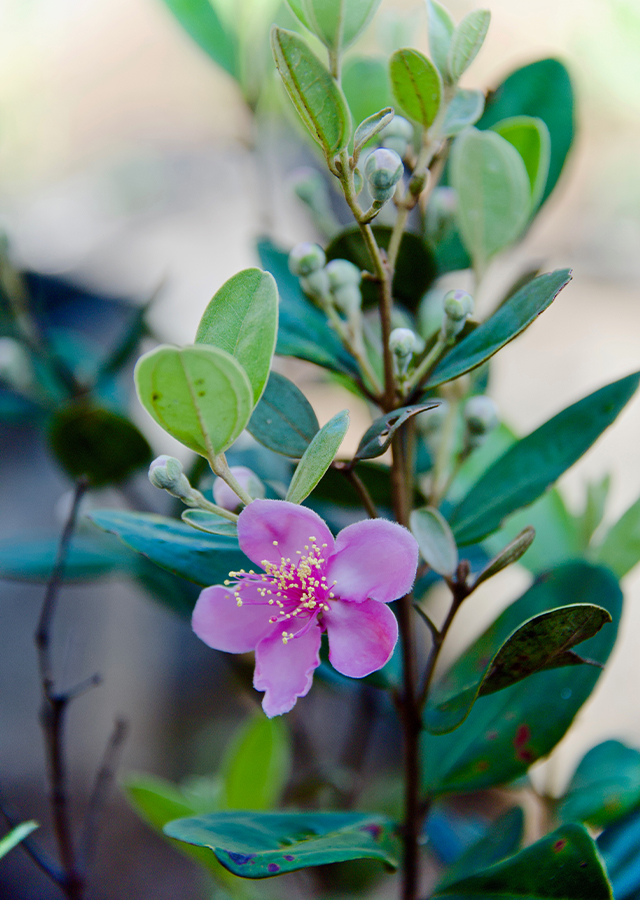
- Flowers -one to five flowers in axillary cymes, each flower subtended by 2 small bracts, petals rose pink.
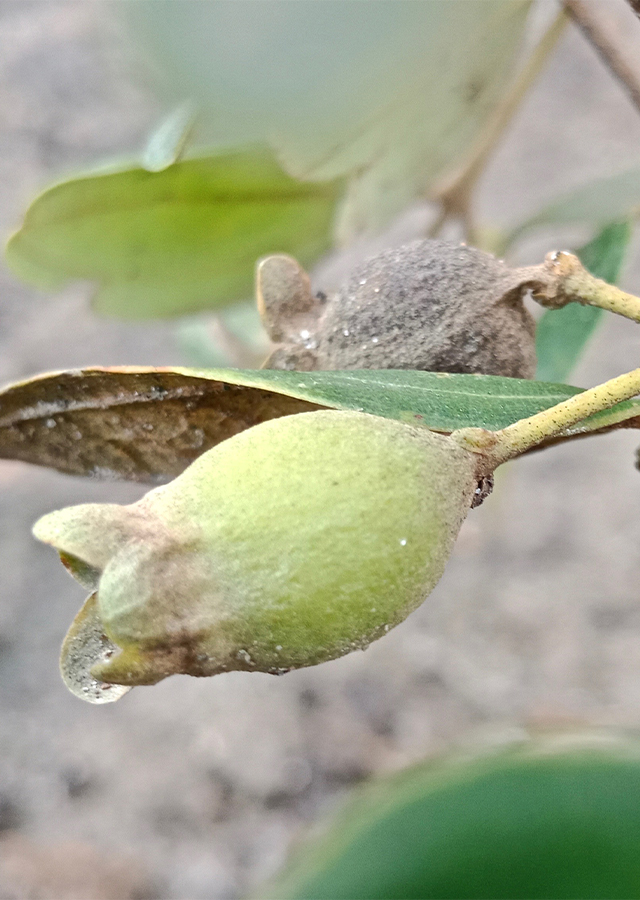
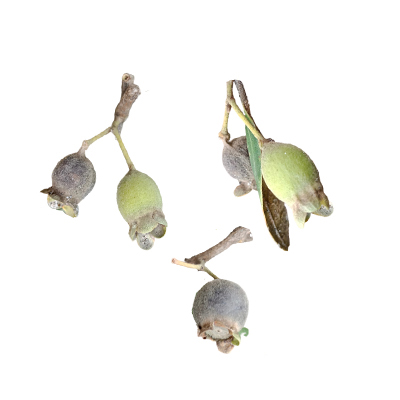
- Fruits - edible, 1.0-1.5 cm long, purple, round, three or four-celled, capped with persistent sepals, soft, with 40-45 seeds in a double row in each cell.
- Seeds - many in 6(-8) pseudo-locules, divided thin false septa, compressed-reniform, 1.5 mm in diameter.
Cultivation
The shrub is normally propagated through cuttings. Plants raised in this way will bear fruit in about 2 years.
Chemical Constituents
Triterpenoids, amino acid, flavonoids, phenols, anthocyanins, flavone glycosides, essential oils, and meroterpenoids.
Traditional Medicinal Uses
Medicinal Uses
- The fruit has been used as a cure for dysentery and diarrhoea.
- A wide variety of pharmacological effects are found in R tomentosa and have been used to treat colic diarrhea, wounds, heartburn, abscesses, gynecopathy, and as a killer of pain.
- The fruit and leaf extract exhibited such activities against Bacillus cereus and Candida albicans.
- The plant is used as antipyretic, antidiarrheal, and antidysentery medicine.
Traditional Uses
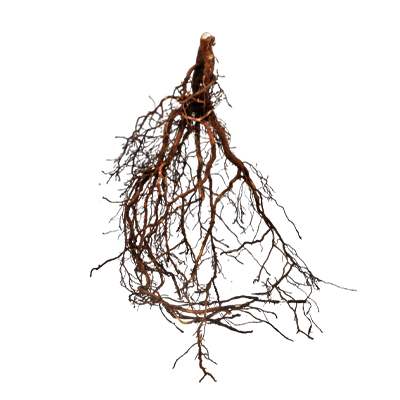
- Decoction of the roots is used to treat low back ache, rheumatic, arthritis, lumbago, by Chinese and Malay traditional practitioners.
- A root or leaf decoction is used as a remedy for diarrhoea and stomach pain and as a preventive medicine after birth.
- The crushed leaves are used for wound dressing.
Part Used

Reference Sources
- CABI. (2012). Invasive Species Compendium. Rhodomyrtus tomentosa (Downy rose-myrtle). https://www.cabi.org/isc/datasheet/47297#tosummaryOfInvasiveness. 15-08-2020.
- Fern, Ken. (2019). Useful Tropical Plants. Rhodomyrtus tomentosa. http://tropical.theferns.info/viewtropical.php?id=Rhodomyrtus+tomentosa. 15-08-2020
- Hamid, H.A., Mutazah, R., and Yusoff, M. (2017). Rhodomyrtus tomentosa: A phytochemical and pharmacological review. https://www.researchgate.net/publication/313386254_Rhodomyrtus_tomentosa_A_phytochemical_and_pharmacological_review. 07-12-2020.
- Latiff, A.M. (2016). Pl@nt Use. Rhodomyrtus tomentosa (PROSEA). https://uses.plantnet-project.org/en/Rhodomyrtus_tomentosa_(PROSEA). 15-08-2020
- Science Direct. (2020). Rhodomyrtus tomentosa (Aiton.): A review of phytochemistry, pharmacology and industrial applications research progress. https://www.sciencedirect.com/science/article/abs/pii/S0308814619318448. 15-08-2020