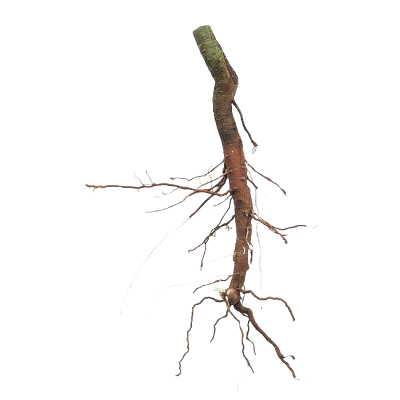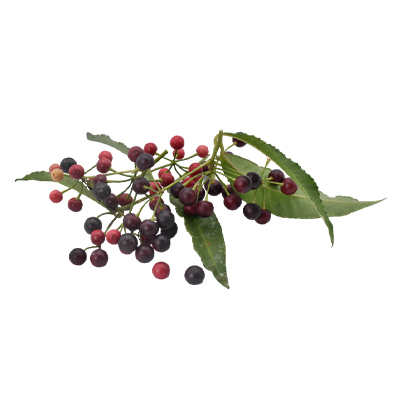
Coralberry
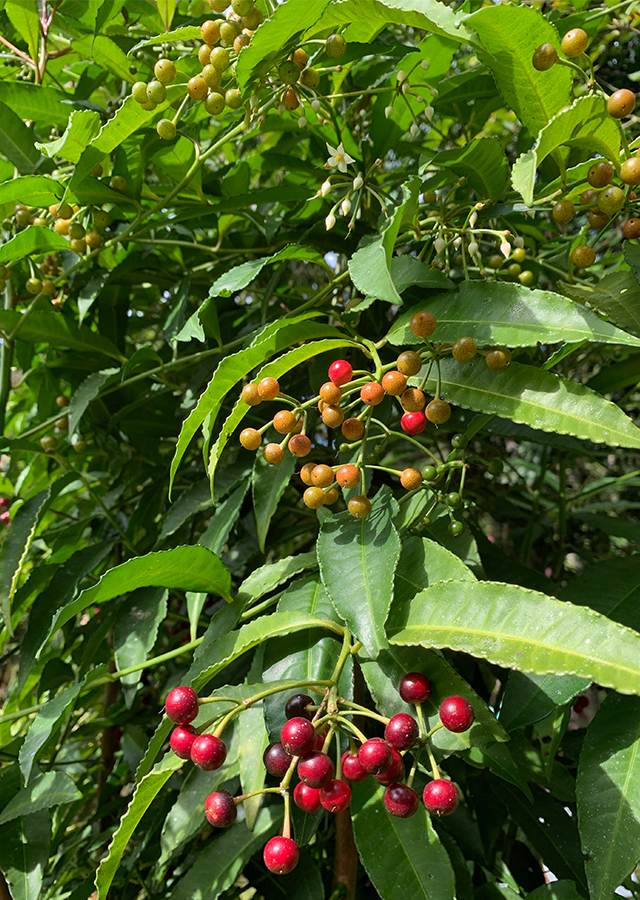
Ardisia crenata Sims
Primulaceae
Location in our garden
Green House
Synonym
Ardisia bicolor E. Walker
Ardisia crenulata G. Lodd.
Ardisia densa Miq.
Habitus

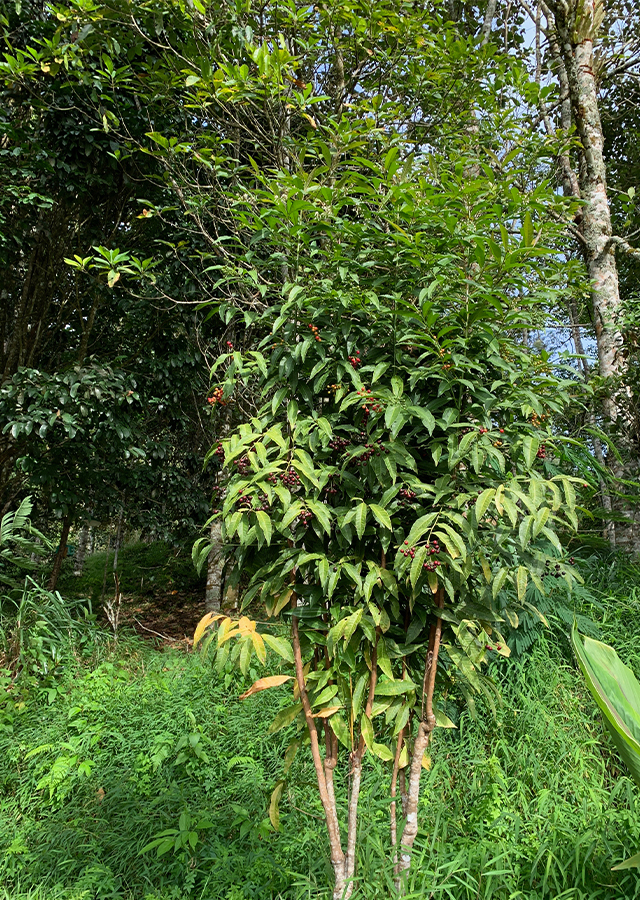
Shrubs. Annual multi-stemmed shrub, growing up to 1 - 2 m tall
Part Used
 Leaves
 Fruit
Fruit Roots
Roots
Growing Requirements
 Full Sunshine
Habitat
 Wetland
 Riverbanks
 Forest
 Coastal
 Shrublands
Overview
It is native to East and South-East Asia and parts of India, emerging as an understorey forest species. It has attractive red berries, which has contributed to it being commonly used in shady conditions as an ornamental plant. Consequently, from its native range, this plant has been transported globally.
Vernacular Names
Koraalbessieboom (Afrikaans), Zhu sha gen (Chinese), Arbre à noël (French), Gewürzbeere (German), Manryo (Japanese), Mata pelandok (Malay), Chamkhruea (Thai).
Agroecology
Found in mountains, hills, valleys, shrubby areas, at altitudes of 100 to 2,400 m, dark damp places, also on secondary forests and open scrub, sometimes in villages and on shores of the sea. Prefers a well-drained humus rich soil in a location shielded from cold drying winds, in partial shade.
Morphology
- Stems - erect, multistemmed.
- Leaves - alternate, < 21 cm long, dark green above and waxy, glabrous, with crenate (scalloped) margins and calluses (bacterial nodules) in the margin notches.
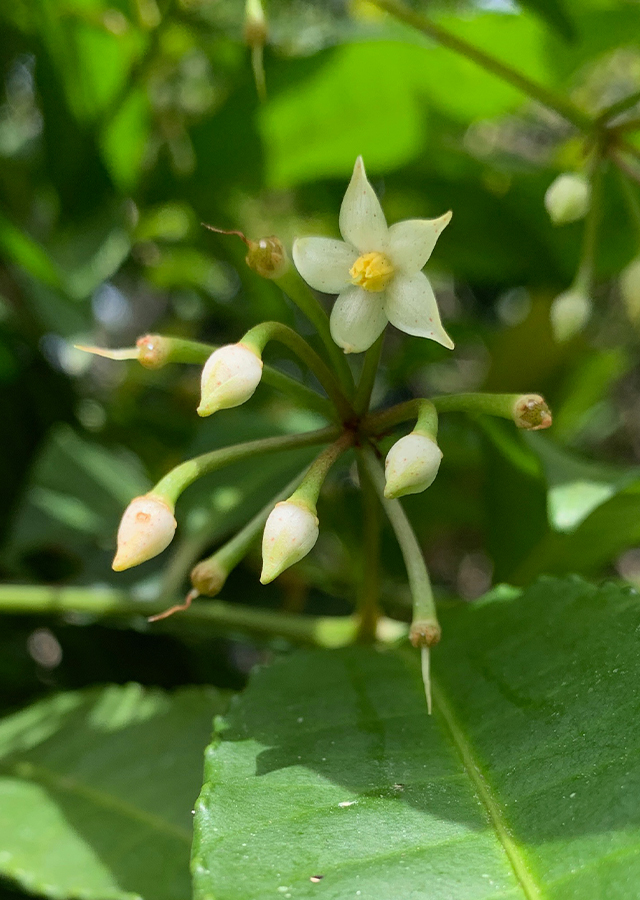
- Flowers - white to pink in stalked axillary clusters, usually drooping below the foliage, small and bisexual, with petaloid parts pink-white, and yellow anthers,inflorescences simple and umbellate or cymose, principal rays 2-4 cm long, pedicels 0.5-1 cm long, elongating in fruit, sepals oblong-ovate to lanceolate.
- Fruits - dark red globose drupe, 5-8 mm in diameter, containing one seed.
Cultivation
- By seeds - sow the seeds in a seedbed or containers in a nursery - better harvested when ripe and sown immediately.
- By cuttings of half-ripe wood, then grow on in cool, shaded, moist conditions until well-rooted.
Chemical Constituents
Bergenin, α-amyrin, β-amyrin, bauerenol, isorhamnetin, quercetin, rapanon, syringic acid, hydroxymethyl, furalclehyde, ardisiacrispins, and asperuloside acid.
Traditional Medicinal Uses
- The anodyne, depurative, and febrifuge root.
- Anodyne, depurative, febrifugal, antidote, anti-tumor, vasorelaxant, diuretic, anti-thrombin, anti-asthmatic, cytotoxic, melanogenesis properties are indicated in plant studies.
- In the treatment of skin diseases and earaches, crushing plants, or their extracted juice, are used externally and internally against fever, cough and diarrhoea.
- Roots are used to treat tonsillitis, toothaches, arthralgia, respiratory infections, and menstrual disorders in traditional Chinese medicine.
- Root juice is used as a remedy for fever, cough and diarrhoea. It is used for blood circulation enhancement.
- Juice from the crushed whole plant is used to treat fever and earaches in Kampung Bawong, Perak, West Malaysia.
- In treating weak, inflamed, or sore eyes, a decoction of the inner bark or leaves has been used as a wash.
- A cold decoction of the root bark has been used as an eyewash for healing sore eyes.