
Lesser Roundweed
Hyptis brevipes Poit.
Lamiaceae
Location in our garden
Principal
Synonym
Hyptis acuta Benth.
Habitus

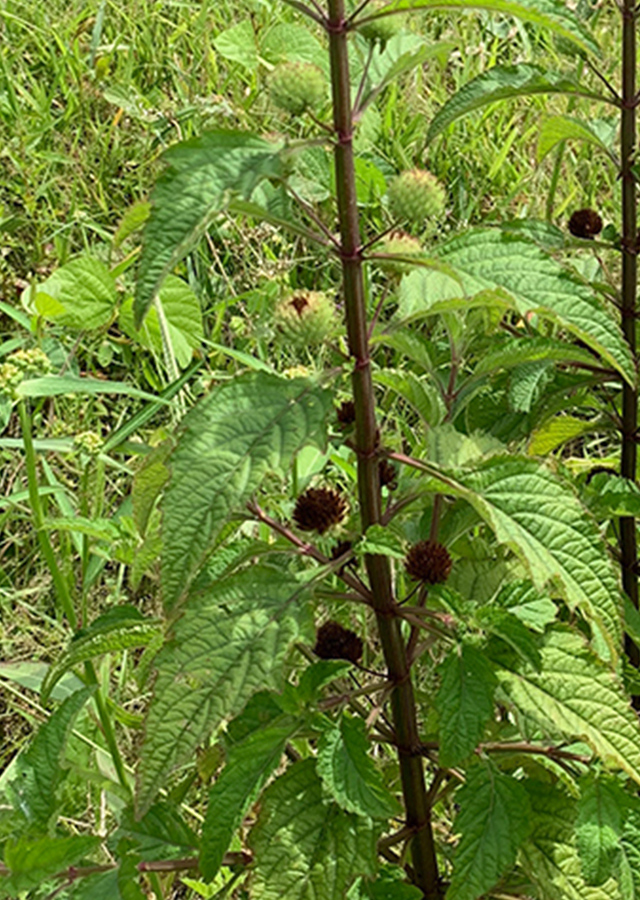
Herbaceous. An erect annual plant up to 1 m high with a square stem, often densely hairy but sometimes less so
Part Used
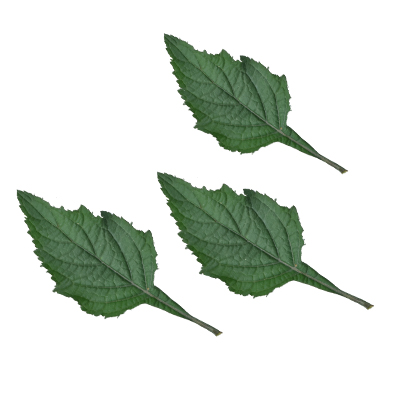
 Leaves
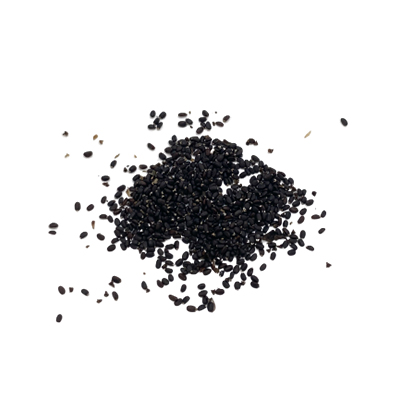
 Seeds
Seeds Flowers
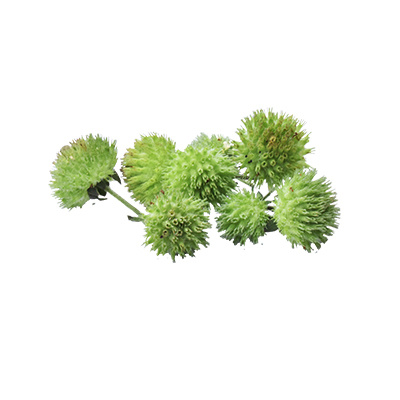
 Fruit
Fruit
Growing Requirements
 Full Sunshine
 Need Shade
Habitat
 Wetland
 Coastal
 Roadside
 Grassland
Overview
This plant is native to Mexico, the Caribbean and most of South America, and has been widely introduced and naturalized in South East Asia. As a seed contaminant, in particular with rice, brevipes can accidentally be introduced into a new field. It has been identified as Malaysia's 'principal' weed and Borneo, the Philippines and Taiwan's common weed.
Vernacular Names
Duan bing diao qiu cao (Chinese), Chibolita (Spanish), Fazendeiro (Brazil), Sawi hutan (Malaysia), Nanto-iganigakusa (Taiwan).
Agroecology
H. brevipes is a wasteland grass, frequently abundant in fallow rice paddies, primarily under ever-wet weather conditions, very uncommon in seasonal drought areas; up to 1,200 m elevations. It is mainly present in open land, but has some occurrence in forest margins, although high levels of humidity and usually a wet tropical environment are often needed.
Morphology
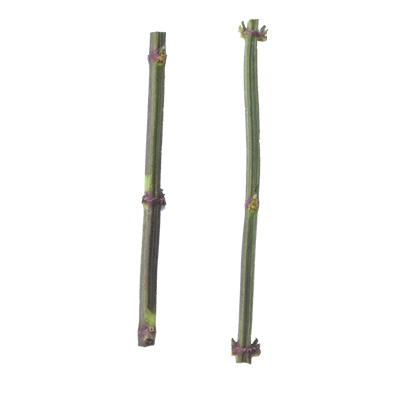
- Stem - Typical of the family, square stem, sparsely or much branched, the stems hirsute with white hairs that are more or less appressed.
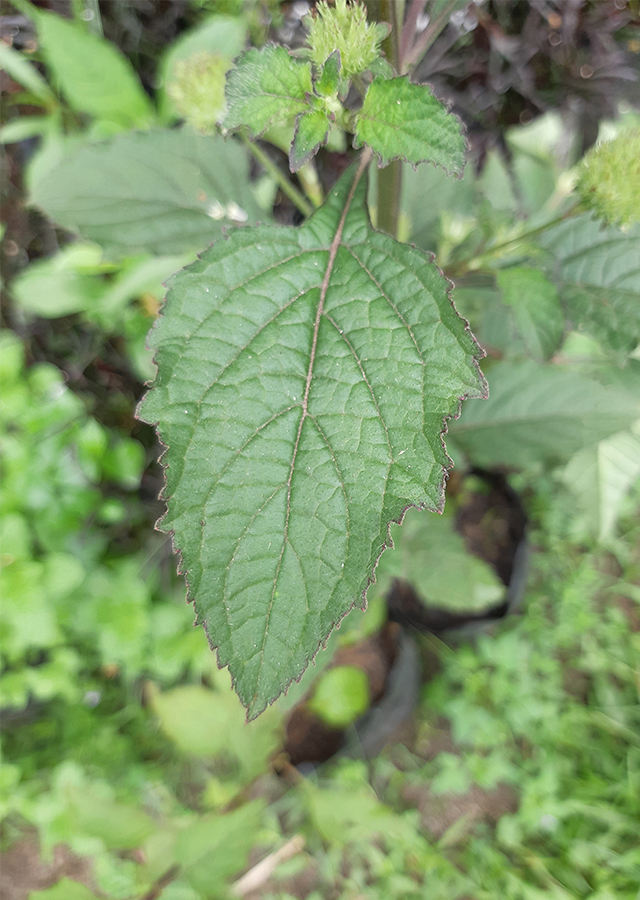
- leaves - On both surfaces, the leaves are usually coarsely hairy, opposite, broadly ovate or lanceolate, 4-7 cm long, up to 2 cm wide, cuneate at the base, irregularly serrated at the margins. Acute to acuminate apex.
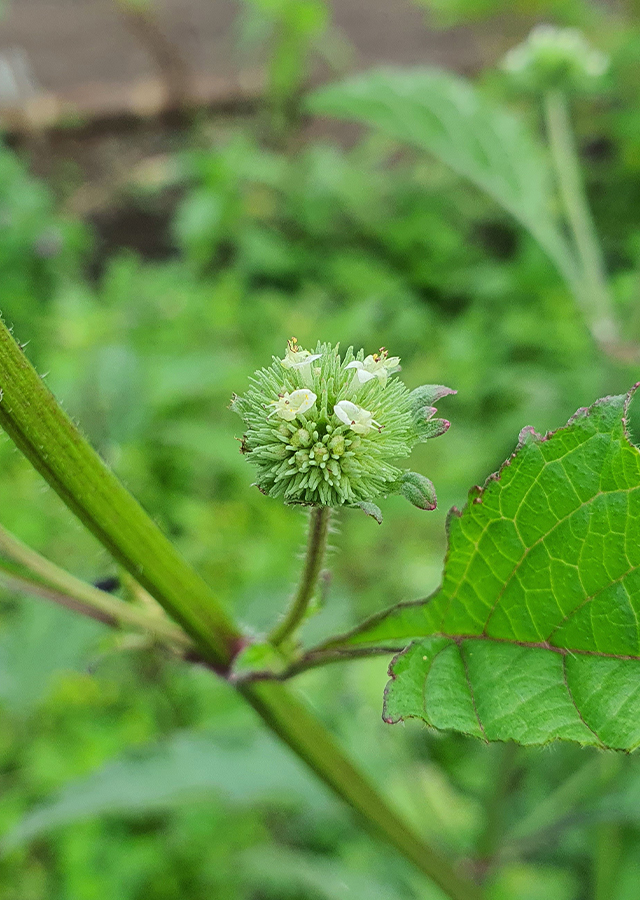
- Flowers - The inflorescence is a thick raceme, almost globose, with a diameter of up to 14 mm, in the axils of most upper leaves, on a peduncle about 1 cm long. White or purple-white corollas, irregularly five-lobed, around 5 mm in length. The 4 mm long calyx has 5 narrow, finely barbed lobes as well. Lanceolate bracts, 8-12 spread or reflexed, 4-6 mm long, almost covered by the flowers.
- Fruit - a brownish black, minutely wrinkled nutlet, 0.7 mm long.
- Seeds - ovoid, up to 1 mm long, dark brown to black, obscurely striate, with a conspicuous scar.
Cultivation
- Propagation is done by seeds
Chemical Constituents
- Germacrene D, caryophyllene , phthalamide doxime, caryophyllene oxide, tetramethyl-12-Oxabicyclo, dodeca-3,7-diene and a-bourbonene.
Traditional Medicinal Uses
- The plant's methanol extracts have shown antibacterial and antifungal activity.
- Caryophyllene oxide and caryophyllene, which have been shown to be antimicrobial, comprise the essential oils of the leaves and flowers.
- It has been documented that the essential oil is used in the treatment of asthma and malaria.
- After childbirth, a decoction of the leaves is considered a preventive drug. It is often used in children to drive out worms by adding them to the abdomen.
Part Used
Reference Sources
- CABI. (2017). Invasive Species Compendium. Hyptis brevipes (lesser roundweed). https://www.cabi.org/isc/datasheet/27851. 10-11-2020
- Fern, Ken. (2014). Useful Tropical Plants: Hyptis brevipes http://tropical.theferns.info/viewtropical.php?id=Hyptis+brevipes. 10-11-2020.
- HEAR. (2012). Pacific Island Ecosystems at Risk (PIER): Hyptis brevipes. http://www.hear.org/pier/species/hyptis_brevipes.htm. 10-11-2020.
- Journal of Medicinal Plants Research. (2010). https://academicjournals.org/journal/JMPR/article-abstract/B3C6EC016437. 10-11-2020.