
Burflower Tree
Neolamarckia cadamba (Roxb.) Bosser
Rubiaceae
Location in our garden
Green House

Synonym
Anthocephalus cadamba (Roxb.) Miq.
Anthocephalus morindifolius Korth.
Nauclea cadamba Roxb.
Habitus

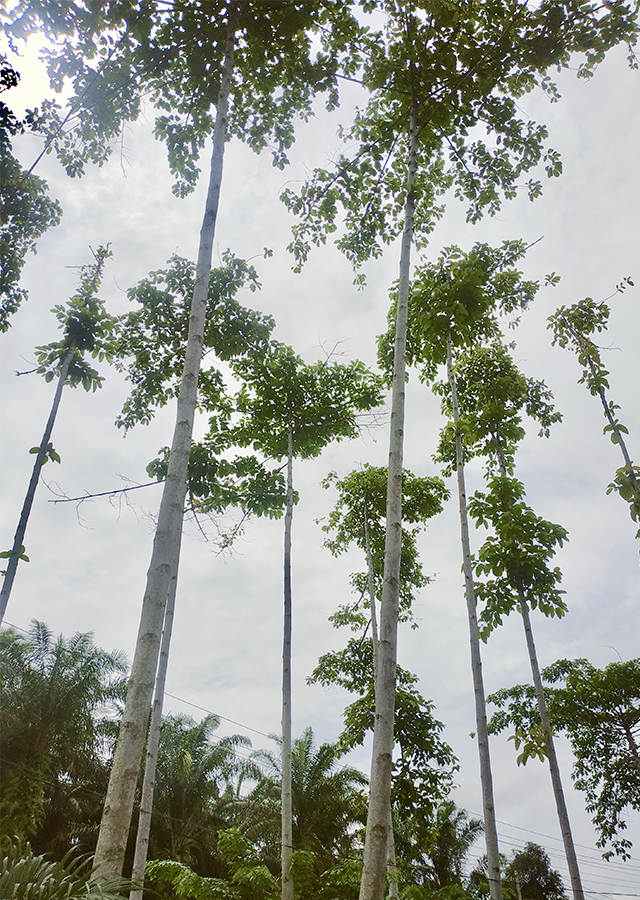
Trees. Large cylindrical ornamental tree grows up to 45 m tall
Part Used
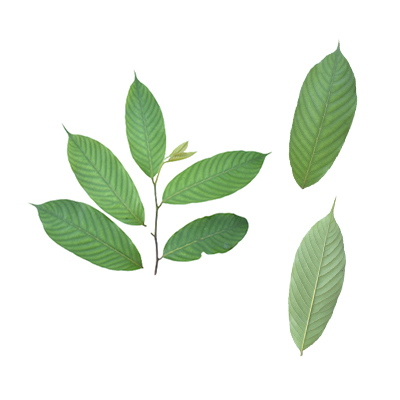
 Leaves
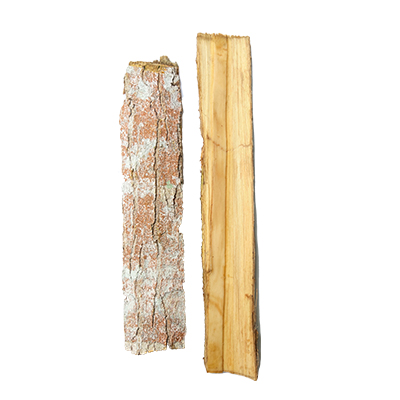
 Bark
Bark
Growing Requirements
 Full Sunshine
 Need Shade
Habitat
 Wetland
 Riverbanks
 Forest
Overview
This tropical tree is native to South and South-East Asia, one of the most frequently planted trees in the tropics where it is often grown along avenues, roadsides, and in villages both for ornament and to provide shade. The tree is highly regarded religiously and culturally in India, Java, and Malaysia, it is considered sacred to Lord Krishna. It is an evergreen tropical tree found in different parts of India, Bangladesh, Nepal, Myanmar, Sri Lanka, Cambodia, Laos, Philippines, Malaysia, Indonesia, Papua New Guinea, and Australia.
Vernacular Names
Thkoow (Cambodian), Kadam (French), Attutek (India), Kalempayan (Malaysia), Kaatoan bangkal (Philippines), Kola-aiyila (Sri Lanka), Chantanaburi (Thai).
Agroecology
The plant is moister tropics, it grows well at an altitude range of 300-800 m. It prefers a mean annual temperature of around 23 °C and is sensitive to frost. It grows best with a mean annual rainfall of around 1,600 mm or more and on deep, moist, alluvial sites, often in secondary forests along riverbanks. Prefers well drained entisols. Older trees require good light conditions, the saplings, however, require the protection of some shade from the hot sun.
Morphology
- Stems - pale brown, 6-8 mm, vertically shallowly grooved, exfoliating in small rectangular flakes; blaze yellowish-brown; bole straight; branches horizontal.
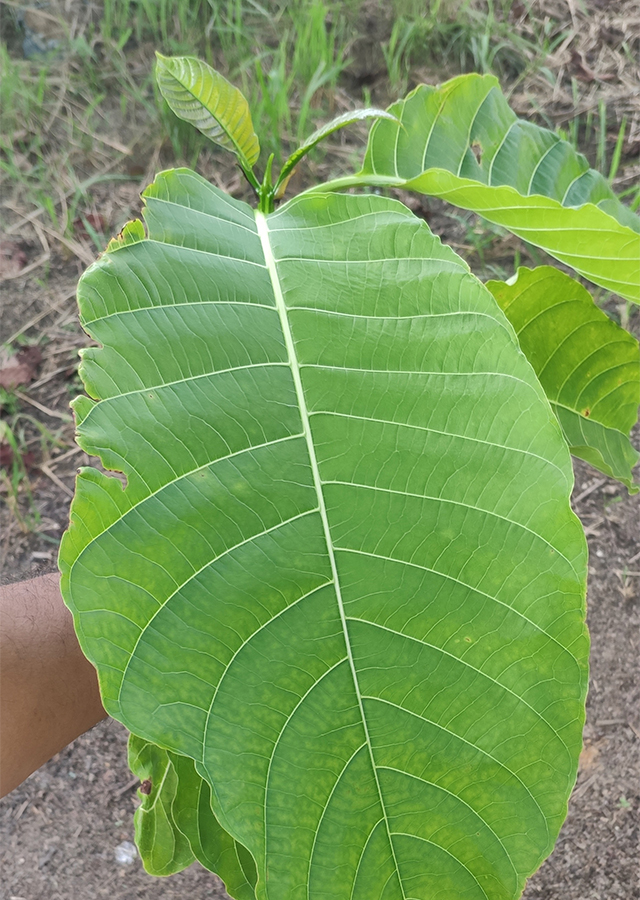
- Leaves - opposite, decussate; stipules interpetiolar, lanceolate, cauducous, petiole 20-45 mm, stout, glabrous, lamina 10-25 x 6, 12 cm, ovate or elliptic-oblong, base truncate or obtuse, apex acuminate, margin entire, glabrous above, pubescent beneath, lateral nerves 10-14 pairs, pinnate, prominent; intercostae scalariform, prominent.
- Flowers - bisexual, yellowish, in globose heads, 2-4.5 cm across; calyx tube 2-3 mm in diameter, tube globose, lobes 5, 5-6 x 3-4 mm, membranous; corolla tube 6-8 mm long, lobes 5, oblong, acute, 3-4 cm long, stamens 5, 3 mm long, anthers sagittate, sessile; ovary 3-4 mm long, 2-celled at base, 4-celled above, inferior, ovules many; style exserted to 5-6 mm, entire; stigma clavate.
- Fruits - capsule on a fleshy globose receptacle, 3.5-5 cm across, orange yellow, capsule membranous.
- Seeds - angular, minute.
Cultivation
- Seeds - best sown in a nursery.
- It is recommended to use a medium that is enriched with organic matter. The young seedlings are highly susceptible to weeds and should be weeded regularly. To ensure successful establishment, seedlings should be planted out with their balls of earth.
Chemical Constituents
Flavonoids, alkaloids, saponins, phenolic, quinones, triterpenoids, glycoside, cadambin, steroids, proanthocyanidin, anthocyanin, tannins.
Traditional Medicinal Uses
Medicinal Uses
- The plant is considered to be astringent, digestive, expectorant, and febrifuge. It is used in the treatment of conditions such as ulcers, digestive problems, fevers, and vomiting.
Traditional Uses
- The dried bark is used to relieve fever and as a tonic.
- An extract of the leaves serves as a mouth gargle.
- Decoction of leaves is used for ulcers, wounds, and menorrhea.
- In Ayurveda, the plant is used in the treatment of fever, anemia, uterine problems, skin diseases, leprosy, and to improve semen quality. Bark used for blood diseases and dysentery.
Part Used
Reference Sources
- Biodiversity India. (No date). India Biodiversity Portal. Neolamarckia cadamba (Roxb.) Bosser. https://indiabiodiversity.org/species/show/244698. 09-01-2021.
- Fern, K. (2014). Useful Tropical Plants. Neolamarckia cadamba. http://tropical.theferns.info/viewtropical.php?id=Neolamarckia+cadamba. 09-01-2021.
- NCBI. (2015). Cadamba: A miraculous tree having enormous pharmacological implications. https://www.ncbi.nlm.nih.gov/pmc/articles/PMC4557232/. 09-01-2021.
- Stuart Xchange. (2016). Philippine Medicinal Plants: Kaatoan-bangkal. http://www.stuartxchange.org/Kaatoan-bangkal.html. 09-1-2021