
Siamese Cassia
Senna siamea (Lam.) H.S.Irwin & Barneby
Fabaceae
Location in our garden
Principal
Synonym
Cassia arborea Macfad.
Cassia florida Vahl
Cassia gigantea Bertero ex DC.
Habitus

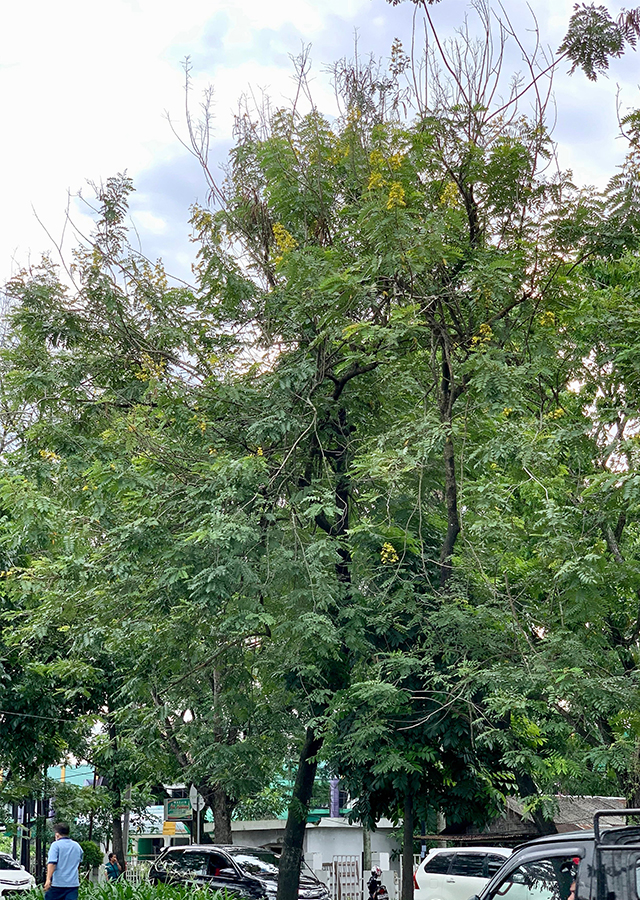
Trees. A medium size, perennial, evergreen tree that grows up to 18 m tall
Part Used
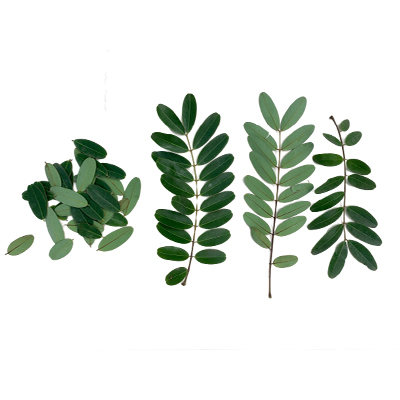
 Leaves
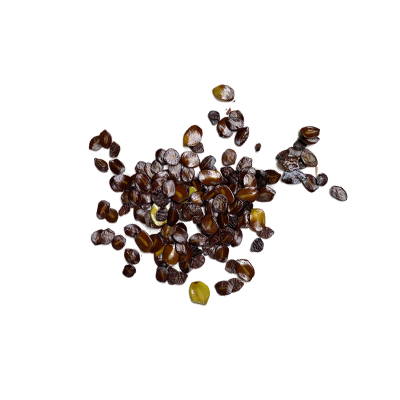
 Seeds
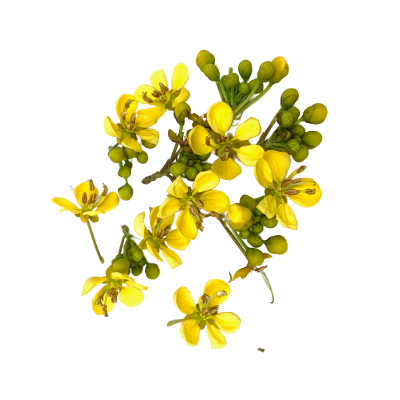
Seeds Flowers
 Roots
Roots Stem
Stem
Growing Requirements
 Full Sunshine
Habitat
 Riverbanks
 Forest
 Coastal
 Shrublands
Overview
This plant is native to Myanmar, Sri Lanka, Laos, Thailand and Vietnam but then introduced and cultivated pantropically. It is widely cultivated because of its high-quality firewood and its many applications in agroforestry systems. It is cultivated as an ornamental tree as well.
Vernacular Names
Minjiri (Bangladesh), Khi lek ban (Thai), Robles (Tagalog), Kassod (India), Mezali (Burmese), Muöng den (Vietnamese), Johor (Malaysia), Bois perdrix (French).
Agroecology
Siamese cassia grows best in areas where the mean annual precipitation ranges from 500-2,800 mm with an optimum of about 1,000 mm. The tree grows in a variety of climatic conditions, but is especially suitable for monsoon-like lowlands, where it can thrive at altitudes up to 1,300 m. A sunny location is needed, and the mean annual temperature is within the 20-28 °C range. It thrives on soils which are deep, well-drained, and fertile. A pH in the 5.5-7.5 range is favored.
Morphology
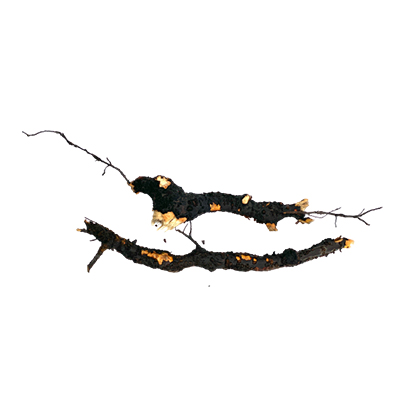
- Root - thick shallow roots, which can easily uprooted by strong winds.
- Stems - erect and slender, spreading branches forming a thick, round, evergreen crown and a short bole with a smooth, longitudinally fissured gray bark.
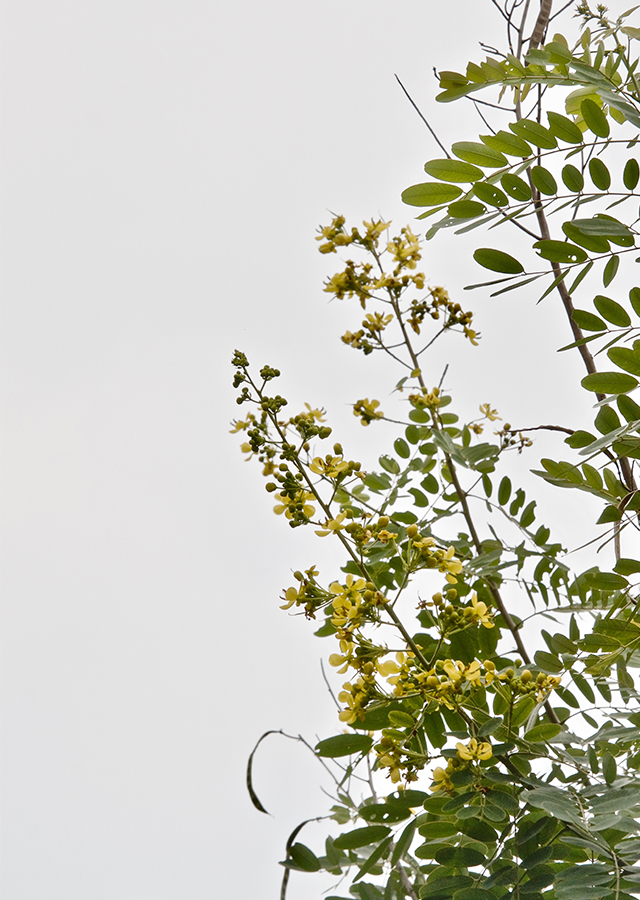
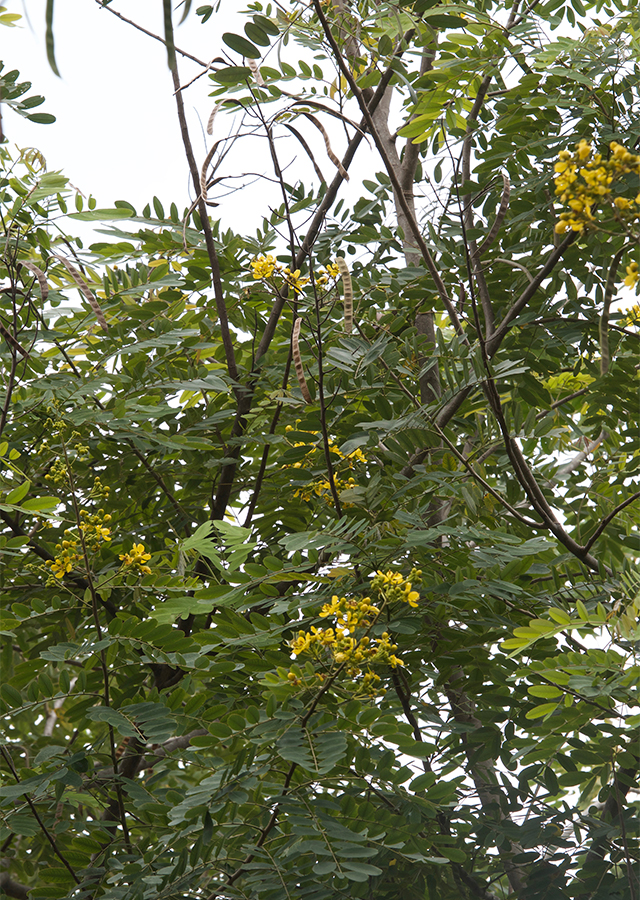
- Leaves - alternate, 15-30 cm long, pinnately compound with 6-14 pairs of leaflets which are oblong, dark green, with midrib ending in a bristle.
- Flowers -bright yellow and borne in numerous large pyramidal panicles up to 60 cm long at the ends of branches. Pods are soft, flat, 15-25 cm long, 20-30 seeds per pod.
- Seeds - bean-shaped, 8 mm long, and shiny dark-brown in colour.
Cultivation
It is possible to this tree using seeds.
Chemical Constituents
Barakol, alkaloids, flavonoids, tannins, saponins, carotenoid, lupeol, anthraquinones, sitosterin, terpenoids, steroids, cardiac glycosides, essential oils.
Traditional Medicinal Uses
Medicinal Uses
- Antimicrobial, antimalarial, antidiabetic, anticancer, diuretic, hypotenive, antioxidant, laxative, anti-inflammatory, analgesic, antipyretic, anxiolytic, antidepressant and sedative activities have been shown.
Traditional Uses
- In Thailand, dried leaves are taken as a laxative or sleeping pill in capsule formulations.
- The decoction of the mixture of leaves and stems is used as an aperitif, antirheumatic, and for swelling in China and Pakistan.
- Leaves are used as an antimalarial agent in Cameroon, and fruits are used to treat intestinal worms and to avoid childhood convulsions. And in India, for anaemia and fever, a leaf decoction is drunk with honey.
- Used for the treatment of syphilis, herpes, swine fever, typhoid fever, jaundice, abdominal pain, and menstrual pain In Nigeria.
- In Burkino Faso, to treat malaria and liver disorders, a decoction of fresh and dried leaves, stem bark, and flowers is used. Drunk stem bark decoction for diabetes.
Part Used
Reference Sources
- CABI. (2013). Invasive Species Compendium. Senna siamea (yellow cassia). https://www.cabi.org/isc/datasheet/11462. 14-08-2020.
- Feedipedia. (No date). Siamese senna (Senna siamea). https://www.feedipedia.org/node/323. 14-08-2020.
- Fern, Ken, (2014). Useful Tropical Plants: Senna siamea. http://tropical.theferns.info/viewtropical.php?id=Senna+siamea. 14-08-2020.
- PFAF. (No date). PFAF Plant Database: Senna Siamea. https://pfaf.org/user/Plant.aspx?LatinName=Senna+siamea. 14-08-2020.
- PROSEA. (2016). Senna siamea - PlantUse English. https://uses.plantnet-project.org/en/Senna_siamea_(PROSEA). 14-08-2020.
- PROSEA. (2016). Senna (PROSEA Medicinal plants). https://uses.plantnet-project.org/en/Senna_(PROSEA_Medicinal_ plants). 14-08-2020.
- PROSEA. (No date). PROSEA Handbook Number. https://www.prota4u.org/prosea/view.aspx?id=3043. 14-08-2020.
- StuartXchange. (2020). Philippine Medicinal Plants: Thailand Shower. http://www.stuartxchange.org/ThailandShower. 14-08-2020.
- Hou, D., Larsen, K., Larsen, S.S. (1996.) Caesalpiniaceae (Leguminosae-Caesalpinioideae). Flora Malesiana Series I 12(2): 409-730.