Pigeon Orchid
Dendrobium crumenatum Sw.
Orchidaceae
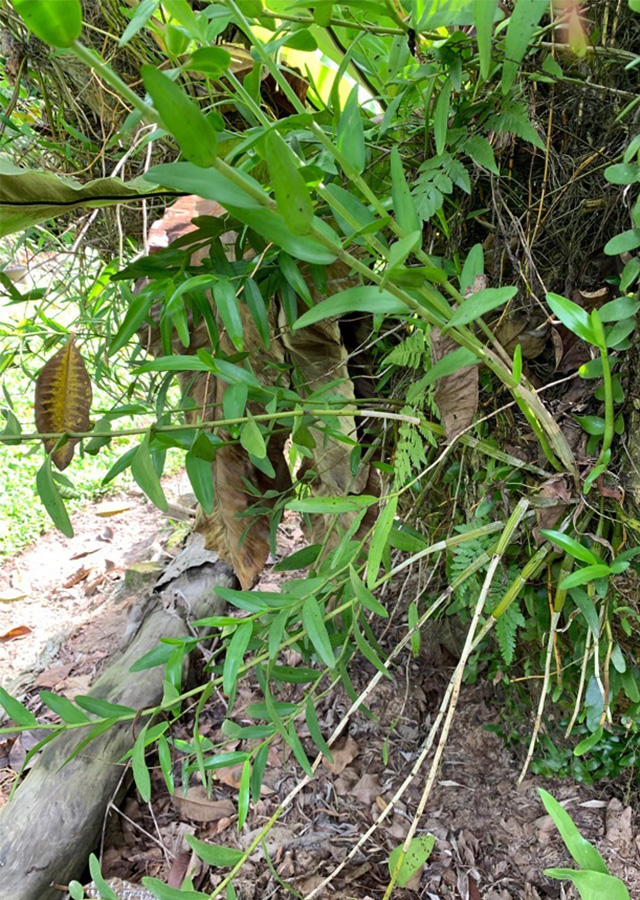
Location in our garden
Shading Area
Synonym
Aerides matutina Willd.
Aporum crumenatum (Sw.) Brieger
Aporum kwashotense (Hayata) Rauschert
Habitus

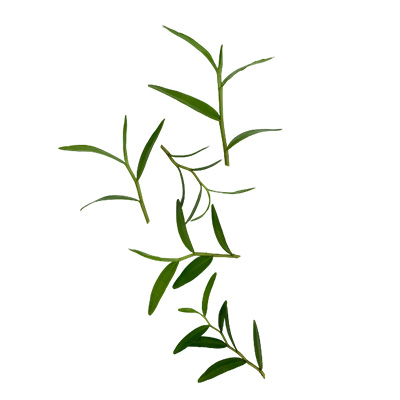
Orchid. An epiphytic orchid, perennial, can reach a height of about 60-90 cm
Part Used
 Leaves
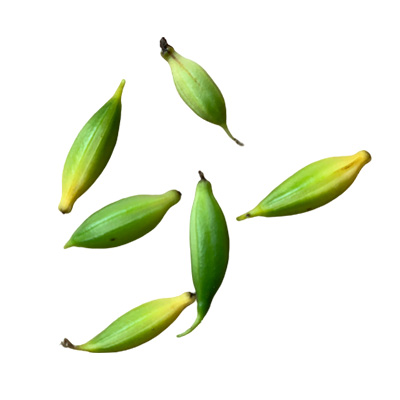
 Fruit
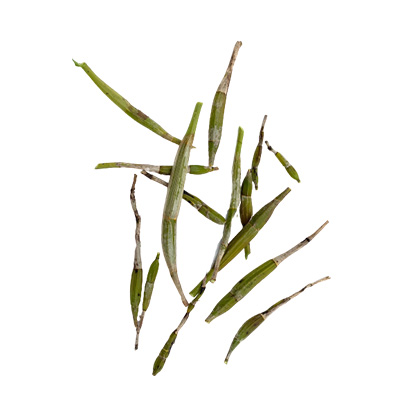
Fruit Pseudobulb
Growing Requirements
 Need Shade
Habitat
 Forest
 Roadside
Overview
Pigeon orchid is native to Christmas Island, Asia, New Guinea and South-East Asia. For local use as medicine, the plant is harvested from the wild. It is also cultivated as an ornamental element.
Vernacular Names
Waai tamoi (Thailand), Mu shi hu (Chinese), Daun sepulah tulang (Malaysia), Thạch hộc (Vietnamese), anggrek merpati (Indonesia)
Agroecology
It is an epiphyte that grows in humid regions, or regions with a short dry season, in open forests and on wayside trees, often on boulders, numerous locally; at altitudes of up to 1,000 m from sea level. The plant has a symbiotic association with a soil-dwelling fungus community. It is important that in any soil in which the plant is produced, spores of this fungus are present.
Morphology
- Roots - underground (fibrous root), and aboveground (aerial root).
- Stem - slender, fascicled, smooth, elongated, up to 1 m in length, with upright, sympodial pseudobulbs at the base, 8-12 m long, about 2 cm thick.
- Leaves - scattered, distichous, oblong, 5-8 cm long and 1.5-2.5 cm wide, with a blunt tip.
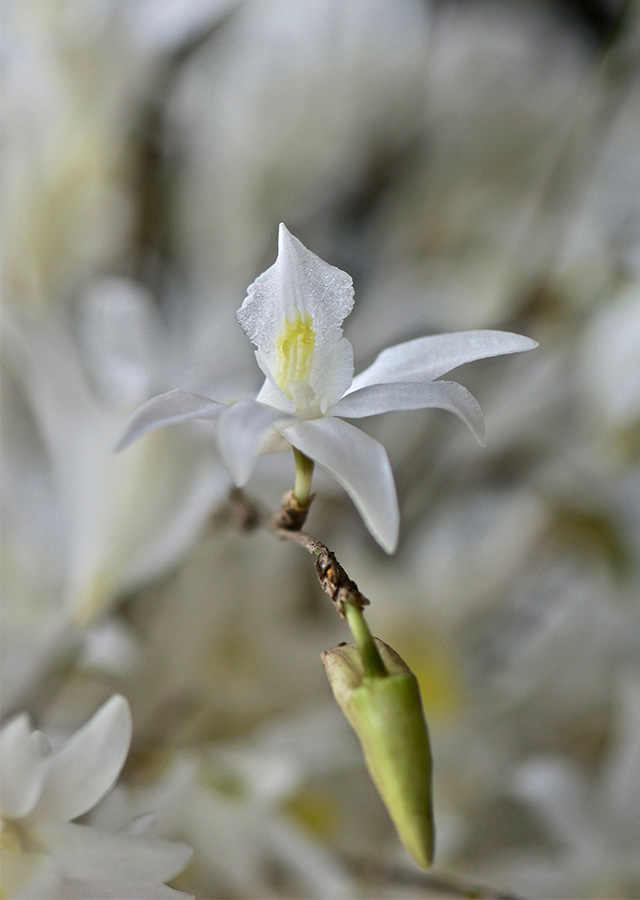
- Flowers - pure white, fugacious, very fragrant, solitary or somewhat fascicled, appearing on the upper parts of the stems at the nodes. The middle of the lip, which is 2.5 to 3 cm long, is pale yellow.
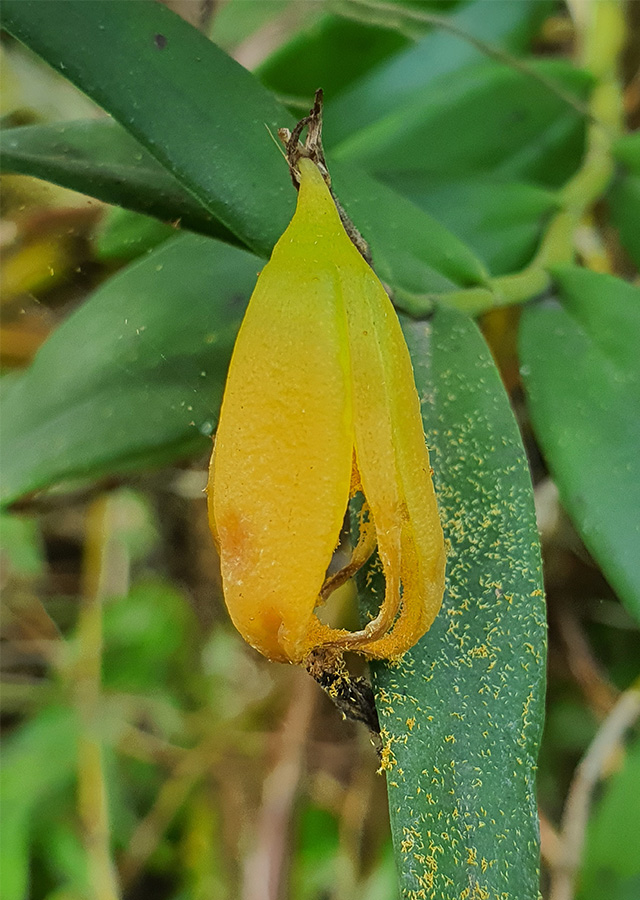
- Fruits - capsular and elliptical, 2.2 cm long.
Cultivation
- Generative propagation is by seed. Sow the surface in a jar, ideally as soon as it is ripe, and do not let the compost dry out. To introduce the fungus or to plant the seed around a plant of the same genus, it is better to use some of the soil that is growing around existing plants and allow the seedlings to grow up until they are large enough to travel.
- Vegetative propagation is by stem cuttings: each must have a dormant bud.
Chemical Constituents
Alkaloids, saponins, terpenoids, poliphenol and flavonoids, cardiac glycosides.
Traditional Medicinal Uses
Medicinal Uses
- D. crumentatum showed antifungal and antibacterial activity.
- Various parts of D. crumenatum against 8 pathogenic bacteria.
- Study showed anti-inflammatory, anti-nociceptive and antioxidant activities.
Traditional Uses
- In Malacca, the pounded leaves of a state within Penninsular Malaysia, they are applied as a curative to pimples and boils.
- The fruits of this species in Java are boiled along with fruits (not necessarily all together) from Plocoglottis javanica, Bulbophyllum vaginatum and Hippeophyllum scortechnii; and for an earache, the juice is applied to one ear.
- Flowers are also ground in Java to make a mixture to be used for those who have cholera.
- In Laos, Vietnam and Cambodia, the plant is used to eliminate blood impurities. Used for treating boils in Malaysia; pseudobulb juice used for relieving earache.
- Pseudobulb juice is widely used by the Malays to treat ear infections. Used similarly in Java.