
Sword Brake Fern
Pteris ensiformis Burm.f.
Pteridaceae
Location in our garden
Green House
Synonym
Pteris ensiformis var. ensiformis
Pteris serrulata var. obtusata Christ
Habitus

Fern. Terrestrial or epilithic, small to very large ferns.
Part Used
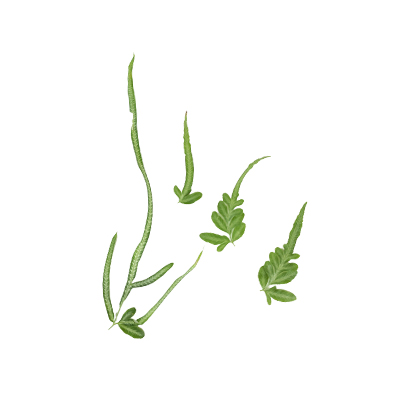
 Leaves
 Roots
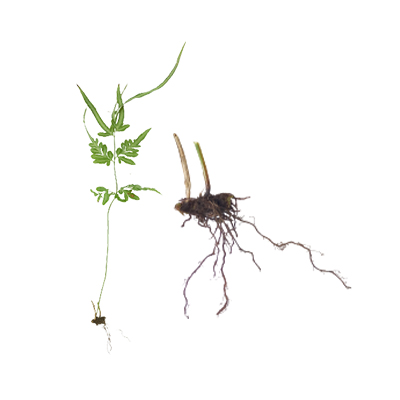
Roots Rhizome
Growing Requirements
 Need Shade
Habitat
 Terrestrial
Overview
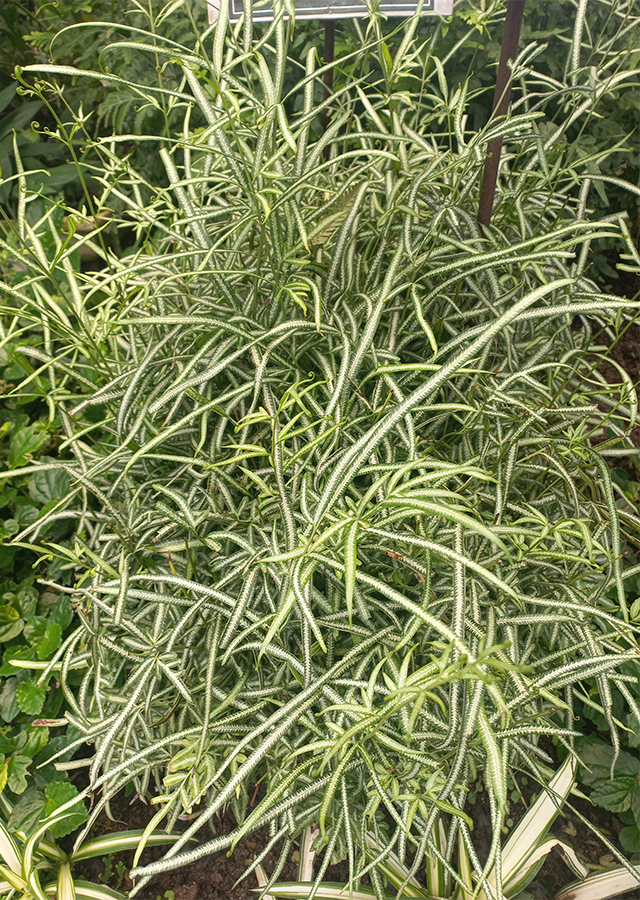
Pteris ensiformis, the silver lace fern or sword brake fern is native to the tropical areas of Africa and Asia. Naturally occurs in Sri Lanka, India, China, throughout South-East Asia to northern Australia and Polynesia, and is widely naturalized elsewhere. It grows well as a house plant and the white-green swords are very attractive. Pteris ensiformis is also used as a herbal drink in Taiwan.
Vernacular Names
Paku padang (Malay), Pakong parang (Philippines), Chièn yèh fèng weich'uéh (Singapore), Foen ngoen (Thai), Ráng chân xì hình gượm (Vietnamese).
Agroecology
Pteris occurs worldwide in tropical and warm-temperate areas but is either absent in very dry regions or poorly represented in regions with periodic drought. It grows terrestrially in more or less shaded locations, from sea-level up to high in the mountains, less often in open places, on all kinds of soils. P. ensiformis is not uncommon and is mostly found in shady places under rocks, in crevices, or old, wet walls. Prefers semi-shade location and moderate amount of water.
Morphology
- Rhizomes - slender, creeping or suberect, bearing leaves close together; scales dark brown, concolorous, entire.
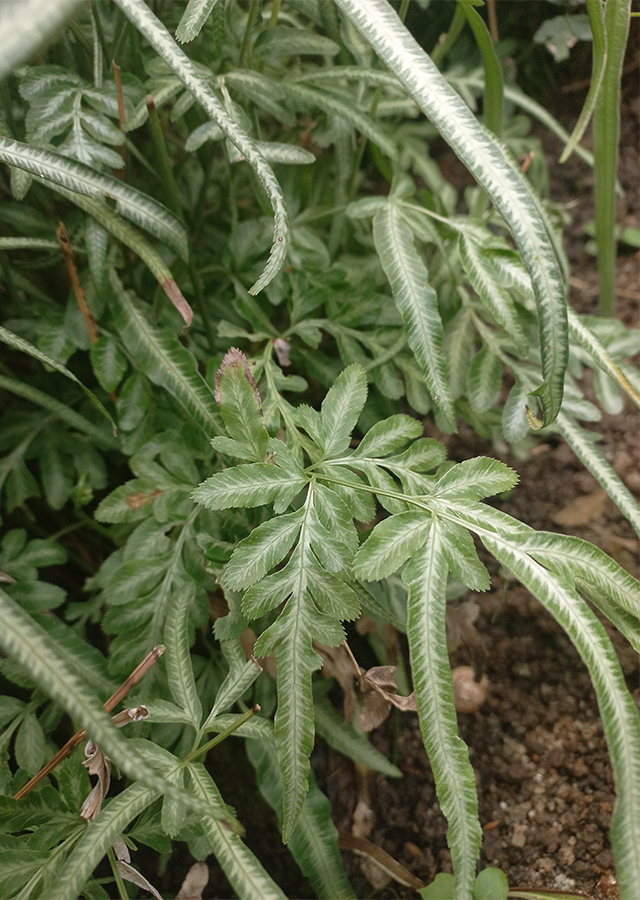
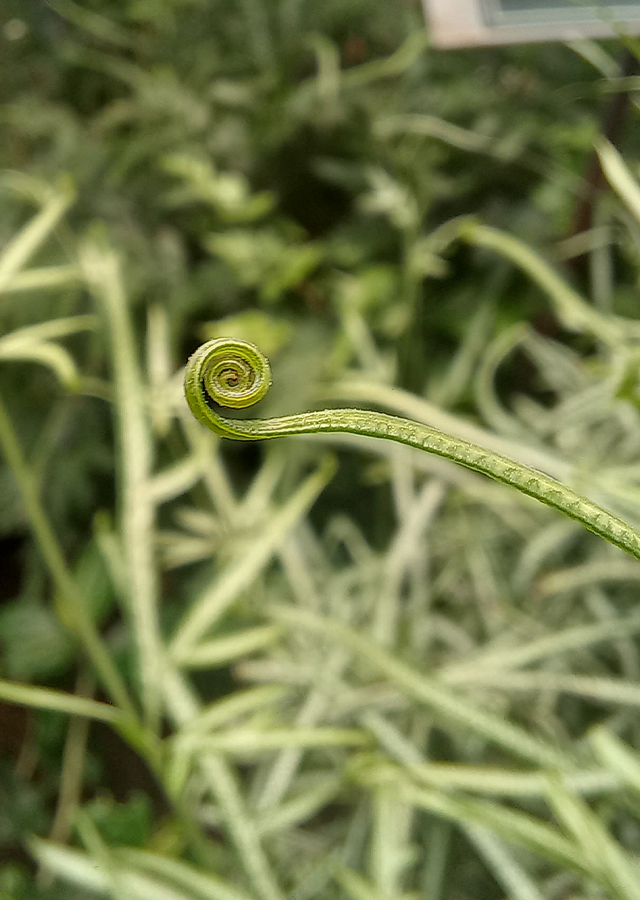
- Leaves - distinctly dimorphic; petiole 5-30 cm long, pale green or stramineous, glabrous; sterile lamina oblong, 7-30 cm long, with usually pinnate lower pinnae, apical part simple, below tripinnatifid or pinnate with 1-3 lobes or pinnules. Fertile leaves taller, bipinnate, pinnae of fertile leaves forked once near the base only, the lobes much narrower than in sterile pinnae, up to 40 cm long, with simple terminal segment, 15-25 cm long, below this about 3 pairs of oblique ascending pinnae, each shaped like the terminal segment but usually with a short branch on the basiscopic side near the base; veins free.
- Sori - are on the lower surface of the leaflets, along the margins in a dense uninterrupted row which does not extend to the apex. Sori protected by a reflexed membranaceous projection of the margin.
Cultivation
All Pteris species grow easily from spores, and this is their preferred method of propagation, although it is possible to propagate from rhizome cuttings and by separation of plantlets. The best germination and rhizoidal and protonemal growth was observed following storage of the spores at 20 °C.
Chemical Constituents
Phenolic compounds, (caffeic acid, hispidin and kaempferol), 4-caffeoyl quinic acid 5-O-methyl, 7-O-caffeoylhydroxymaltol 3-O-B-D- glucopyranoside and hispidin 4-O-B-D-glucopyronoside.
Traditional Medicinal Uses
- In Pahang, juice of young fronds used as astringent for cleansing unhealthy tongues of children.
- Root juice used as application for glandular swellings of the neck.
- Decoction of fresh fronds drunk by dysenteric patients.
- To cure bacillary dysentery, enteritis, fever, malaria, swelling and painful throat, urinary tract infection, leucorrhea, consume 30 to 60 gms dried material in decoction.
- A poultice applied to mumps, measles, eczema
- In New Guinea, fronds applied to boils, ulcers and arrow wounds; also used to control menstruation.
- A decoction of Eclipta prostrata and Pteris ensiformis used for hemorrhoidal bleeding, dysentery and enteritis.
- In Vanuatu, for dysmenorrhea, a handful of leaf fronds are rubbed over the abdominal area.
Part Used
Reference Sources
- StuartXchange. Philippine Medicinal Plants. 2011. Pteris ensiformis. http://www.stuartxchange.org/BuntotKapon. 25-08-22.
- Plant Resources of South-East Asia. 2016. Pteris ensiformis. https://uses.plantnet-project.org/en/Pteris_(PROSEA). 25-08-22.
- National Parks. Flora &Fauna Web. 2022. Pteris ensiformis. https://www.nparks.gov.sg/florafaunaweb/flora/1/5/1566. 25-08-22.